



Article by
M. Skipper
Founder & Lead · Craft'n Build Creator Studio
A beautiful sketch is merely a suggestion until it survives the uncompromising physics of the real world. Many designers focus on the silhouette, only to watch their work fail because of seasonal wood movement or misunderstood load-bearing limits. Deepening your material knowledge for furniture designers isn't just about choosing a finish; it's about adopting a logic-first methodology that ensures every joint and span is engineered for longevity. You understand that true craftsmanship starts long before the first cut, yet communicating these technical requirements to manufacturers often feels like a linguistic hurdle you can't quite clear.
This article promises to bridge that gap by teaching you the technical properties of the materials you specify. You'll learn to anticipate structural failures before they happen and master the professional-grade vocabulary needed to lead any production meeting with confidence. We'll break down the "why" behind structural logic, examine the mechanics of different mediums, and provide a framework for selecting materials that are both manufacturable and enduring. By the end, your designs won't be limited by technical uncertainty; they'll be empowered by it.
Key Takeaways
- Adopt a logic-first approach that prioritizes structural integrity over superficial aesthetics. This ensures your designs survive the transition from sketch to reality.
- Master timber mechanics by analyzing the three planes of wood movement to anticipate and mitigate seasonal warping.
- Evaluate the tensile and compressive strengths of metals and glass. This allows you to engineer high-performance frames that meet rigorous safety standards.
- Match construction methodology to specific material properties, ensuring joinery choices respect the natural behavior and grain logic of the medium.
- Build a systematic material library to enhance your material knowledge for furniture designers and streamline the integration of technical specs into your professional workflow.
Why Material Knowledge is the Foundation of Professional Furniture Design
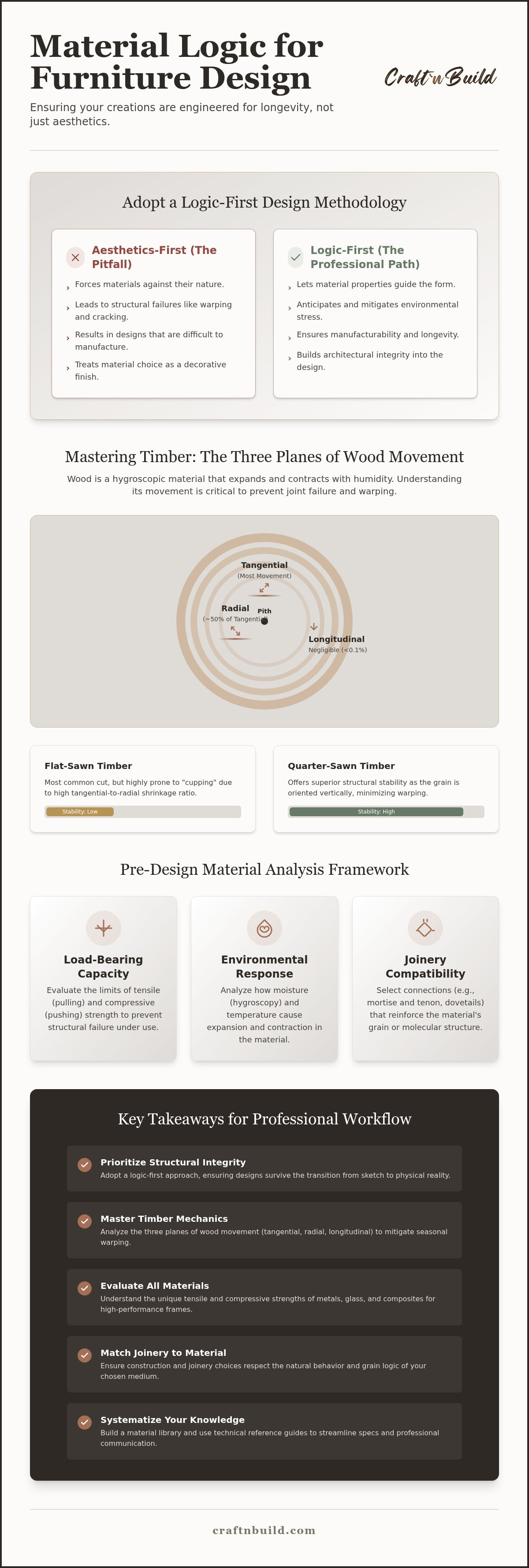
Professional furniture design begins with an admission: the material is the final arbiter of your design's success. For the serious practitioner, material knowledge for furniture designers is defined as a deep technical understanding of physical properties and how they react to environmental and structural stress. It's the difference between a concept that looks good on a screen and a piece that survives decades of use. You must move beyond aesthetic thinking, where materials are chosen for their color or grain, and embrace structural logic, where the medium's inherent strengths and weaknesses dictate the form.
Adopting a "material-first" approach means letting the medium dictate the joinery and the overall construction methodology. When a chair leg snaps or a tabletop warps, it's rarely a manufacturing error; it's almost always a design failure. These failures occur when a designer forces a material to behave in a way that contradicts its nature. To avoid this, you must analyze the following variables before finalizing any sketch:
- Load-bearing capacity: Understanding the limits of tensile and compressive strength.
- Environmental response: How moisture and temperature fluctuations cause expansion and contraction.
- Joinery compatibility: Selecting connections that reinforce the material's grain or molecular structure.
The Interplay of Utility and Aesthetics
Material selection defines the visual weight and perceived value of your work. A slender steel frame communicates precision and lightness, while a thick oak slab suggests permanence and warmth. You must balance this tactile experience with long-term durability, especially in high-traffic environments where surfaces face constant abrasion. Material logic is the prerequisite for architectural integrity in furniture. Without this foundation, your aesthetic choices are merely decorative rather than functional.
The Designer-Maker Relationship
Precise material specifications are the backbone of professional project documentation. When you bridge the gap between a 3D CAD model and the workshop floor, your technical vocabulary determines how accurately your vision is executed. Using Technical Reference Guides allows you to standardize communication with manufacturers, ensuring that grain orientation, moisture content, and tolerance levels are clearly understood. This disciplined approach to documentation eliminates ambiguity and establishes you as an authoritative expert in the eyes of the maker.
By mastering these principles, you ensure your designs are manufacturable and enduring. It's about moving from a place of creative guesswork to a methodology of technical precision.
Mastering Timber: Wood Movement, Hygroscopy, and Grain Logic
Wood is a biological medium. Unlike inert materials, it remains active long after it has been harvested and milled. For the disciplined practitioner, material knowledge for furniture designers requires a deep technical understanding of hygroscopy. It's the process by which wood fibers absorb and release moisture to reach equilibrium with the surrounding atmosphere. As humidity fluctuates, the wood expands and contracts. If your design doesn't account for this physical reality, the piece will eventually self-destruct through cracking or joint failure.
To master this medium, you must analyze wood movement across three distinct planes:
- Longitudinal: Movement along the grain, which is usually negligible; typically less than 0.1%.
- Radial: Movement across the growth rings, spanning from the pith to the bark.
- Tangential: Movement along the direction of the growth rings, which is typically the most severe and twice as reactive as radial movement.
Professional designers prioritize grain orientation to manage these forces. Flat-sawn timber is prone to cupping because of the high tangential-to-radial shrinkage ratio. Conversely, quarter-sawn boards offer superior structural stability because their grain is oriented vertically. Understanding the cellular structure is equally vital. Hardwoods contain specialized vessel elements for water transport, while softwoods rely on simpler tracheids. This distinction determines how a species responds to finishes and mechanical fasteners, regardless of its actual density.
Preventing Failure: Designing for Wood Movement
Developing robust material knowledge for furniture designers means moving from reactive fixes to proactive engineering. Eliminating wood movement is impossible. Your goal is to accommodate it through clever detailing. This often involves "floating" components, such as solid wood panels in a frame-and-panel construction, allowing the wood to breathe without stress on the joints. You can study specific techniques in our guide on Wood Movement in Furniture Design. Calculating expected movement requires using species-specific shrinkage coefficients. To refine your technical approach to complex builds, consider exploring our interior design master programmes.
Advanced Hardwood Treatments
Stability is also influenced by how timber is seasoned. Kiln-drying reduces moisture content to a controlled percentage, typically between 6% and 8% for interior furniture. Beyond drying, chemical treatments can alter the material's aesthetic and physical properties. For instance, Ammonia Fuming of Hardwoods reacts with naturally occurring tannins to darken the wood deep into the grain. This process creates a rich, light-fast color that doesn't obscure the tactile nature of the timber. Every treatment you specify must be rooted in a logic-first understanding of the wood's chemistry.
Beyond Wood: Engineering with Metals, Glass, and Composites
Mastering timber is a prerequisite, but a professional's material knowledge for furniture designers must also encompass the uncompromising physics of metals, glass, and engineered composites. These mediums aren't merely aesthetic alternatives; they're structural tools that solve specific engineering challenges. Metals offer superior tensile strength, allowing you to design cantilevered forms or slender profiles that timber simply cannot support. When you specify a steel frame, you're utilizing its ability to resist being pulled apart, whereas glass and stone are utilized primarily for their high compressive strength.
Safety is the primary driver of glass specification. You must distinguish between tempered and laminated glass based on the application's risk profile. Tempered glass is heat-treated to increase its strength and ensure it breaks into small, relatively harmless granules. Laminated glass, however, uses a polymer interlayer to hold shards in place upon impact. This technical distinction is vital for structural shelving or tabletop surfaces where failure could lead to injury. Similarly, engineered composites like Valchromat or high-grade Birch Plywood offer isotropic stability. Because these materials lack a dominant grain direction, they provide a predictable, stable substrate that eliminates the warping issues inherent in solid wood.
Hybrid designs present the greatest technical risk. The primary challenge lies in managing different expansion rates. While steel is dimensionally stable under indoor humidity, the timber components attached to it are constantly in motion. If you secure a solid wood top to a rigid metal base without allowing for movement, the wood will eventually split. You must use mechanical solutions, such as slotted holes or Z-clips, to accommodate this physical reality.
Metal Fabrication and Hardware Logic
Precision in hardware is what separates custom work from mass-produced furniture. Investment casting is a sophisticated process used to create complex, high-strength metal components with exceptional surface detail. It's the ideal method for producing bespoke handles or structural brackets that require both durability and a refined aesthetic. You can explore the technical application of this process in our guide on Brass Hardware Investment Casting. When joining metal components, choose between welding for permanent, rigid structures and mechanical fastening for pieces that require modularity or allowance for material movement.
Sustainability and Modern Composites
Your material knowledge for furniture designers should also guide your ethical and environmental choices. Modern composites solve many structural problems, but their lifecycle impact depends on the adhesives used in their manufacture. Professional designers prioritize formaldehyde-free binders and non-toxic finishes to ensure indoor air quality. By selecting engineered boards with high recycled content or FSC-certified veneers, you ensure that your structural logic aligns with sustainable practice. This disciplined approach to material selection ensures your furniture is as responsible as it is enduring.
How Material Properties Dictate Joinery and Construction Methodology
Every joint is a negotiation between two physical bodies. Your material knowledge for furniture designers is most critically tested at these points of intersection. While a mortise and tenon is often cited as the gold standard of strength, its performance is contingent on the species it's applied to. For example, porous hardwoods like Oak provide excellent mechanical "teeth" for adhesives, whereas oily species like Teak require solvent cleaning to ensure the glue bond doesn't fail prematurely. You must select connections that respect the material's cellular behavior rather than imposing a generic solution.
A disciplined approach involves studying Furniture Joinery Design Principles to understand how different connections handle stress. In professional knockdown (RTA) furniture, mechanical fasteners serve a specific purpose. They aren't just for ease of shipping. They provide the necessary tension to hold components together while allowing for the discrete movement discussed in previous sections. This logic-first mindset ensures that the furniture remains stable throughout its lifecycle, regardless of how many times it's assembled or moved.
The Physics of the Joint
Joint failure is often the result of ignoring shear forces. When you design a connection, you're essentially creating a path for load to travel through the frame. To maximize structural integrity, you must prioritize long-grain to long-grain contact. End-grain is essentially a bundle of straws; it wicks adhesive away from the surface, resulting in a brittle, unreliable bond. Utilize 3D CAD tools to visualize these internal geometries. This allows you to test joint clearances and wall thicknesses before a single piece of timber is cut, reducing material waste and production errors.
Advanced Construction Principles
The transition from a design concept to a manufacturable product requires a rigorous Furniture Design Methodology. This includes the development of professional cut lists that account for grain orientation and material yield. You're not just listing dimensions; you're providing a technical roadmap for the maker. Designing for assembly (DFA) means you've considered how parts will be clamped, glued, and finished in the real world. To refine these technical skills and gain a competitive edge in the industry, consider enrolling in our professional interior design course programmes. It's the difference between a designer who draws and a designer who builds.
Integrating Material Logic into Your Professional Design Workflow
Material knowledge for furniture designers is only as valuable as its integration into your daily studio practice. It's the bridge between a poetic concept and a functional reality. You should build a personal material library that goes beyond visual swatches. Include technical data sheets, moisture content targets, and specific gravity metrics for every species or composite you frequently specify. This technical archive allows you to make informed decisions during the earliest conceptual stages, preventing costly redesigns later in the project lifecycle. When you understand the physical limits of your medium, your creativity is focused rather than restricted.
Modern design requires modern tools. You can leverage AI Implementation in Design Workflow to rapidly research material alternatives and cross-reference sustainability metrics. AI can help you analyze lifecycle data or find species with similar Janka hardness ratings but lower carbon footprints. This isn't about replacing your expertise; it's about augmenting your material knowledge for furniture designers with real-time data. It ensures your specifications are both technically sound and environmentally responsible. This disciplined approach to research transforms a simple moodboard into a rigorous technical specification.
From Concept to Execution
The transition from a moodboard to a technical drawing is where aesthetic intent meets structural logic. In The Design Key methodology, material constraints are introduced early to define the boundaries of the form. You must use Design Concepts in 3D CAD to validate material thickness and structural spans. Testing a 20mm oak shelf against a 1200mm span in a digital environment allows you to visualize deflection before manufacturing begins. This methodical validation ensures that your final technical drawings are grounded in physical reality and ready for the workshop floor.
Standardizing Your Professional Practice
Precision is a repeatable habit, not a one-time effort. You need a systematic framework for material selection that remains consistent across all projects. This involves standardizing how you communicate tolerances, finishes, and grain direction to manufacturers. Master designers understand that material science is an evolving field. New composites and sustainable treatments emerge constantly, requiring a commitment to continuous learning. By adopting a logic-first mindset, you transform from a stylist into an interior architect who understands the "why" behind every structural decision. This commitment to technical mastery is what defines a professional career.
To elevate your studio practice and gain total confidence in your technical execution, master professional interior architecture with our comprehensive programs. Your journey toward structural integrity and design excellence begins with a disciplined methodology.
Building a Legacy of Structural Integrity
Mastering the physics of form is what separates a visionary designer from a mere stylist. By embracing a logic-first approach, you've learned that understanding wood movement and the tensile limits of metal isn't a constraint on your creativity; it's the foundation of it. Deepening your material knowledge for furniture designers ensures your work survives the rigors of the real world. You now possess the framework to select materials that respect the laws of physics and the professional vocabulary to lead production teams with confidence.
True craftsmanship requires a commitment to technical precision and a repeatable methodology. Whether you're validating spans with professional-grade 3D CAD models or utilizing technical reference guides for real-world execution, your growth depends on adopting a rigorous methodology used by industry experts. It's time to move beyond the superficial and master the technical depths of your craft. Every specification you write is a testament to your professional standards.
Elevate your professional practice with our Interior Design Programs and join a community of designers dedicated to structural excellence. The path to mastery is disciplined, but the results are enduring. We're here to guide you through every technical milestone.
Frequently Asked Questions
Why is wood movement so important for furniture designers to understand?
Wood movement is critical because it directly influences the longevity and structural stability of a piece. As a hygroscopic material, wood absorbs and releases moisture to reach equilibrium with its environment; this causes it to expand and contract across its grain. Ignoring these physical forces leads to catastrophic failures such as split panels or failed joints. Professional designers accommodate these changes by utilizing floating components and specialized fasteners that allow the medium to breathe without compromising the frame's integrity.
What is the difference between hardwood and softwood in furniture construction?
The distinction between hardwood and softwood is botanical rather than a measure of physical density. Hardwoods come from angiosperm trees, which possess specialized vessel elements for water transport, creating a complex grain structure. Softwoods originate from gymnosperms and rely on simpler tracheids. While hardwoods are often denser and more resistant to abrasion, some softwoods like Yew are harder than certain hardwoods like Balsa. Understanding this cellular logic is essential for selecting appropriate finishes and mechanical connections.
How do I choose between solid wood and engineered boards for a project?
Choosing between these mediums depends on the structural requirements and aesthetic goals of your project. Solid wood offers unparalleled grain beauty and heirloom durability but remains susceptible to seasonal movement. Engineered boards, such as high-grade Birch Plywood or Valchromat, provide isotropic stability and are ideal for large, flat spans where warping must be eliminated. Professionals often combine both; they use solid timber for primary frames and engineered substrates for stable, veneered panels to achieve technical precision.
What are the most durable materials for commercial furniture design?
Commercial environments demand materials with high resistance to abrasion, impact, and chemical cleaning. Powder-coated steel frames provide superior tensile strength for high-traffic seating, while compact laminates and tempered glass offer hygienic, durable surfaces for hospitality settings. For timber elements, specify high-density hardwoods like White Oak or Maple. These species possess a tight cellular structure that resists indentation. Pairing these with professional-grade catalyzed lacquers ensures the piece survives the rigors of heavy public use.
How does material knowledge affect the cost of furniture manufacturing?
Material knowledge for furniture designers significantly reduces manufacturing costs by optimizing material yield and reducing production errors. When you understand the physical properties of your medium, you can create precise cut lists that minimize waste and specify joinery that requires fewer machining steps. This technical expertise prevents the costly over-engineering of components. It also allows you to substitute expensive species with more affordable alternatives that possess similar structural characteristics, ensuring the project stays within budget without sacrificing integrity.
Can I use AI to help with material selection in my design workflow?
AI is a powerful tool for researching material alternatives and cross-referencing sustainability metrics within your workflow. You can use specialized prompts to compare Janka hardness ratings, carbon sequestration data, or moisture-response coefficients across hundreds of species in seconds. This digital augmentation of your material knowledge for furniture designers allows for faster iterations during the conceptual phase. However, AI should only be used to inform your decisions; the final structural logic must always be validated by your own professional expertise.
What technical drawings are necessary to communicate material specs to a maker?
To communicate specifications effectively, you must provide detailed section drawings and exploded axonometric views. These drawings should clearly indicate grain orientation, joint clearances, and the placement of mechanical fasteners. A professional documentation package also includes a comprehensive cut list and a finish schedule that specifies the chemical nature of the coating. Using 3D CAD models to generate these views ensures that every component is technically viable before it reaches the maker, eliminating ambiguity on the workshop floor.
Partners
Craft'n Build welcome affiliate marketers, https://craftnbuild.com/pages/affiliate-partner-programme-1


Share:
Furniture Joinery Design Principles: A Professional Framework for Structural Logic
Advanced Furniture Construction: Design for Manufacturing