




Article by
M. Skipper
Founder & Lead · Craft'n Build Creator Studio
A professional interior design studio isn't built on a collection of mood boards; it's forged through the discipline of architectural logic and technical precision. You likely recognize that aesthetic intuition only carries a project so far. The gap between an enthusiast and a studio owner often feels like a chasm of software choices, complex floor plans, and the constant fear of being exposed as an amateur. It's a heavy burden to carry. Many talented designers struggle to bridge the gap between creative vision and the structural integrity required for high-end delivery.
Mastering how to start an interior design business requires more than just a keen eye for color. It demands a systematic approach to technical delivery and an AI-integrated workflow that ensures every project is repeatable, scalable, and profitable. You need a methodology that replaces operational chaos with professional order. By adopting a logic-first mindset, you can transition from an aspiring creative to a disciplined innovator who commands respect in the architectural space.
This guide provides the professional framework needed to master technical drawing, implement efficient business logic, and build a high-end client base with absolute confidence. We'll explore the essential software stacks, floor plan design principles, and the AI tools currently reshaping the 2026 design market. You're about to move from raw inspiration to structural mastery.
Key Takeaways
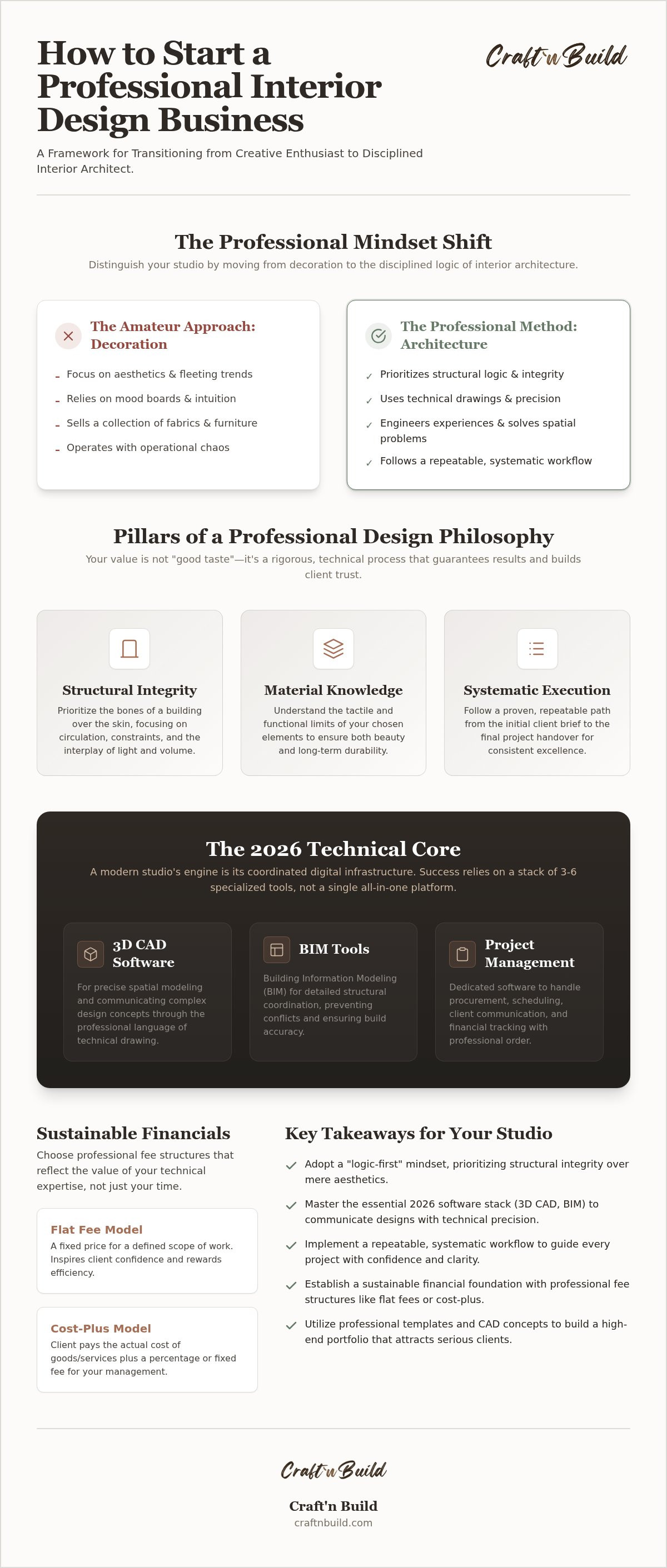
- Adopt a "logic-first" mindset to distinguish your professional interior architecture studio from amateur decorators by prioritizing structural integrity over mere aesthetics.
- Master the essential 2026 software stack, including 3D CAD and BIM tools, to communicate your designs through the precise language of technical drawing.
- Implement a repeatable, systematic workflow that guides you through the technical methodology of how to start an interior design business with confidence.
- Establish a sustainable financial foundation by choosing professional fee structures, such as flat fees or the "cost-plus" model, that reflect the value of your technical expertise.
- Utilize professional-grade project templates and CAD concepts to build a high-end portfolio that attracts serious clients and ensures efficient studio operations.
Defining Your Professional Identity: Interior Architecture vs. Decoration
Success in this industry begins with a fundamental shift in perspective. Many enthusiasts believe that passion is the primary catalyst for growth, yet a logic-first mindset is what truly separates a high-end studio from a hobbyist. If you're learning how to start an interior design business, you must decide whether you're selling a collection of fabrics or a structural solution. One relies on fleeting trends; the other relies on the permanent integrity of space. You're not just decorating rooms. You're engineering experiences.
Defining your niche is a strategic necessity. Focus on residential Interior Architecture rather than just soft furnishings. This distinction allows you to operate at a higher level of the value chain. You aren't just a service provider; you're a practitioner seeking a patron. A customer buys a product and expects a simple transaction. A patron invests in your methodology, your technical vision, and your ability to transform a raw environment into a finished masterpiece. Establishing this professional design methodology early prevents the operational chaos that often plagues amateur startups.
Moving Beyond Aesthetic Intuition
Stop picking styles and start solving spatial problems. Professional designers prioritize structural logic because it provides a repeatable framework for excellence. While an amateur might focus on a specific wallpaper, a professional considers the circulation paths, structural constraints, and the relationship between light and volume. Interior architecture is the disciplined intersection of engineering and art, where utility dictates form. Transitioning to this mindset requires you to look past the surface. You must understand the "why" behind every partition wall and floor finish before you address the "how" of the decoration.
Establishing Your Design Philosophy
Your value proposition shouldn't be "I have good taste." It should be "I have a rigorous, technical process that guarantees a result." Technical precision builds client trust faster than any mood board ever could. When you present a project with detailed CAD concepts and material logic, you demonstrate mastery. Mastering how to start an interior design business is as much about your mindset as it is about your toolkit. To truly excel, you must learn how to think like a professional interior designer by adopting a structured curriculum. This preparation ensures you aren't just guessing, but executing with clarity. A disciplined design philosophy includes:
- Structural Integrity: Prioritizing the bones of a building over the skin.
- Material Knowledge: Understanding the tactile and functional limits of your chosen elements.
- Systematic Execution: Following a proven path from the initial brief to the final handover.
This approach doesn't just produce better spaces; it builds a sustainable, authoritative business that attracts high-end clients who value expertise over bargains.
Building the Technical Core: Systems and Software for 2026
A professional studio's engine is its technical stack. While the U.S. Small Business Administration's guide to launching a business provides the necessary administrative foundation, your daily success depends on your digital infrastructure. In 2026, professional interior design studios don't rely on a single all-in-one platform. Instead, they utilize a coordinated stack of three to six specialized tools. This includes 3D CAD for spatial modeling, Building Information Modeling (BIM) for structural coordination, and dedicated project management software to handle procurement and scheduling. This digital-first approach ensures that your project delivery is precise, transparent, and scalable.
Technical drawing is the professional designer's primary language. It's the bridge between a creative concept and a built reality. Without it, you're merely suggesting ideas rather than providing instructions. When you're learning how to start an interior design business, mastering this language is non-negotiable. It allows you to communicate effectively with contractors, engineers, and high-end clients who expect architectural-grade documentation. By implementing structural logic into every drawing, you eliminate ambiguity and reduce costly on-site errors.
Mastering 3D CAD and Technical Documentation
Loose sketches are sufficient for initial brainstorming, but they're inadequate for professional project delivery. You must transition to producing professional CAD concepts that provide exact dimensions and material specifications. Building a robust library of technical reference guides within your studio allows for a repeatable workflow. This ensures that every floor plan, section, and elevation meets a consistent standard of excellence. If you want to elevate your output, focus on Mastering Technical Drawing and Structural Logic to ensure your designs are grounded in reality.
Furniture Design as a Revenue Stream
Custom cabinetry and furniture design represent significant revenue opportunities for modern studios. However, these require more than just a sense of style. You must understand the math of wood movement, the physics of joinery, and the constraints of manufacturing. Incorporating a custom furniture methodology into your service suite allows you to offer truly bespoke solutions that off-the-shelf products cannot match. This level of detail is what defines a high-end practice. For those ready to deepen their expertise, adopting a Furniture Design Methodology for Professionals is the most direct path to mastery.
Developing these technical core competencies is a rigorous process, but it's the only way to ensure your business survives the shift toward increasingly complex, digital-first project environments. You might consider exploring professional-grade education programs to accelerate this transition and secure your studio's future.
Developing a Systematic Workflow: From Brief to Execution
A professional interior architecture studio operates like a finely tuned machine. It doesn't rely on sporadic flashes of inspiration. Instead, it functions through a proven sequence of technical stages. When you're determining how to start an interior design business, your primary goal is to replace creative chaos with operational order. A systematic workflow ensures every project receives the same level of architectural rigor. This consistency isn't just about quality; it's about studio scalability and protecting your profit margins.
- Phase 1: The Brief. You must move beyond a client's emotional desires to extract logical requirements. Utilizing a structured tool like the brief allows you to identify technical constraints and spatial needs early.
- Phase 2: Space Planning. This is the methodology of efficient layouts. It requires a deep understanding of floor plan design to ensure circulation and ergonomics are optimized before any aesthetic choices are made.
- Phase 3: Documentation. Your studio's authority is forged in the details. You must create precise technical schedules and cut lists that leave no room for interpretation by contractors.
- Phase 4: Execution. This involves managing trades with professional authority. Your documentation serves as the definitive guide, ensuring the built result matches your technical vision.
Utilizing Project Templates for Consistency
Scaling a design practice is impossible without standardization. Professional templates are the essential backbone of a growing studio. They act as a "Design Key" for every project, ensuring that quality control remains high regardless of project volume. These frameworks allow you to delegate tasks without sacrificing precision. You can explore professional project templates for interior success to establish these high standards from day one.
Implementing AI for Modern Design Efficiency
The 2026 design market demands both speed and accuracy. AI has emerged as the ultimate efficiency engine for small studios, automating tedious documentation and enabling rapid conceptualization. It's not a replacement for craftsmanship but a tool for refinement. By integrating AI implementation for design workflows, you can generate moodboards and technical schedules in seconds rather than hours. This technological shift allows you to focus on the high-level structural logic that defines a professional practice. To understand the full scope of these tools, review our guide on AI implementation for modern design workflows to see how to bridge the gap between manual precision and digital speed.
The Business of Design: Legals, Fees, and Client Management
The commercial infrastructure of a studio is as vital as its technical output. When researching how to start an interior design business, you'll find that legal and financial frameworks provide the necessary stability for creative work. Choosing between a sole proprietorship and a limited company is your first major decision. While a sole proprietorship offers simplicity for startups, a limited company provides a critical layer of protection for your personal assets. This structural choice should reflect your long-term studio ambitions and the scale of projects you intend to lead.
Professional fee structures must be transparent and grounded in specific deliverables. Avoid vague "design fees" that invite negotiation or confusion. Instead, utilize hourly rates for initial consultations, flat fees for defined design phases, and the "cost-plus" model for procurement and project management. This clarity ensures you're compensated fairly for the technical precision you bring to the project. Contracts and professional indemnity insurance aren't just administrative burdens; they protect your intellectual property and mitigate liability during the construction phase. Managing client expectations through transparent communication is the hallmark of a disciplined studio owner.
Crafting a Professional Fee Proposal
High-end pricing is inextricably tied to the complexity of your architectural deliverables. When you link your fees to specific outputs, such as 3D CAD models, floor plans, or technical schedules, you justify your value through tangible work. The psychology of professional pricing relies on the client's perception of your expertise and methodology. This approach prevents "scope creep" by establishing clear technical boundaries from the outset. It transforms the conversation from a simple price tag to a calculated investment in structural logic and project success.
Sourcing and Managing Trade Relationships
Your role as a professional designer extends to being the project lead during the construction phase. Building a network of reliable contractors and suppliers is essential for maintaining the integrity of your vision. You must communicate technical requirements with absolute clarity to avoid site errors and delays. Your drawings serve as the definitive guide for these trades, ensuring that every joinery detail and material transition is executed according to the plan. This level of oversight requires a deep respect for the craftsmanship of others and a firm command of the technical specifications.
To master these commercial frameworks and elevate your studio's operations, enroll in our professional interior design programs to gain the insights needed for long-term success.
Launching Your Studio with The Design Key Framework
The transition from a dedicated student to a studio owner is a deliberate act of professional positioning. Launching a business in this field requires more than a brand name and a social media profile. It demands a robust technical foundation that withstands the pressures of real-world construction. When you're determining how to start an interior design business, understand that your most significant investment isn't marketing or office space. It's the methodology you use to solve complex spatial problems. This structural approach ensures that your first project is a success and your studio's reputation is built on steady reliability rather than creative guesswork.
Your portfolio must reflect this technical rigor. High-end clients and architectural partners aren't looking for aesthetic inspiration alone; they're looking for evidence of technical mastery. By populating your portfolio with professional-grade CAD concepts and detailed floor plans, you demonstrate that you're a disciplined innovator. This level of documentation proves you can handle the intersection of utility and aesthetics, making you a low-risk, high-value partner for any construction project.
Education as a Competitive Advantage
In an industry where many competitors rely on "passion" and "intuition," technical education becomes your primary barrier to entry. Most aspiring designers rush into marketing before they've mastered the logic of the craft. This creates a gap in the market for those who prioritize structural knowledge and professional frameworks. The Design Key program provides the specific methodology that many competitors lack, focusing on deep material knowledge and engineering principles. You must commit to mastery before you focus on expansion. To secure this foundation, you can Enroll in The Design Key Master Programme and adopt the refined secrets of the trade.
Your Professional Launch Checklist
A successful launch is the result of methodical preparation. Before you accept your first contract, you must finalize your technical toolkit and establish a repeatable workflow. This preparation allows you to move with confidence when opportunities arise. Your launch checklist should include:
- Finalize Your Template Library: Ensure your project templates, fee proposals, and technical schedules are ready for immediate deployment.
- Build a Logic-First Portfolio: Showcase 3D CAD models and technical drawings that highlight your ability to solve spatial problems.
- Network with Architects: Build relationships within the professional architecture community to position your studio as a technical collaborator.
The first 90 days of your business should follow a structured roadmap. The first month focuses on finalizing your systems. The second month is dedicated to building your technical portfolio. The final 30 days involve active outreach and networking. Throughout this process, you must remain committed to continuous learning. As AI tools and technical innovations reshape the 2026 market, keeping pace with these efficiency engines is vital. By combining traditional manual precision with modern digital tools, you'll build a studio that is both technically superior and commercially resilient.
From Vision to Structural Reality
Building a professional studio is a journey of refinement and structural logic. You've learned that aesthetic intuition is merely the surface; true authority comes from technical precision and a systematic approach to spatial problems. By prioritizing interior architecture over simple decoration, you establish a value proposition that commands respect from both patrons and trades. Your success depends on the tools you wield and the frameworks you follow.
Mastering how to start an interior design business requires a commitment to continuous growth and the adoption of modern efficiencies like AI-integrated workflows. When you replace operational chaos with architectural rigor, you create a repeatable path to high-end results. This transition from enthusiast to studio owner is attainable for those willing to embrace a disciplined methodology. You have the vision; now, you need the system to support it.
Master the professional framework with The Design Key Master Programme. This flagship curriculum provides the professional 3D CAD concepts and AI-integrated design workflows needed to execute with absolute confidence. Your future as a disciplined innovator starts with a solid foundation.
Frequently Asked Questions
Do I need a degree to start an interior design business in 2026?
Legal requirements depend on your specific jurisdiction. Approximately 20 states mandate licensure for interior designers, often requiring the National Council for Interior Design Qualification (NCIDQ) certificate. While a degree is a traditional path, the market in 2026 prioritizes technical methodology and structural logic. You must research your state's "practice acts" versus "title acts" to ensure compliance. Regardless of formal schooling, mastering a professional framework is essential for studio survival.
How much does it cost to start a professional interior design studio?
Initial investment typically covers software subscriptions, legal registration, and professional indemnity insurance. Most studios require a stack of three to six specialized digital tools to function at an architectural level. You'll also need to budget for professional education to bridge the gap between enthusiast and practitioner. Since project delivery is increasingly digital, your primary costs are centered on technical infrastructure and building a library of professional project templates rather than physical storefronts.
What software is essential for a new interior architecture business?
A professional stack in 2026 includes 3D CAD for spatial modeling, Building Information Modeling (BIM) for structural coordination, and project management software for procurement. SketchUp Pro remains a widely utilized tool for residential designers. You also need AI-powered platforms for context-aware redesigns and rapid documentation. Relying on a single all-in-one platform is rarely sufficient for high-end delivery. You must build a toolkit that prioritizes technical precision and clear communication with trades.
How do I get my first high-end interior design client?
High-end clients are attracted to technical mastery rather than just aesthetic taste. You should populate your portfolio with professional-grade CAD concepts and detailed floor plans that demonstrate structural logic. Networking within the professional architecture community is also vital, as architects often require specialized interior collaborators. When you present a systematic methodology for project delivery, you position yourself as a low-risk, high-value expert who understands the complexities of construction and material constraints.
What is the difference between interior design and interior architecture?
Interior architecture focuses on the structural logic and spatial engineering of a building's interior. It involves moving walls, altering circulation paths, and understanding technical systems like lighting and ventilation. Interior design is a broader term that often encompasses decoration and soft furnishings. When you learn how to start an interior design business, choosing the architectural path allows you to solve complex spatial problems. This distinction separates disciplined practitioners from hobbyists who focus primarily on surface aesthetics.
How should I charge for my interior design services as a beginner?
You should link your fees to specific architectural deliverables to ensure transparency. Common structures include hourly rates ranging from $75 to $250 or flat fees based on the project scope. Some designers charge a percentage of the total project budget, typically between 10% and 30%. As a beginner, using a "cost-plus" model for procurement can provide a steady revenue stream. Always define technical boundaries in your contract to prevent scope creep during the design phase.
Is it necessary to have a physical office for my design business?
A physical office is not a requirement for a modern, digital-first studio. Many successful designers operate remotely, utilizing cloud-based BIM tools and AI implementation for design workflows to collaborate with clients and contractors. In 2026, your digital presence and the quality of your technical documentation matter more than a storefront. A well-organized home studio equipped with the necessary software and a library of technical reference guides is sufficient for launching a professional practice.
How can AI help me grow my interior design business faster?
AI serves as an efficiency engine that automates tedious documentation and rapid conceptualization. Platforms like RenoAI allow you to generate context-aware redesigns in seconds, significantly reducing the time spent on initial moodboarding. In 2026, AI implementation for design workflows is a standard requirement for competitive small studios. It doesn't replace your creative judgment; it refines your process, allowing you to focus on high-level structural logic and client management while the software handles repetitive tasks.
Partners
Craft'n Build welcome affiliate marketers, https://craftnbuild.com/pages/affiliate-partner-programme-1


Share:
3D CAD Furniture Design: Professional Technical Framework
The Freelance Interior Designer Guide 2026: Building a Logic-First Practice