




Article by
M. Skipper
Founder & Lead · Craft'n Build Creator Studio
Professional interior design is not a pursuit of aesthetic intuition. It is a rigorous discipline of structural logic, technical precision, and systematic methodology. If you've spent hours scrolling through surface level decorating courses only to realize they lack the architectural depth required for real world execution, you aren't alone. Many aspiring designers fear they lack the technical foundation to move beyond simple styling. Understanding how to become a professional interior designer requires more than a keen eye for color. It demands a commitment to mastering the workflows used in high end studios.
You deserve a path that respects the complexity of the craft. This guide provides a disciplined, logic first roadmap to help you transition from a design enthusiast to a professional interior architect. We will explore the essential technical standards for 2026, including AutoCAD 2026.1.2 workflows and the strategic integration of AI in modern design. You'll discover how to build confidence in technical drawing and structural logic. By following this structured curriculum, you will gain the clarity needed to handle complex project templates and execute sophisticated floor plans with the authority of a master practitioner.
Key Takeaways
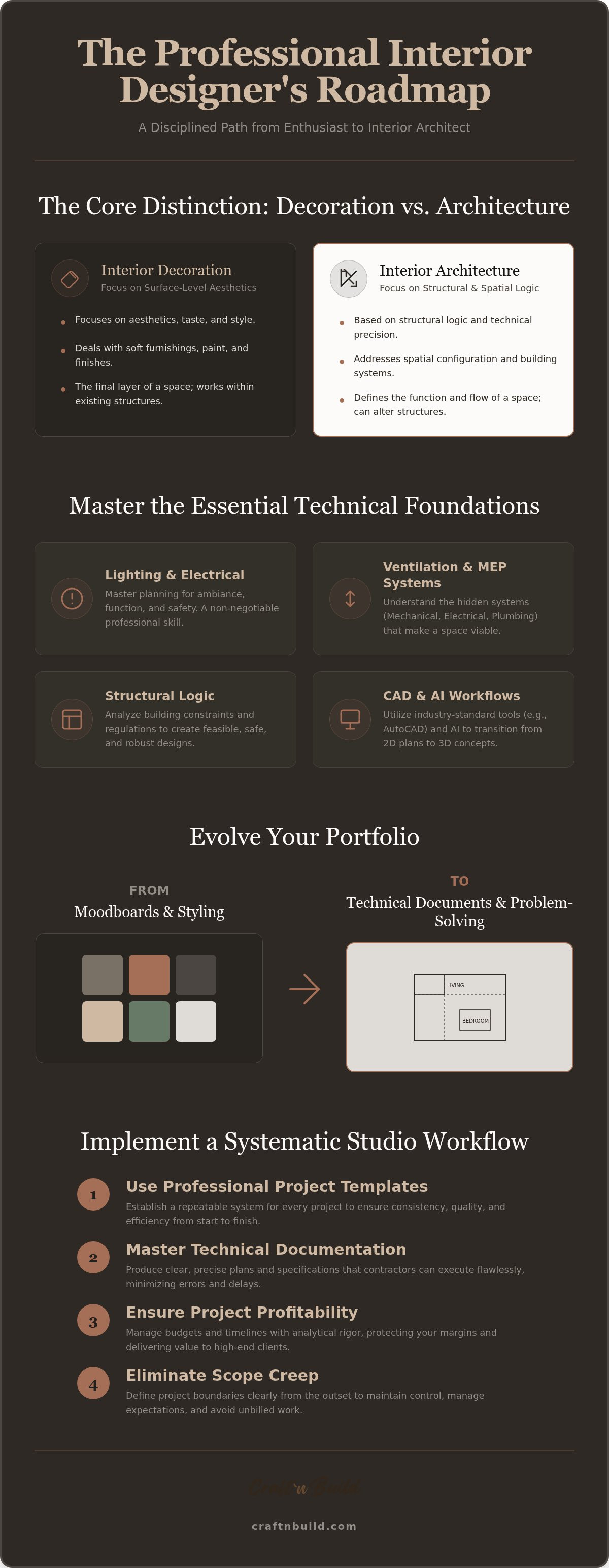
- Distinguish between surface-level decoration and the structural logic of interior architecture to establish a foundation in spatial configuration.
- Learn how to become a professional interior designer by prioritizing technical modules such as lighting, ventilation, and structural systems.
- Master the transition from 2D floor plans to 3D spatial concepts using industry-standard CAD tools and AI-enhanced design workflows.
- Evolve your portfolio from a collection of moodboards into a rigorous showcase of technical documentation and architectural problem-solving.
- Implement a systematic studio workflow using professional project templates to ensure profitability and eliminate scope creep in high-end projects.
Defining the Professional Path: Interior Design vs. Interior Architecture
To understand how to become a professional interior designer, you must first strip away the misconception that the role is primarily about "taste." Professional design is the disciplined intersection of structural logic, human ergonomics, and technical precision. While decorating focuses on surface-level aesthetics like soft furnishings and paint colors, interior architecture addresses the spatial configuration and technical systems of a building. It is the difference between selecting a sofa and determining the structural viability of an open-plan living area.
A logic-first mindset is the primary differentiator for high-end designers. It is the ability to see a space not as a canvas for decoration, but as a complex machine that must function perfectly for its inhabitants. The profession of interior design has evolved to require deep knowledge of how humans interact with their environment. When you approach a project with this structural integrity, you move beyond the "stylist" label and enter the world of professional architecture.
The Scope of Professional Interior Architecture
Professional project delivery relies on the mastery of technical documentation. Understanding building regulations and structural constraints is not optional; it is the foundation of every successful project. When you transition into this field, you must realize that style is the result of a rigorous process rather than a starting point. Your value as a professional lies in your ability to manage lighting systems, ventilation layouts, and acoustic requirements. These elements define the integrity of the finished product and ensure the space is both safe and functional.
Why Career Changers Succeed in Design
If you are wondering how to become a professional interior designer after a career in law, engineering, or business, your analytical background is a significant advantage. Managing large client budgets and complex timelines requires professional maturity and steady reliability. A systematic approach often compensates for a lack of traditional design school background. You already understand how to follow a methodology to achieve a high-level result. This disciplined perspective is exactly what high-end clients look for when commissioning an interior architect to transform their property.
Mastery of this professional distinction is the core of The Design Key. This methodology provides the structural logic needed to move beyond the enthusiast level and execute projects with architectural authority. It serves as the bridge between creative vision and technical execution.
The Educational Foundation: Choosing Professional Rigour
Choosing the right educational path is the first critical hurdle in learning how to become a professional interior designer. Traditional four-year degrees provide a broad historical context, but they often struggle to keep pace with the technical demands of a 2026 studio environment. In contrast, specialized professional courses offer a concentrated focus on high-level execution and architectural logic. The goal isn't just to earn a credential; it's to acquire a toolkit that allows you to manage complex residential projects with confidence. You need a curriculum that prioritizes structural integrity over surface-level decorating trends.
Essential Technical Modules for Professionals
Mastery in this field requires a deep understanding of the hidden systems that make a space functional. Mastering Lighting Design and electrical planning is a non-negotiable skill for any serious practitioner. Without this knowledge, your designs will fail at the implementation stage. You must also prioritize the study of Ventilation and MEP systems. These technical layers ensure that your spatial configurations are viable and meet modern building standards. Organizations like the American Society of Interior Designers (ASID) frequently highlight that technical competency is the cornerstone of professional practice. Utilizing technical reference guides is the most efficient way to maintain these high standards across your portfolio.
Methodology Over Inspiration
Amateurs wait for inspiration; professionals rely on a repeatable methodology. To succeed, you must move away from "waiting for an idea" and embrace the discipline of a structured design brief. Using a tool like The Brief allows you to ground every creative decision in structural logic and client objectives. This systematic approach ensures that your work remains consistent, even when creative energy is low. Systematic research into materials and furniture design replaces guesswork with certainty.
If you are seeking a comprehensive alternative to the slow pace of traditional schooling, The Design Key - Full Master Programme offers the rigorous, logic-first training needed to enter the industry at a high level. To find a path that fits your professional goals, you can explore our interior design programs and begin your transition today. This disciplined approach is the most direct way to master how to become a professional interior designer in the current market.
Mastering the Technical Toolkit: CAD, Structural Logic, and AI
Professionalism in this industry is defined by the tools you utilize to bridge the gap between a conceptual vision and a physical reality. In 2026, 3D CAD has become the non-negotiable industry standard for communicating design intent to both clients and contractors. While 2D sketches provide a preliminary starting point, the transition to 3D spatial concepts allows you to identify structural conflicts before construction begins. This volumetric logic ensures that your design survives the scrutiny of engineers and site managers. Learning how to become a professional interior designer involves moving beyond simple moodboards to master these sophisticated digital environments.
Efficiency in a modern studio environment demands a refined approach to emerging technology. AI is no longer a gimmick; it functions as a vital workflow automation tool that handles repetitive tasks and data-heavy analysis. By integrating these tools, you free up cognitive resources for high-level architectural decisions and material selection. To remain competitive in a rapidly evolving market, mastering AI implementation for architects and designers is essential. It streamlines the refinement of raw elements into finished products, ensuring your studio operates with the precision of a master practitioner.
Technical Drawing and Floor Planning
Every successful project rests on the integrity of its initial layout. You must prioritize mastering The Floor Plan as the absolute foundation of your professional practice. Precision in technical drawing is the only way to prevent costly on-site construction failures that can derail a project budget. If your documentation lacks structural logic, your vision cannot be executed with accuracy. For those ready to deepen their expertise, exploring an Interior Design Technical Drawing Course provides the rigorous training required to produce professional-grade documentation that commands respect from tradespeople.
Furniture Design and Joinery Logic
A professional designer must understand the anatomy of the objects they specify. You aren't merely choosing furniture; you are often designing bespoke joinery that must integrate seamlessly with the interior architecture. This requires a deep knowledge of materials, manufacturing processes, and structural integrity. Understanding how a piece is built allows you to push the boundaries of both utility and aesthetics. By adopting a formal Furniture Design Methodology, you ensure that every element of the interior serves a logical purpose. This disciplined mindset is a core requirement when discovering how to become a professional interior designer who delivers high-end, custom results.
Building a Professional Portfolio: Beyond the Moodboard
A professional portfolio is not a curated social media feed. It is a technical record of your ability to solve complex spatial problems. When you are learning how to become a professional interior designer, you must shift your focus from "pretty pictures" to technical documentation. Clients and high-end studios look for proof that you can manage a project from the initial brief through to the final execution. Your work samples should document the structural logic behind every decision, proving that your designs are as viable as they are visually compelling.
Including Design Concepts in 3D CAD format is the most effective way to demonstrate this competence. 3D documentation shows that you understand volume, clearance, and spatial relationships. It transforms your portfolio from a collection of ideas into a professional toolkit. Utilizing standardized project templates ensures that your presentation remains consistent and polished, reflecting the disciplined methodology expected in a professional architecture studio.
Professional Moodboards and Colour Systems
Even the more tactile elements of your portfolio must be grounded in theory. Using The Mood Board Design Key allows you to set a professional standard that prioritizes material integrity over fleeting trends. You should develop a Colour System based on light reflectance values and pigment chemistry rather than simple intuition. Presenting materials with a focus on durability and tactile reality proves that you understand the long-term lifecycle of a finished product. This analytical approach to aesthetics builds trust in your ability to execute high-level commissions.
Specialized Room Design Documentation
True professionalism is found in the details of the most demanding spaces. Your portfolio should demonstrate expertise in areas that require high technical precision, such as Kitchen Design or complex Bathroom Design. Successfully documenting a Utility Room layout often proves more about your professional capabilities than a standard living room styling. It shows you can manage plumbing, electrical zones, and ergonomic efficiency. Include furniture cut lists and joinery details to show that you understand the manufacturing process. This level of detail is the hallmark of an expert practitioner.
To master the technical documentation required for a world-class portfolio, you can explore our interior design programs. This is the most direct path for those serious about how to become a professional interior designer in 2026.
Launching Your Practice: Implementing a Systematic Workflow
Establishing your own studio is the final stage in the journey of how to become a professional interior designer. It requires a fundamental shift from executing individual tasks to managing entire project lifecycles with authority. A professional workflow is the only way to prevent scope creep and ensure your practice remains profitable. Without a repeatable system, even the most creative projects can become financial and operational burdens. You must treat your studio as a refined machine where every process is documented and every decision is grounded in structural logic.
Moving from a junior role to a studio owner involves adopting professional infrastructure from day one. Utilizing Interior Design Project Templates allows you to maintain architectural rigour without reinventing the wheel for every new commission. These frameworks provide a "studio in a box" solution, ensuring that your documentation meets the high standards of the industry. By using these templates, you manage client expectations through clear, technical communication that leaves no room for ambiguity or error.
The Business of Design Methodology
Professionalism demands a logic-first client communication strategy. When you ground your design decisions in structural constraints and ergonomic data, you create a powerful defense against subjective client objections. Technical reference guides are vital for standardizing output, especially as you begin to grow a team and delegate tasks. Consistency in your technical documentation builds a reputation for steady reliability. It proves to your clients that you are a master practitioner who values preparation and deep material knowledge over fleeting trends.
Continuous Skill Building
The design industry moves quickly, and your methodology must evolve to stay relevant. Staying updated with AI Implementation ensures your studio remains competitive, efficient, and innovative. Beyond digital tools, you should continue refining specialized knowledge in complex residential zones. Deepening your expertise in Bedroom Design or Living Area Design allows you to offer the high-level results that sophisticated clients demand.
Professionalism is a journey of technical mastery, not an overnight aesthetic reveal. By adopting a rigorous methodology and using professional-grade tools, you secure your place as a leader in the field. This disciplined approach is the most direct path to understanding how to become a professional interior designer who commands high-end projects and achieves long-term success in the 2026 market.
Mastering the Architectural Discipline
Transitioning from a design enthusiast to a professional architect requires a fundamental shift in mindset. True success in 2026 relies on structural logic rather than fleeting aesthetic trends. You've discovered that professional-grade technical frameworks, from CAD precision to AI-enhanced workflows, are the essential tools for high-end project execution. By prioritizing technical documentation and systematic studio management, you ensure your designs are both viable and profitable. This disciplined approach sets you apart in a competitive global market.
Understanding how to become a professional interior designer is a continuous journey of technical mastery and craftsmanship. You have the potential to deliver high-level results by adopting a rigorous, methodology-focused curriculum. To begin this transition with confidence, master the professional methodology with The Design Key Full Master Programme. This program is used by serious design learners globally to bridge the gap between creative vision and structural integrity. Embrace the quiet satisfaction that comes from mastery and start your professional journey today.
Frequently Asked Questions
Do I need a degree to be a professional interior designer?
While a degree is a common path, it's not the only way to enter the field. Many practitioners achieve success through specialized programs that focus on technical rigour. If you aim for NCIDQ certification, you must meet specific education and experience requirements, including a $235 application fee. Mastering structural logic and technical documentation is the true differentiator for high-level work, regardless of whether you follow a traditional or alternative educational route.
What is the difference between an interior designer and an interior decorator?
The distinction lies in technical depth. Interior designers address spatial configuration, structural logic, and complex systems like lighting or ventilation. Decorators focus on surface-level aesthetics such as soft furnishings and color palettes. To understand how to become a professional interior designer, you must move beyond decoration and master the architectural documentation required to manipulate the built environment. This logic-first approach ensures the space functions as well as it looks.
What software should I learn first as a design student?
You should prioritize mastering 3D CAD software as it is the industry standard for communicating design intent. AutoCAD 2026.1.2 is a foundational tool that now includes AI-powered Smart Blocks to automate repetitive tasks. Revit 2026.5 is also essential for Building Information Modeling (BIM) in professional studios. Focus on learning tools that allow you to create precise technical drawings and spatial concepts rather than simple visualization software.
Can I teach myself interior design to a professional level?
Yes, it's possible to reach a professional level through self-directed study if you adopt a rigorous methodology. You must avoid superficial tutorials and instead focus on a structured curriculum that covers structural logic, technical documentation, and project management. Utilizing professional project templates and technical reference guides allows you to build a studio-ready toolkit. This disciplined approach ensures you develop the same precision as those in traditional architectural environments.
How long does it take to become a professional interior designer?
The timeline varies based on your chosen path and location. A traditional degree typically requires four years, while intensive programs can condense the technical phase into six to twelve months. However, becoming a master practitioner requires several years of experience. Most states require between two and six years of supervised work before you can sit for licensing exams. This is a vital step in learning how to become a professional interior designer.
Is interior design a good career for career changers?
Interior design is an excellent field for career changers who possess professional maturity and analytical skills. Individuals coming from law, engineering, or business often excel because they understand how to manage large budgets and complex client expectations. By applying a systematic workflow to the design process, you can leverage your previous experience to handle high-end projects with a level of reliability that younger graduates might lack.
What is the most important skill for a professional interior designer?
The most critical skill is the ability to apply structural logic to a spatial problem. While a keen eye for aesthetics is helpful, a professional must understand how to translate a creative vision into technical documentation that can be built. This involves mastering floor planning, lighting design, and joinery details. Precision in these areas prevents on-site failures and ensures that every design decision is grounded in utility, safety, and architectural integrity.
How do I get my first interior design client with no experience?
Secure your first client by showcasing a portfolio that emphasizes technical competence over simple inspiration. Document specialized areas like kitchen or bathroom design to prove you understand complex mechanical, electrical, and plumbing systems. You don't need a massive project list to start; instead, provide technical drawings and 3D CAD concepts that demonstrate your methodology. This level of architectural rigour builds trust with clients who are investing significant capital into their properties.
Partners
Craft'n Build welcome affiliate marketers, https://craftnbuild.com/pages/affiliate-partner-programme-1


Share:
Interior Design Course for Architects: Bridging Structural Logic and Interior Architecture
Interior Design Beyond the Basics: Mastering Professional Interior Architecture