



Article by
M. Skipper
Founder & Lead · Craft'n Build Creator Studio
A beautiful joint that fails under the inevitable pressure of seasonal wood movement isn't a design success; it's a structural liability. Many designers find themselves trapped in a frustrating cycle where concepts look impeccable in a 3D CAD environment but crumble once they reach the workshop floor. This disconnect usually stems from a lack of foundational furniture joinery design principles that prioritize engineering over mere decoration. If you've ever watched a tabletop cup or a tenon shear because you ignored the physics of the material, you know that aesthetics cannot save a flawed mechanical connection.
We understand the desire to create pieces that last for generations, but achieving heirloom quality requires more than just intuition. It demands a systematic methodology. This article provides a professional framework for structural logic, moving beyond basic assembly steps into the critical engineering behind joinery selection. You'll master the mechanics of joint failure, learn to anticipate hygroscopic movement, and discover how to integrate high-performance joinery into your overall design aesthetic. By adopting this logic-first approach, you'll develop a repeatable process to ensure every piece you design is as robust as it is refined.
Key Takeaways
- Shift your perspective from aesthetics to structural logic by treating joinery as the engineering foundation of every piece you design.
- Anticipate material failure by analyzing how hygroscopic wood movement and mechanical stresses like shear impact joint integrity over time.
- Apply a logical decision-making framework for furniture joinery design principles to select the most effective connection for carcase, frame, or leg-to-apron assemblies.
- Leverage 3D CAD as a digital prototyping tool to visualize complex intersections and verify tolerances before you ever commit to the workshop.
- Follow a disciplined five-step workflow that integrates technical documentation and physical mockups to ensure professional-grade execution.
The Intersection of Structural Logic and Furniture Joinery Design Principles
Professional furniture design is not merely the act of selecting attractive materials or defining a silhouette; it's the disciplined application of mechanical physics to wood assembly. At its core, furniture joinery design principles represent a systematic framework for managing the physical forces that act upon a finished piece. While aesthetic finishes may capture the eye, it's the internal logic of the assembly that ensures a piece remains functional for decades. Professional designers don't just pick joints; they engineer systems.
The primary differentiator between disposable, mass-market furniture and professional interior architecture is the approach to woodworking joinery. Disposable items rely on mechanical fasteners and adhesives to overcome poor design, often failing when the material inevitably moves. Professional work utilizes the inherent strength of the timber itself. This requires a "Logic-First" mindset where structural requirements precede aesthetic choices. Before deciding on a finish or a profile, you must first solve the puzzle of how the piece will stand, move, and resist gravity.
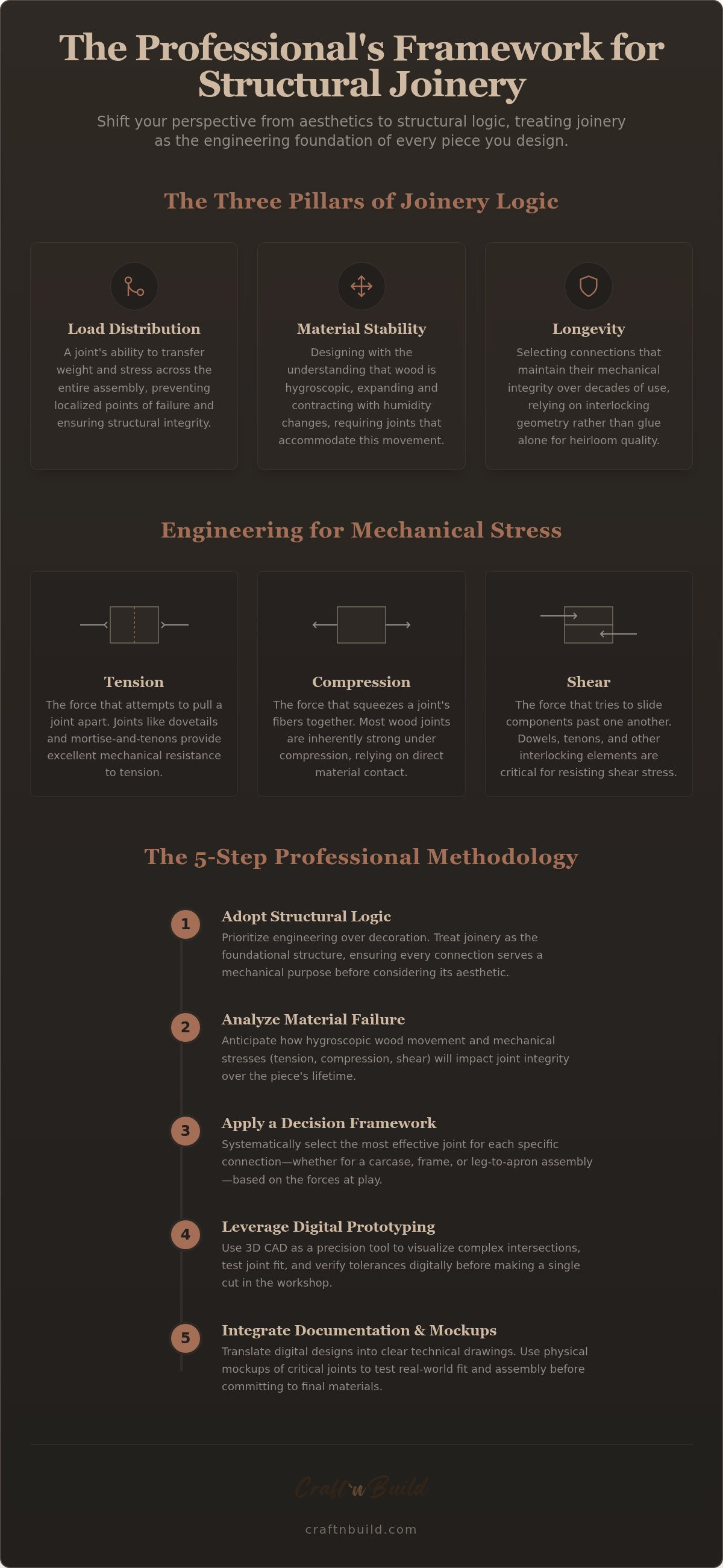
To master this framework, you must build your designs upon three pillars of joinery logic:
- Load Distribution: The ability of a joint to transfer weight and stress across the entire assembly without creating localized points of failure.
- Material Stability: Designing with the understanding that wood is a hygroscopic material that expands and contracts with environmental changes.
- Longevity: Selecting connections that maintain their mechanical integrity over decades of use, rather than relying on glue alone.
Joinery as the Language of Construction
Joinery communicates the intent of a designer through both visible and hidden connections. In high-end design, we distinguish between decorative joinery, which serves as a visual signature, and structural joinery, which performs the heavy lifting behind the scenes. A through-dovetail might be a stylistic choice, but its mechanical resistance to tension is what makes it a professional solution. Structural grammar is the foundational logic that dictates how individual timber components interact to form a cohesive, load-bearing system within a furniture designer's workflow.
The Design Key Perspective on Craftsmanship
Integrating these principles into a broader furniture design methodology allows you to move away from intuition-based guesswork toward a repeatable professional framework. Serious designers don't rely on introductory DIY tips; they seek technical reference guides that explain the "why" behind a connection. By adopting a rigorous approach, you transform from a maker of objects into an architect of interior elements. This transition requires a commitment to technical precision and a deep respect for the material's natural properties.
Engineering for Wood Movement and Mechanical Stress
Wood is a hygroscopic material, meaning it constantly exchanges moisture with its environment. This biological reality is the most significant factor in joint failure. As fibers swell and shrink, they exert immense pressure on connections. Mastering furniture joinery design principles requires you to treat wood as a dynamic material rather than a static medium. If your design doesn't account for these shifts, the internal stresses will eventually overcome even the strongest chemical adhesives.
Every joint must withstand three primary types of mechanical stress: tension, compression, and shear. Tension attempts to pull the joint apart; compression squeezes the fibers together; and shear forces try to slide the components past one another. Professional designers analyze these forces during the conceptual stage to ensure the joint geometry is appropriate for the anticipated load. You must engineer the connection to resist these forces through mechanical interlocking rather than relying solely on the bond of the glue line.
The "Rule of Threes" in grain orientation is equally vital to structural logic. Glue creates a chemical bond that is often stronger than the wood itself, but only when applied to long-grain surfaces. End-grain is essentially a bundle of open tubes that absorb glue without providing a sufficient surface for bonding. Ignoring wood movement in furniture design is the primary cause of structural failure in bespoke pieces. To avoid this, you must adopt a logic-first methodology that respects these physical constraints and grain directions.
Managing Seasonal Expansion and Contraction
Designing for movement means creating connections that allow for expansion without losing structural integrity. Professional joinery often employs "floating" tenons or breadboard ends to manage large surface areas like tabletops. These techniques allow a wide panel to expand across its width while remaining flat and secure. You should calculate specific movement margins based on the wood species and the expected humidity range of the final environment. For those looking to integrate these engineering standards into a comprehensive professional practice, our Design Key master programme provides the technical depth required to master these complex assemblies.
Stress Distribution and Joint Geometry
Joint surface area is directly proportional to bond strength. However, mechanical advantage is what truly defines high-quality work. Interlocking joints, such as dovetails and mortise-and-tenon connections, provide a physical barrier against failure that glue alone cannot match. These traditional woodworking techniques are essential for resisting racking forces. Racking is the lateral stress that threatens the stability of chairs and tables, and it can only be countered through superior joint geometry and precise fitment.
A Professional Framework for Selecting Joinery Systems
Selecting a joinery system requires a decision-making framework rather than a list of aesthetic preferences. Professional furniture joinery design principles dictate that the function of the assembly must govern the selection of the joint. We categorize connections into three functional families: carcase construction, frame-and-panel assemblies, and leg-to-apron connections. Each family faces unique stressors and requires a specific mechanical response to remain stable over time.
You must also evaluate the project life cycle during the design phase. Heirloom-quality pieces demand traditional mechanical joints that resist failure through geometry and material interaction. In contrast, commercial-grade designs might utilize modern engineered solutions like the Festool Domino, biscuits, or dowels for speed and repeatability. While modern adhesives are excellent, they don't replace the need for mechanical integrity in high-load applications. The choice between a hand-cut joint and an engineered fastener should be a conscious engineering decision based on the intended longevity of the piece.
Understanding the hierarchy of joints is essential for managing the load path of a furniture piece. For example, you must decide when to use a dovetail versus a box joint based on the direction of tension. A dovetail is superior in applications where tension is the primary force, such as a drawer front being pulled. The interlocking tails provide a physical stop that a box joint simply lacks. By prioritizing the load path, you ensure that the joint's geometry works with the physics of the piece rather than against it.
Carcase Joinery for Casegoods
Miters offer clean lines but require internal reinforcement like splines to provide sufficient glue surface. Rabbets and dados provide a shoulder for load-bearing shelves, ensuring that weight is transferred directly to the cabinet sides. When designing internal dividers, ensure they are housed in ways that don't restrict wood movement. The dovetail remains the gold standard for drawer construction because its mechanical geometry physically prevents the drawer front from separating from the sides during use.
Frame and Leg Connections
The mortise and tenon is the gold standard for structural frames, offering a massive surface area for long-grain bonding. You should select variations based on specific needs: haunched tenons for door frames or drawbored tenons for a permanent mechanical lock. For leg-to-rail connections, maximize the tenon's width and depth to ensure lateral stability. Utilizing expert joinery techniques ensures that these high-stress points don't degrade over decades of use.
Digital Precision: Designing Joinery within a 3D CAD Workflow
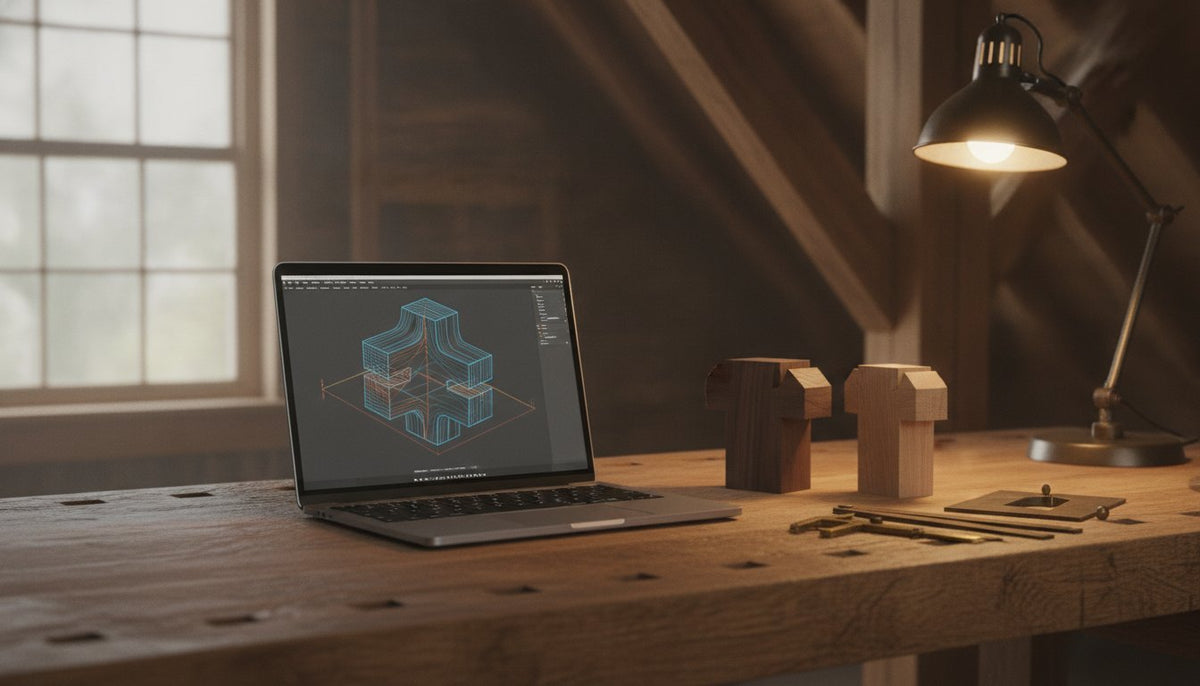
Digital precision represents the modern evolution of traditional craftsmanship. In a professional workflow, 3D CAD is not just a visualization tool; it is a rigorous environment for interference checking and structural validation. By building a digital prototype, you can identify complex joint intersections that would be impossible to see in a 2D sketch. This process ensures that your furniture joinery design principles are grounded in spatial reality before you ever touch a piece of timber. It's the difference between hoping a joint fits and knowing it will perform.
The ability to test joinery tolerances virtually allows for a level of refinement that manual methods cannot replicate. We integrate these advanced modeling techniques into The Design Key - Full Master Programme to help designers bridge the gap between creative vision and technical execution. Moving from conceptual sketches to technical drawing precision is the hallmark of a professional who values structural integrity as much as aesthetic form. This disciplined transition ensures that the structural logic established in the previous sections remains intact through the manufacturing phase.
Modeling Joint Tolerances
Precision in CAD requires more than just drawing lines; you must model specific "glue gaps" and fitment allowances to account for adhesive thickness and assembly ease. Utilizing pre-built Design Concepts in 3D CAD format can significantly accelerate this detailing process, providing a library of verified structural connections. Digital environments also allow you to visualize grain direction in three dimensions. This predictive capability helps you anticipate wood movement issues, such as cross-grain tension, during the design phase rather than discovering them through workshop failure.
From CAD to Cut List
The transition from a digital model to a professional cut list should be seamless and automated. Technical drawing precision serves as the foundation of professional manufacturing. It eliminates the ambiguity that leads to costly material waste and assembly errors. CAD software allows you to optimize material yield by nesting components efficiently, all while ensuring that joint strength remains the priority. This disciplined approach ensures that every component is sized correctly for the intended joinery system. To master these technical workflows and elevate your design practice, explore our interior design programs for a structured path to mastery.
The Professional Methodology: From Technical Drawing to Execution
Methodology is the bridge between a conceptual sketch and a structural masterpiece. To achieve consistent, high-level results in interior architecture, you must move beyond the haphazard "make it as you go" approach. A repeatable workflow ensures that your furniture joinery design principles are applied with the same rigor across every project. This disciplined transition from the design studio to the workshop floor is what separates the professional practitioner from the amateur maker. It's a commitment to a "logic-first" philosophy that values preparation as much as the final finish.
We define the professional workflow for joinery-heavy projects through a five-step sequence. First, you perform a structural load analysis to identify where tension and shear will occur. Second, you select the joinery system that best manages those forces while accounting for wood movement. Third, you execute digital interference checking within a CAD environment to ensure complex intersections are viable. Fourth, you produce comprehensive technical documentation. Finally, you validate the assembly through physical mockups. This final stage is vital for testing the fit and "feel" of a joint before you commit to expensive, primary timber stock.
The Documentation Standard
Professional joinery detail drawings must leave no room for interpretation. Your documentation should include detailed sections, exploded blow-ups of complex intersections, and clearly defined tolerances. Using standardized project templates helps maintain consistency across different designs, ensuring that every detail aligns with your established structural logic. Precise annotation links your design intent to the manufacturing reality. It's not enough to draw a joint; you must specify the fitment allowances and grain orientations that will guarantee the piece's longevity.
Elevating Your Design Practice
Mastering joinery logic doesn't restrict your creativity; it expands it. When you understand the engineering limits of your materials, you can design more daring and expressive furniture forms with total confidence. The future of the craft lies at the intersection of traditional wisdom and modern innovation. Tools like AI Implementation for Design Workflows can assist in the early concepting stages, allowing you to explore structural variations rapidly before applying your technical expertise. This "Logic-First" philosophy is a career-long pursuit. It's a journey toward mastery that demands constant refinement, deep material knowledge, and an unwavering respect for the structural integrity of the objects you create.
Mastering the Logic of Structural Integrity
Transitioning from a designer who simply draws to an architect who understands engineering requires a fundamental shift in mindset. You've seen how seasonal wood movement and mechanical stresses like shear dictate the success of every connection. By applying a rigorous framework to your furniture joinery design principles, you bridge the gap between creative concepts and heirloom-quality execution. This disciplined approach ensures that your work remains stable for generations.
True mastery is found at the intersection of traditional craftsmanship and modern digital precision. Utilizing technical reference guides for serious learners and a professional CAD-based workflow ensures your designs are validated long before the first piece of timber is cut. This methodology is the same used by leading interior architects to produce consistent, high-level results in complex furniture projects. It's about moving from intuition to a repeatable, professional standard of construction.
Master the full professional methodology with The Design Key Full Master Programme
Your journey toward structural mastery is a career-long pursuit. Adopt these logic-first principles today and watch your designs transform into enduring legacies of quality and craft.
Frequently Asked Questions
What are the most important furniture joinery design principles for beginners?
The most fundamental furniture joinery design principles for beginners involve mastering grain orientation and maximizing long-grain to long-grain contact. You must understand that end-grain is essentially a bundle of open tubes that provides a poor bonding surface for adhesives. Additionally, beginners should prioritize joints that account for seasonal expansion. Start with simple rabbets and dados to learn how shoulders transfer loads. Mastering these basics ensures that your early projects don't fail due to ignored physics or insufficient glue surface area.
How do I choose between a mortise and tenon and a dovetail joint?
Choosing between these joints depends entirely on the functional family of the assembly. Use a mortise and tenon for frame-and-panel construction or leg-to-apron connections where lateral stability is the primary requirement. Reserve dovetails for carcase construction, particularly drawers and chest corners, where resistance to tension is vital. While both are structurally superior, the mortise and tenon excels at resisting racking forces, whereas the dovetail is the gold standard for resisting pulling forces in casegoods.
Does wood movement really matter if I use modern high-strength glues?
Wood movement matters regardless of adhesive strength because glue cannot counteract the immense hydraulic pressure of expanding wood fibers. If you use high-strength glue to lock a cross-grain joint, the wood will eventually split itself to relieve internal tension. Modern glues provide incredible bond strength, but they don't change the biological nature of timber. You must design joints that allow for movement rather than attempting to fight it with chemical bonds that the wood will eventually break.
Can I design professional-grade joinery using 3D CAD software?
You can absolutely design professional-grade joinery using 3D CAD software, and for complex work, it's often essential. Digital modeling allows you to perform interference checking to ensure tenons don't collide in a leg or that dovetail spacing is mathematically sound. By building a digital prototype, you can verify tolerances and visualize structural intersections before making a single cut. This precision reduces material waste and ensures that every connection follows established furniture joinery design principles from the start.
What is the difference between mechanical joinery and reinforced joinery?
Mechanical joinery relies on the physical geometry of the wood parts to resist forces, such as the interlocking pins of a dovetail. Reinforced joinery uses secondary elements like dowels, biscuits, or loose tenons to strengthen a connection that lacks inherent mechanical resistance. While reinforced joints are efficient and common in modern manufacturing, mechanical joints are traditionally preferred for heirloom pieces because they remain structurally sound even if the adhesive eventually degrades over many decades of use.
How do I calculate the correct size for a tenon based on the rail thickness?
The professional standard for calculating tenon thickness is the "one-third rule." Your tenon should be approximately one-third the thickness of the rail or workpiece it's cut from. This ratio ensures the tenon is thick enough to resist shear forces while leaving enough material on the mortise walls to prevent splitting under load. For a 21mm rail, a 7mm tenon is ideal. Maintaining this proportion is a key technical requirement for achieving long-term structural integrity in any frame assembly.
Is it better to hide joinery or make it a visible design feature?
Whether to hide or reveal joinery is a stylistic choice that should be guided by your design intent. Visible joinery, such as through-tenons or dovetails, celebrates the construction process and serves as a mark of craftsmanship. Hidden joinery, like blind mortises, allows for a cleaner, more minimalist aesthetic. However, the structural logic must remain the same regardless of visibility. Never choose a joint for its look if it doesn't first meet the engineering requirements of the piece.
Why is structural logic more important than aesthetic style in furniture design?
Structural logic is more important than aesthetic style because it determines if a piece is a functional object or a failing sculpture. A beautiful cabinet that cannot support its own weight or that cracks during the first winter is a failure of design. Style is subjective and evolves over time, but the physics of wood and gravity are constant. By prioritizing structural logic, you ensure that the piece remains safe, functional, and durable enough to carry your aesthetic vision for decades.
Partners
Craft'n Build welcome affiliate marketers, https://craftnbuild.com/pages/affiliate-partner-programme-1


Share:
AI Architecture & Design Courses: 2026 Buying Guide
Material Knowledge & Structural Logic for Furniture Design