




Article by
M. Skipper
Founder & Lead · Craft'n Build Creator Studio
A design presentation is not a marketing brochure; it is a technical document that must communicate structural logic and project feasibility before it ever sells an aesthetic. You know the frustration of watching a sophisticated interior concept lose its impact because the slides look like an amateur DIY project. It's a common struggle for interior architects who find themselves wasting hours formatting layouts instead of refining their CAD details or furniture logic. You deserve a workflow that respects your time and reflects the high level of craftsmanship you bring to every floor plan and joinery detail.
By adopting a methodology centered on professional design presentation templates, you can transform your client meetings from defensive explanations into authoritative masterclasses. This article provides a rigorous framework designed specifically for the complexities of interior architecture and furniture design. We'll examine how to build a repeatable system that increases client trust through technical clarity and structural integrity. You will learn to integrate technical reference guides into your presentations, ensuring your design-to-presentation workflow is as efficient as the refined spaces you create.
Key Takeaways
- Transition from superficial visual storytelling to a rigorous technical communication style that emphasizes structural logic and project feasibility.
- Implement a structured 20-slide deck methodology to systematically guide clients through complex space planning and circulation logic.
- Integrate high-fidelity 3D CAD concepts and AI-driven automation to maintain technical precision without sacrificing valuable design time.
- Utilize professional design presentation templates to establish a repeatable, disciplined workflow that builds immediate client trust through technical authority.
- Conduct a thorough audit of your studio's current presentation habits to identify and resolve the technical gaps that often lead to an amateur aesthetic.
Beyond Aesthetics: What Defines Professional Design Presentation Templates in 2026?
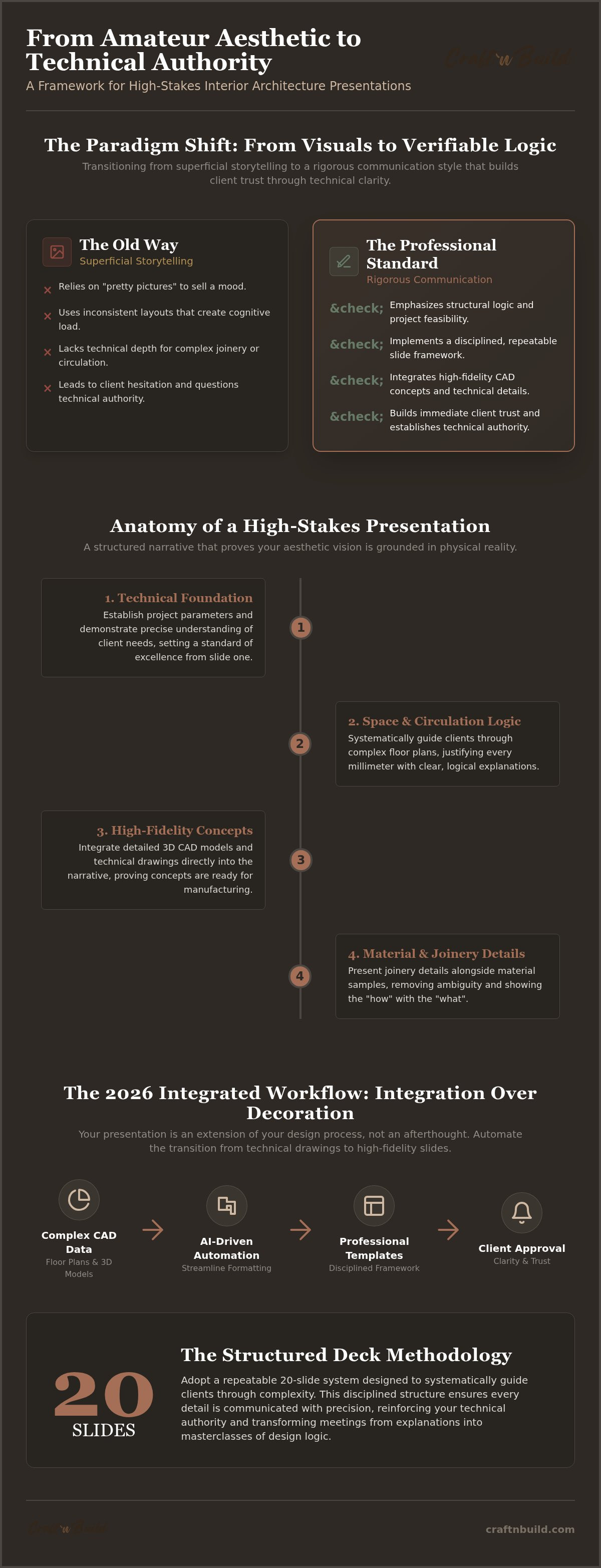
In the high-stakes environment of interior architecture, a slide deck is more than a collection of images. It's a technical instrument. While amateur projects rely on "pretty" pictures to distract from a lack of planning, professional design presentation templates serve as the skeletal structure of your project's logic. They shift the focus from simple visual storytelling to rigorous technical project communication. This transition is essential for architects who must justify every millimetre of a floor plan or the structural integrity of a bespoke furniture piece.
Modern clients are increasingly sophisticated. They don't just want to feel a mood; they want to understand the mechanism. Refining your presentation skills means moving beyond the "mood" and into the "mechanism" of the build. By utilizing a disciplined framework, you reduce the cognitive load on your client. Instead of forcing them to decipher inconsistent layouts, you provide a clear, repeatable path that guides them through your design thinking. This methodology reflects your underlying professionalism and ensures that your technical authority is never questioned.
Logic vs. Style: The Professional Standard
Generic minimalist slides often fail because they lack the technical depth required to explain complex joinery or spatial circulation. A professional standard demands consistent technical notation across every slide. Whether you're presenting a detailed section or a material palette, the notation must remain disciplined and predictable. This consistency establishes authority. It tells the client that you've applied the same level of rigor to your communication as you have to your 3D CAD models. Within The Design Key methodology, we prioritize structural logic over superficial decoration to ensure that every design decision is backed by sound architectural principles.
The 2026 Design Workflow: Integration Over Decoration
Effective templates bridge the gap between complex CAD data and client approval. In 2026, the industry has moved toward integration. Your presentation shouldn't be a separate task that starts after the design is finished. Instead, it should be an extension of your workflow. By leveraging Ai Implementation for Design Workflows, you can automate the transition from technical drawings to high-fidelity presentation slides. This allows you to focus on the craftsmanship of the design rather than the tedious formatting of a deck. These professional design presentation templates act as a repository for your technical reference guides, ensuring that every project follows a proven, successful path.
The "Logic-First" presentation mindset is the 2026 industry standard for interior architects who prioritize technical feasibility and structural integrity over superficial rendering.
The Anatomy of a High-Stakes Interior Design Presentation
A high-stakes presentation is an architectural argument. It must prove that your aesthetic vision is grounded in physical reality. To achieve this, your professional design presentation templates must follow a specific anatomical structure that mirrors the construction process itself. You begin with the technical foundation. This is where you establish the project's parameters and demonstrate that you've listened to the client's needs with clinical precision. It's about setting a standard of excellence from the first slide.
A professional deck must bridge the gap between creative vision and the workshop floor. Your technical slides should integrate floor plans and furniture cut lists directly into the narrative. This transparency proves that your 3D CAD concepts aren't just digital fantasies; they are ready for manufacturing. When you present a joinery detail alongside a material sample, you remove the ambiguity that often leads to client hesitation. It's about showing the "how" alongside the "what" to build lasting professional trust.
Essential Slides for Professional Credibility
Professionalism starts with alignment. Using The Brief - The Design Key Series allows you to document client requirements in a way that feels binding and authoritative. This isn't just a list of wishes; it's the project's constitutional document. Following this, you must present the spatial logic. Relying on The Floor Plan Design Key ensures that your layouts aren't just attractive but functional. You're communicating circulation paths and ergonomic clearances, not just furniture placement. You should also include slides for "invisible architecture" such as lighting and ventilation. While these elements are often overlooked in generic decks, presenting them shows a deep understanding of human comfort and technical engineering.
Visualising the Concept: Professional Moodboards
Moodboards are often the point where a presentation loses its technical edge. Don't let your boards become a chaotic collage of "vibes." Instead, use a method-driven approach that connects textures and tones to specific technical outcomes. This means linking your visual choices to Colour Systems and Professional Palettes that are reproducible in the physical world. Applying graphic presentation tips for interior designers can help you maintain a hierarchy that highlights material specifications over mere decoration. For a deeper look at this process, read our guide on Professional Moodboard Templates to see how to structure these slides for maximum impact.
Crafting these technical slides requires a disciplined mindset and a commitment to precision. If you want to master this entire workflow, consider exploring our full interior design master programme to refine your skills from the initial brief to final execution.
Structuring the Narrative: The Methodology Behind the Template
Structuring a presentation requires more than selecting a color palette. It demands a rigorous narrative framework that mirrors the design process itself. Within the "Design Key" philosophy, we move deliberately from foundational principles to advanced execution. This ensures that the client understands the "why" behind every spatial decision before they are asked to approve the "how." By utilizing professional design presentation templates that prioritize structural logic, you lead the client on a journey of discovery rather than a mere sales pitch.
A comprehensive 20-slide deck provides the necessary space for this technical story to unfold. You should allocate the first four slides to the "Design Thinking" phase, where you establish the project's core objectives and constraints. The subsequent eight slides focus on spatial planning and technical logic, while the final section focuses on materiality and joinery details. This methodical progression allows you to address technical objections before they arise. When you present a solution alongside its technical justification, you eliminate the ambiguity that often fuels client doubt.
From Concept to Execution: The Narrative Arc
Your narrative must establish the problem or opportunity immediately. Don't hide the challenges of a site; expose them and then present your "Structural Logic" as the definitive solution. This builds a sense of momentum and clarity. You can validate your design decisions by integrating data from technical reference guides directly into your slides. This methodology aligns with the AIGA Standards of Professional Practice, which emphasize a designer's responsibility to provide clear, honest, and technically sound communication. It's about moving beyond the superficial and grounding your work in professional responsibility.
Refining the Apprentice-to-Master Presentation Style
Adopting an authoritative voice is essential when guiding a client through complex CAD concepts or bespoke furniture logic. You aren't just a service provider; you're a master practitioner sharing refined secrets with a serious-minded apprentice. This requires a delicate balance between technical precision and accessible communication. You must use industry-specific terminology to establish expertise, but you should always explain its impact on the final product. Explore the full Design Key Master Programme to learn how to master this narrative arc and elevate your studio's communication standards. Mastery is a repeatable path, and it starts with a disciplined approach to how you tell your design story.
Tools for High-Fidelity Design Presentations: Beyond Generic Layouts
High-fidelity presentations require tools that go beyond the surface. While generic platforms offer aesthetically pleasing layouts, they often lack the technical infrastructure to support a professional architectural workflow. True professional design presentation templates must act as a bridge between the precision of the design studio and the clarity of the client meeting. They must be capable of housing complex data without compromising the visual integrity of the project. You shouldn't have to choose between technical depth and a polished appearance.
Generic presentation platforms are designed for marketing brochures and simple business pitches. They rely on "visually appealing" slides that often mask a lack of technical detail. In contrast, professional design frameworks are built on a foundation of structural logic. They provide specific containers for technical notation, material specifications, and architectural sections. This ensures that every slide serves a functional purpose in the design-to-presentation workflow.
AI and Automation in Modern Presentations
The integration of artificial intelligence has moved beyond simple image generation. By utilizing AI Implementation for Architects and Designers, you can significantly accelerate the slide creation process. This isn't about replacing your creative vision; it's about automating the repetitive tasks that drain your time. You can use these tools to organize technical specifications or to ensure that furniture cut lists are consistently formatted across your entire deck. This automation allows you to maintain technical accuracy while focusing on the high-level refinement of your interior architecture. It's a disciplined way to leverage modern technology without sacrificing the craftsmanship of your documentation.
CAD Integration and Technical Fidelity
Technical fidelity is what separates a master practitioner from an amateur. Integrating Design Concepts in 3D CAD format directly into your presentation allows you to communicate scale and proportion with absolute certainty. When you present a bespoke furniture piece, the client needs to see the structural logic of the joinery, not just a flat render. Professional design presentation templates allow you to embed these CAD concepts in a way that feels seamless and authoritative. This approach ensures that your technical drawings remain the hero of the presentation. For a more comprehensive look at how to manage your project assets, see our Interior Design Documentation framework. Mastery of these tools is the only way to ensure your studio remains competitive in a logic-first industry.
If you're ready to move beyond generic layouts and adopt a more rigorous methodology, enroll in our professional interior design programs today.
Implementing Professional Templates in Your Design Studio
Adopting a new presentation system requires more than a simple file download. It demands a disciplined shift in how your studio operates. To successfully implement professional design presentation templates, you must first audit your current workflow for technical gaps. Review your past three project deliveries. Identify where clients asked for clarification on structural details or where your team spent excessive time on manual formatting. These gaps represent the friction points where your current process fails to meet the standard of a master practitioner.
Once you've identified these weaknesses, select a framework that aligns with your specific design methodology. This isn't a search for the most "stylish" layout; it's a search for the most logical one. After selection, customize the template with your studio's technical standards. This includes your specific CAD notation styles, material callout formats, and technical drawing conventions. The final step is the most vital: train your team on the "Logic-First" narrative structure. Every designer in your studio must understand how to present a technical argument so that the client sees the project’s feasibility as clearly as its beauty.
Scaling Your Practice with Standardised Templates
Standardization is the bedrock of a scalable interior architecture practice. When you use professional design presentation templates, you ensure that a junior designer produces the same technical depth as a senior partner. This consistency builds a recognizable brand of authority. It also significantly reduces the revision cycle. When you communicate technical logic clearly from the start, you eliminate the misunderstandings that lead to costly design changes later in the project. Efficiency is not just about speed; it's about the quiet satisfaction of getting it right the first time.
Continuous Learning and Professional Growth
A template is a living document that should evolve with your expertise. You must regularly update your frameworks with the latest insights from Technical Reference Guides to ensure your studio remains at the cutting edge of the industry. Moving beyond basic layouts allows you to master a complete Interior Design Methodology that prioritizes structural integrity and craftsmanship. This commitment to growth is what separates the disciplined innovator from the amateur decorator. If you're ready to transform your studio's output and command greater technical authority, Download the Professional Project Templates to start your transformation today.
Elevating Your Technical Authority Through Structured Communication
Mastering the art of technical communication is the final step in refining your professional identity as an interior architect. By moving beyond superficial slide decks and adopting professional design presentation templates, you align your client delivery with the rigorous standards of your design process. You've learned that a structured narrative, grounded in structural logic and enhanced by 3D CAD and AI implementation frameworks, is the most effective way to build lasting client trust. These tools aren't just for decoration; they're essential components of a repeatable, disciplined workflow.
Our methodology, developed by the Danish Creator Studio ApS, is used by professional interior architects worldwide to bridge the gap between creative vision and technical execution. It's time to stop wasting hours on formatting and start focusing on the craftsmanship that defines your practice. You have the potential to execute complex tasks with precision and authority. Adopting a logic-first mindset ensures that every project you present stands on a foundation of structural integrity.
Transform your workflow with the Professional Project Templates
The path to mastery is available to those willing to adopt a rigorous methodology. Your next project deserves the technical clarity and professional weight that only a dedicated architectural framework can provide. Move forward with confidence, knowing your communication now matches the high standard of your design work.
Frequently Asked Questions
What should be included in a professional interior design presentation?
A comprehensive presentation must include the project brief, spatial planning logic, floor plans, material specifications, and technical joinery details. It's essential to move beyond aesthetic moodboards to provide a rigorous structural narrative. You should also present the invisible architecture, such as lighting and ventilation, to demonstrate technical mastery. This ensures the client understands the project's feasibility and the structural integrity of your proposed solutions from the initial concept.
How do professional design templates differ from generic ones like Canva?
Professional frameworks prioritize technical depth and structural logic over superficial decoration. Unlike generic platforms that focus on "pretty" layouts, professional design presentation templates provide specific containers for architectural notation, CAD details, and furniture cut lists. They're designed for a disciplined design-to-presentation workflow rather than simple marketing. This distinction ensures your work is perceived as a rigorous architectural project rather than an amateur DIY exercise.
Can I use AI to help create my design presentations?
You can certainly leverage AI to automate technical documentation and streamline the slide creation process. By implementing AI workflows, you can generate furniture specifications or organize technical reference data more efficiently. This isn't about replacing your creative vision; it's about reducing the manual formatting burden. Using AI allows you to maintain high-fidelity accuracy across your entire deck while focusing your energy on the refinement of complex interior architectural elements.
Do I need CAD knowledge to use professional design templates?
While you don't need to be a CAD expert to use these templates, having foundational knowledge allows you to integrate high-fidelity technical drawings effectively. Professional templates are designed to house 3D CAD concepts and architectural sections. If you lack these skills, it's beneficial to seek training that bridges the gap between traditional manual skills and modern digital tools. This ensures every slide reflects a disciplined, logic-first mindset.
How many slides should a professional design deck have?
A comprehensive interior architecture presentation typically requires approximately 20 slides to cover the narrative arc from brief to execution. This length provides enough space to establish the design thinking, present floor plan logic, and detail specific material palettes. Avoid cluttering your presentation with unnecessary filler. Every slide must serve a functional purpose. A methodical, 20-slide structure ensures you address technical requirements without overwhelming the client with superficial imagery.
What is the best format for sending design presentations to clients?
The most professional format is a high-resolution PDF or a secure, interactive digital link. These formats preserve your technical notation, font hierarchy, and image quality across different devices. Don't send raw presentation files that can be easily edited or misaligned. Providing a polished, locked document reinforces your authority as a master practitioner and ensures the structural logic of your presentation remains intact during the client's review process.
How do I present technical furniture designs to a non-technical client?
Use authoritative language that explains the "why" behind the technical "how." Instead of focusing solely on joinery mechanics, explain how the structural logic improves the piece's longevity or tactile experience. Use professional design presentation templates to place technical drawings alongside realistic renders. This dual approach allows the client to appreciate the craftsmanship while trusting the engineering. It's about acting as a generous guide through complex manufacturing secrets.
Are professional presentation templates worth the investment for a new studio?
Investing in professional frameworks is vital for establishing immediate technical authority in a competitive market. For a new studio, these templates provide a repeatable, proven path to success that minimizes time wasted on trial and error. They allow you to scale your practice by ensuring consistency and high output quality from day one. This investment reflects a commitment to craftsmanship and a disciplined methodology that inspires long-term client trust.
Partners
Craft'n Build welcome affiliate marketers, https://craftnbuild.com/pages/affiliate-partner-programme-1


Share:
Interior Design Documentation: 2026 Professional Framework
Furniture Design Specification Sheet: A Professional Architectural Framework