


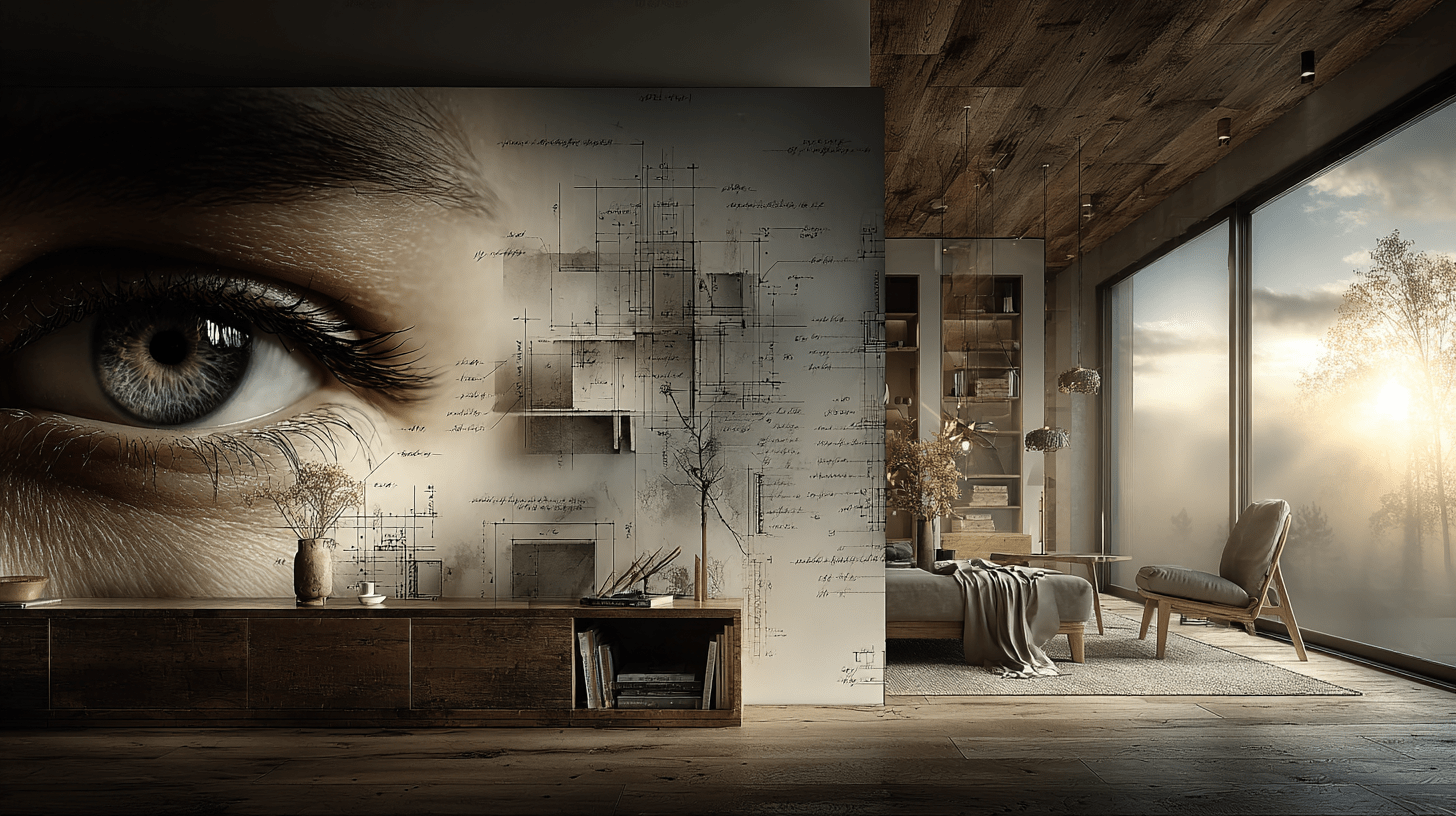
The Designer's Eye Is Not a Gift. It's a Trained Instrument.
Ten signs you're building professional judgement — and the one thing that separates the people who see it from the people who can build it.
There's a comfortable story the industry keeps telling itself: that the best designers were born with something. An eye. An instinct. A gift for proportion that arrived fully formed and cannot be taught.
It's a flattering story if you have it. It's a discouraging one if you don't. And it's mostly wrong.
What people call "the eye" is a set of learned discriminations. It looks like instinct because the learning happened invisibly — in a childhood spent noticing, in years of looking at good work, in the slow accumulation of reference. But it is training. It has always been training. Which means it can be trained deliberately, faster and more thoroughly than it can be absorbed by accident.
Here's the harder truth, though, and the one this industry avoids: the eye is the entry fee, not the profession. Plenty of people can see that a room is wrong. Far fewer can say precisely why, in dimensions and materials. Fewer still can write the instruction that makes it right — the drawing, the schedule, the specification that a joiner, an upholsterer, a contractor can actually build from without calling you three times.
That gap — between seeing and specifying — is where careers stall.
So here are ten signs you're developing real professional judgement. Not taste. Judgement.

1. You reach for the brief before you reach for the mood board
Amateurs start with how it should feel. Professionals start with what it has to do — who uses this room, how often, how badly, and what happens when it fails. The brief is not paperwork you get through on the way to the fun part. It is the fun part. Every constraint in it is a design decision waiting to be made well.
If your first question about a space is what is this for, rather than what should this look like, you're already working like a professional.
2. You can say why something is wrong
Anyone can walk into a room and feel that it's off. That's not an eye — that's being human.
The professional signal is the next sentence. The sofa isn't "too big," it's 240mm too deep for a 900mm circulation route. The joinery doesn't "feel cheap," it has a 3mm reveal where it needs 6mm to hide the tolerance. The moment your discomfort becomes a number, a dimension, or a named material property, you've crossed from reaction into diagnosis.
The Living Area here: circulation, seating geometry, and the dimensional reasoning behind why a room "feels wrong."
3. You think in millimeters, not in vibes
Scale and proportion are not mystical. They are measurable, and the good ones can be learned. Seat heights, worktop depths, door swings, reach zones, the clearance a chair needs to be pulled out and sat in by an actual adult body — this is ergonomic literacy, and it is the difference between a room that photographs well and a room that works on a Tuesday morning.
4. You know how the thing is made
You cannot specify what you don't understand. A designer who knows that veneer moves, that solid timber cups, that a mitre opens up in a dry flat, that a foam density is a durability decision — that designer makes fewer expensive mistakes and gets taken seriously by the people who build.
Material knowledge isn't trivia. It's the vocabulary of instruction.

5. You design for the fifth year, not the first photograph
Anyone can make a room look good on handover day. The professional question is what it looks like after two winters, a dog, three dinner parties, and a spilled glass of red.
Durability is a design decision, not a maintenance afterthought. Finish selection, fabric rub counts, edge details, how a surface is going to be cleaned by someone who doesn't care about your intent — these get decided at the drawing board or they get decided for you later, badly.
The Utility Room — the wet, working, hard-wearing side of the home, where durability stops being theoretical.
6. You solve the plan before you decorate it
Flow, sequence, thresholds, where you drop your keys, where the wet coat goes, what you see the moment the door opens. The rooms that feel effortless were solved as circulation problems long before anyone chose a colour.
If you find yourself resolving the plan first and enjoying it — that's professional instinct, not stubbornness.
The Entry: the threshold, the storage of what people wear and carry, the first ten seconds of a home.
7. You listen for what the client didn't say
Clients tell you what they want. They rarely tell you what they need, because they don't have the language for it. "I want it to feel calm" is a symptom. Your job is the diagnosis underneath it — too much visual noise, no landing surfaces, bad lighting layers, storage that lost the argument years ago.
Empathy in this profession isn't softness. It's a diagnostic tool.
8. You can hand it over
This is the one nobody puts on their list, and it's the one that decides who gets rehired.
Design intent that lives only in your head is not design. It's an opinion. The professional deliverable is instruction: a drawing that dimensions itself, a schedule that leaves nothing to be guessed, a specification that survives contact with a maker who has never met you and never will.
Turning intent into producible instruction is the actual job. Everything upstream of it is preparation.

9. You are precise about small things without being precious
Whether the screw heads align. Whether the reveal is consistent. Whether the socket landed 40mm off centre and nobody said anything.
These are not fussiness. They are the visible evidence of whether a project was controlled or merely survived. Clients can't always name what they're seeing — but they can feel the difference between a room that was executed and a room that was assembled.
10. You are still learning, deliberately
Not scrolling. Learning. Looking at how things are made, reading the technical data sheet, asking the fabricator why they did it that way, going back to the project that went wrong and working out exactly which decision caused it.
The designers who plateau are the ones who decided their eye was finished.

The part the industry keeps leaving out
Every article about "the designer's eye" stops at perception. Notice things. Appreciate beauty. Trust your gut.
But no client has ever paid for a gut feeling. They pay for a room that got built, on budget, that still works in five years. And between the intent and the built thing sits a layer of professional judgement that almost nobody teaches: the drawings, the schedules, the specifications, the sequence of decisions that turns a good idea into something a workshop can make.
That's the layer we teach.
Make it work. Then make it beautiful.
In that order — because the other order is how projects fail.
The Design Key — the Master Programme. Twelve courses covering the full professional method, room by room, from brief to buildable instruction, ending in a Master Certificate earned through demonstrated competency rather than attendance.
The eye gets you into the room. The method gets you paid for it.


Share:
So You Want to Work in Interior Design
The Design Key: Master Professional Interior Architecture in 2026