


THE DESIGN KEY SERIES
The Living Area

The method taught here is the one used on paid commissions, not a simplified teaching version of it. You learn the sequence a working studio actually follows.
You do not need a design degree or prior CAD experience to start. Everything the course depends on is built inside the course.
Every exercise produces something you could hand to a maker or a client. The work you do here is portfolio work, not practice work.
Taught by someone who specifies and builds this work, not someone who only teaches it. The judgement in the course comes from projects that shipped.
Secure checkout — all major payment methods accepted
The Design Key — Master Programme
1 of 12 courses toward the Master Programme. Every course counts.Every single course counts towards the full Master Programme.
What You'll Learn
-
Decide what the room must do before you furnish it
-
Create separate zones without building a wall
-
Make it work from studio flat to villa
-
Fit a real office and a guest bed into a living room
-
Plan any shared room so none of it sits empty
-
Carry one story across the whole space
Four starting points — one method.
Who is this course for

Working designers
Put a repeatable method under the instinct you already have, and sharpen the process you use every day.

Aspiring designers
Build real professional skills from the ground up. No degree, no prior experience needed.

Project owners
Understand the process well enough to brief sharply, judge the work, and manage the people delivering it.

Homeowners
Approach your own space the way a professional would, and stop guessing on decisions that cost real money.
No credentials required. No experience assumed. Just a commitment to learn how design actually works — because the method is the same for all of you.
How to get the most from this course
Four steps to turn watching into doing.
Set up to work, not just watch
Have pen and paper beside you. This is a course you do, not one you passively watch — the method only sticks when you work it by hand.

Have pen and paper beside you. This is a course you do, not one you passively watch — the method only sticks when you work it by hand.
Take one module at a time
Each module is a complete idea. Work through one per sitting, finish its exercise before moving on, and let it settle rather than racing to the end.

Apply it to a real space as you go
Use your own home, a past project, or an imagined brief. Run each method on something real so it becomes a skill, not just notes.

Expect about a week, at your pace
Most people complete a course in around a week at a relaxed module-a-day rhythm — faster if you push, slower if you savour it. There's no clock; lifetime access means you set the speed.

FAQ
What is "The Design Key"?
The Design Key is a series of professional methodology courses from Craft'n Build, each covering one core discipline of interior design — the Brief, the Mood Board, the Floor Plan, Lighting, the Kitchen, and more. It teaches how working designers actually think, plan and execute, through the same rigorous framework used in real practice. It's about method, not aesthetics or inspiration.
Who is this for?
Anyone who wants to learn professional interior design method, whatever their starting point — working designers, students and career-changers, homeowners approaching their own space properly, and project owners who need to brief and judge the work. No credentials or prior experience required. The method is the same for everyone.
What do I get, and how do I access it?
Everything is online and yours the moment you buy — instant access, no waiting, nothing shipped. You watch the course in your browser on any device and download the accompanying course material to keep. Access doesn't expire.
Is the course video, text, or both?
Both. Each course combines video lessons with a downloadable written guide and practical exercises, so you can watch, read, and work through the method by hand — which is how it's designed to be learned.
Do I need any experience or special software?
No. The courses assume no prior experience and no expensive software — just a willingness to work through the method. Where a tool is useful, the course shows you accessible options. The method matters more than the software.
How long do I have to complete a course?
As long as you like — access is for life, with no deadline. Most people work through a course in about a week at a relaxed module-a-day pace, faster if they push. You set the speed and can return to the material whenever you need it.
Do I get a certificate?
Yes. Complete any course and you earn a Certificate for that discipline. Complete all twelve and pass the final synthesis exam — which tests your ability to solve real problems across several disciplines at once — and you earn the Design Key Diploma, a credential that reflects mastery of the whole method, not just course completion.
What is "The Master Programme"?
The Master Programme is the full path: all twelve courses together, leading to the Design Key Diploma. You don't commit up front — every single course you take counts toward it. Start with one; the whole programme stays open to you.
Can I just buy one course, or do I have to take the whole series?
Start with a single course — most people do. There's no obligation to take more, but everything you complete counts toward the Master Programme and the Diploma, so a single course is also a first step if you decide to go further.
Do you offer a refund?
Yes — if a course isn't right for you, contact us and we'll make it right.
THE DESIGN KEY
About the Programme

Start with one course
Learn a complete discipline — the Brief, the Mood Board, a room — and earn its Certificate. One course is a real skill on its own.

Build toward the whole
Every course you complete counts toward the Master Programme. You're never starting over — always adding to the same path.

Earn the Diploma
Complete all twelve and pass the synthesis exam to earn the Design Key Diploma — proof you can integrate the whole method, not just finish the courses.
The Design Key Master Programme


$89.00


$89.00


$89.00


$89.00


$89.00


$89.00


$89.00


$89.00


$89.00


$89.00


$89.00


$89.00
The Design Key — Master Programme
1 of 12 courses toward the Master Programme. Every course counts.Every single course counts towards the full Master Programme.
Description
Short description
Full description
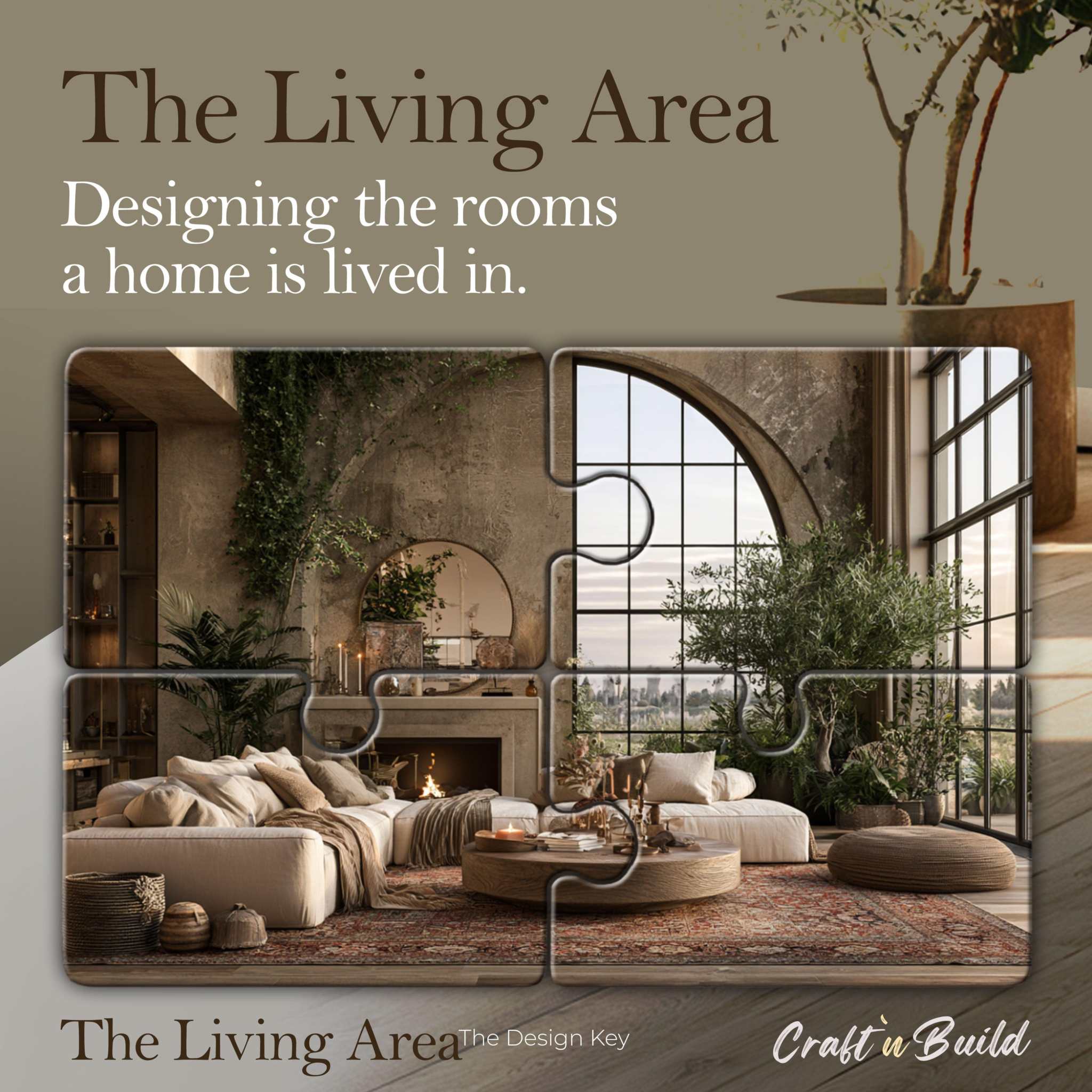
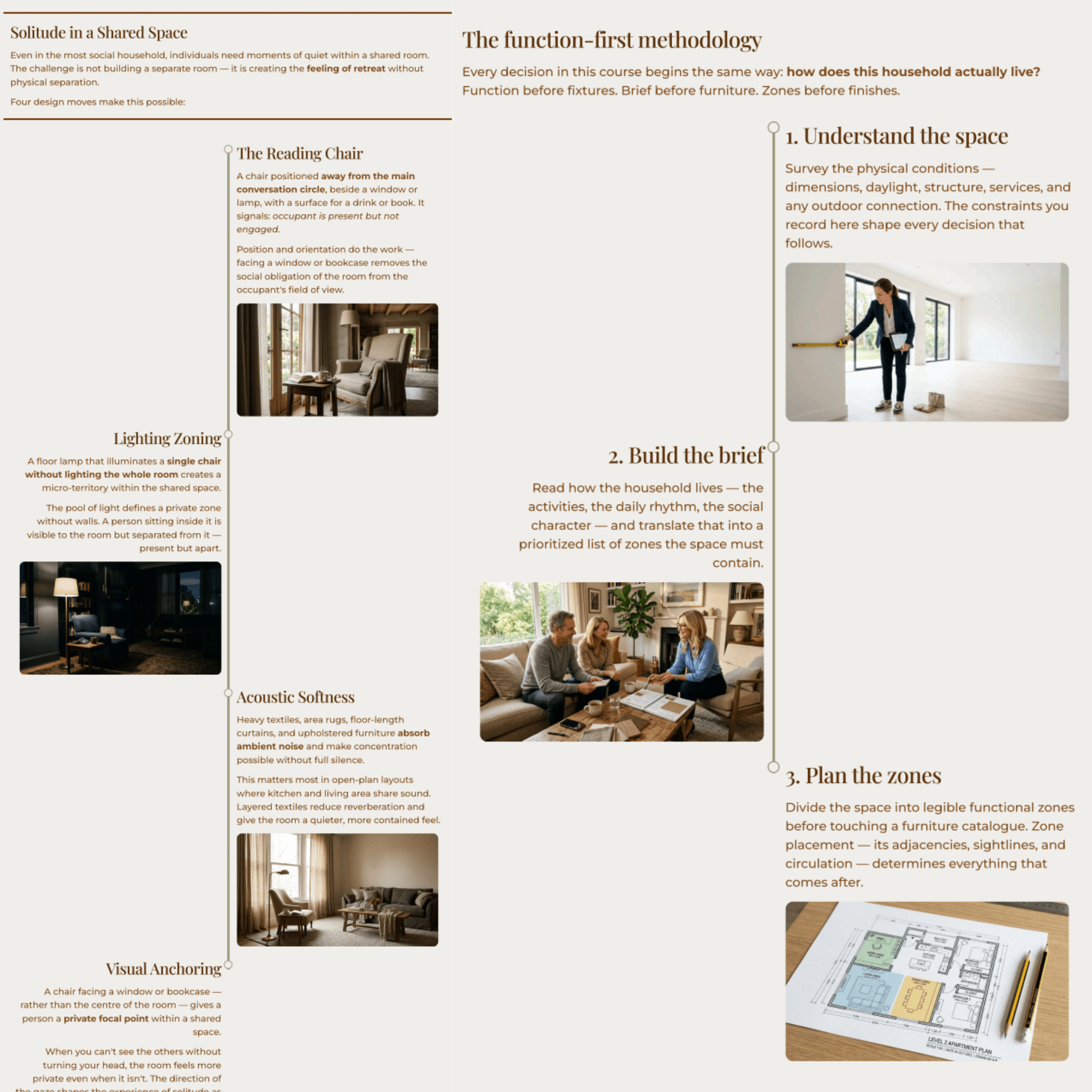
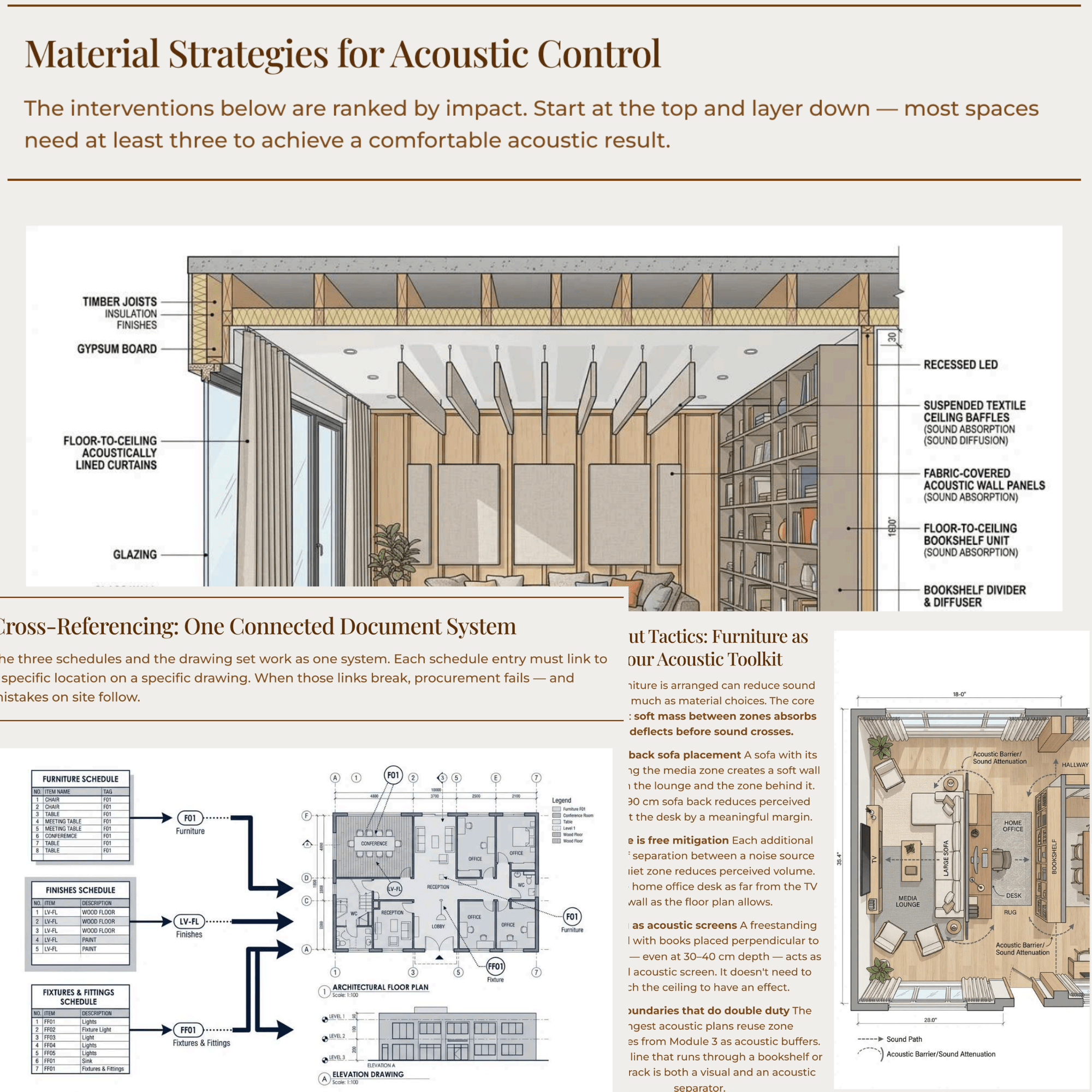
The Living Area is a professional interior design course offered by The Design Key, focusing on designing coexistent and multipurpose shared spaces within residential settings. It teaches a function-first approach to planning and furnishing areas such as the living room, dining room, home office, guest bedroom, and flexible zones, at various scales from balconies to sprawling terraces. The course emphasizes understanding household routines and activities, then dividing spaces into functional zones using circulation, sightlines, levels, lighting, and furniture without relying solely on walls. It covers how to embed multiple functions—like a home office and guest space—within one room through smart, dual-use furniture, ensuring all functions coexist without conflict. Material, light, and color consistency across zones are integral parts of the method, which also includes documenting and presenting design solutions for clear communication with clients and contractors. The curriculum is six modules and thirty lessons, with lifetime access, culminating in a Course Certificate that counts toward The Design Key Master Programme.
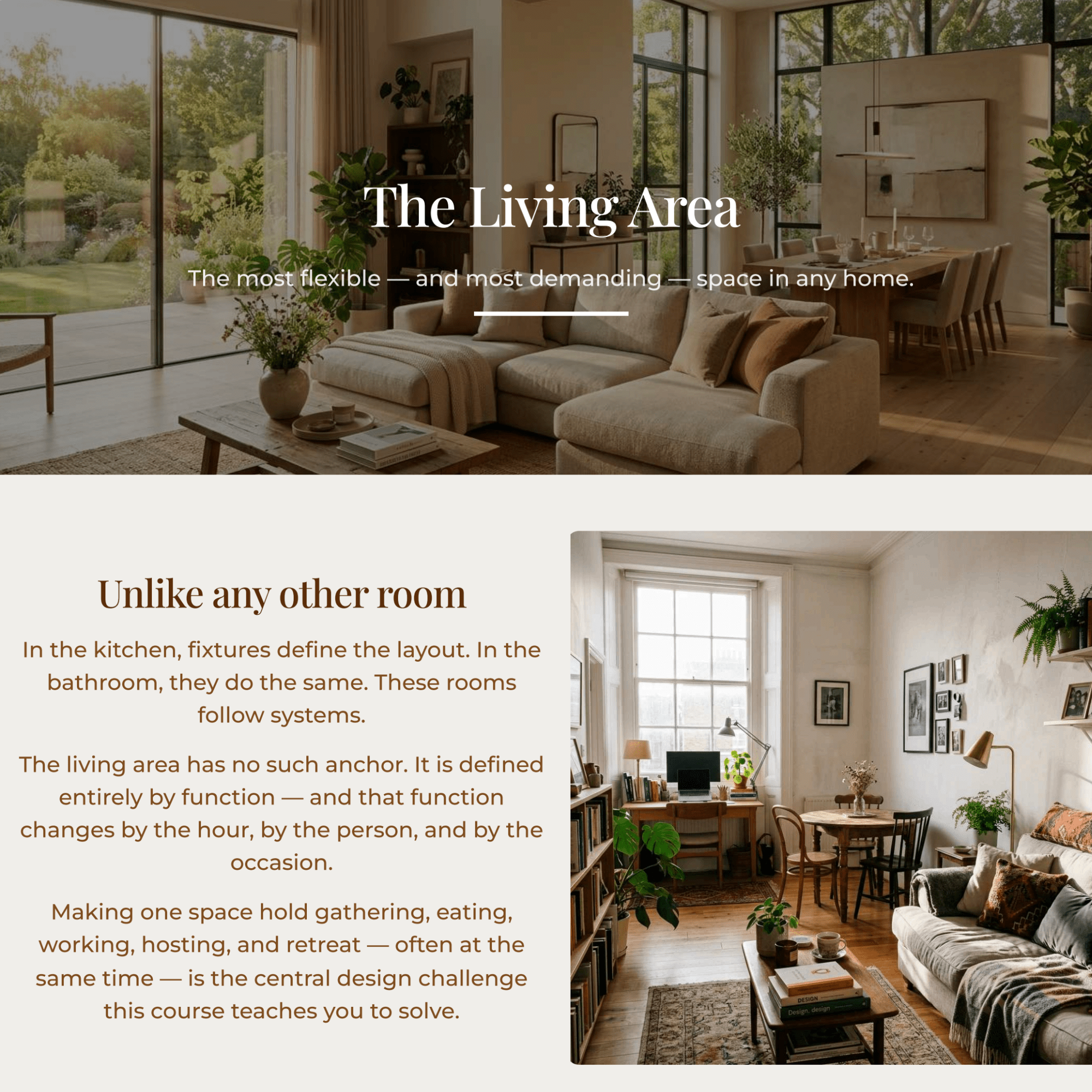
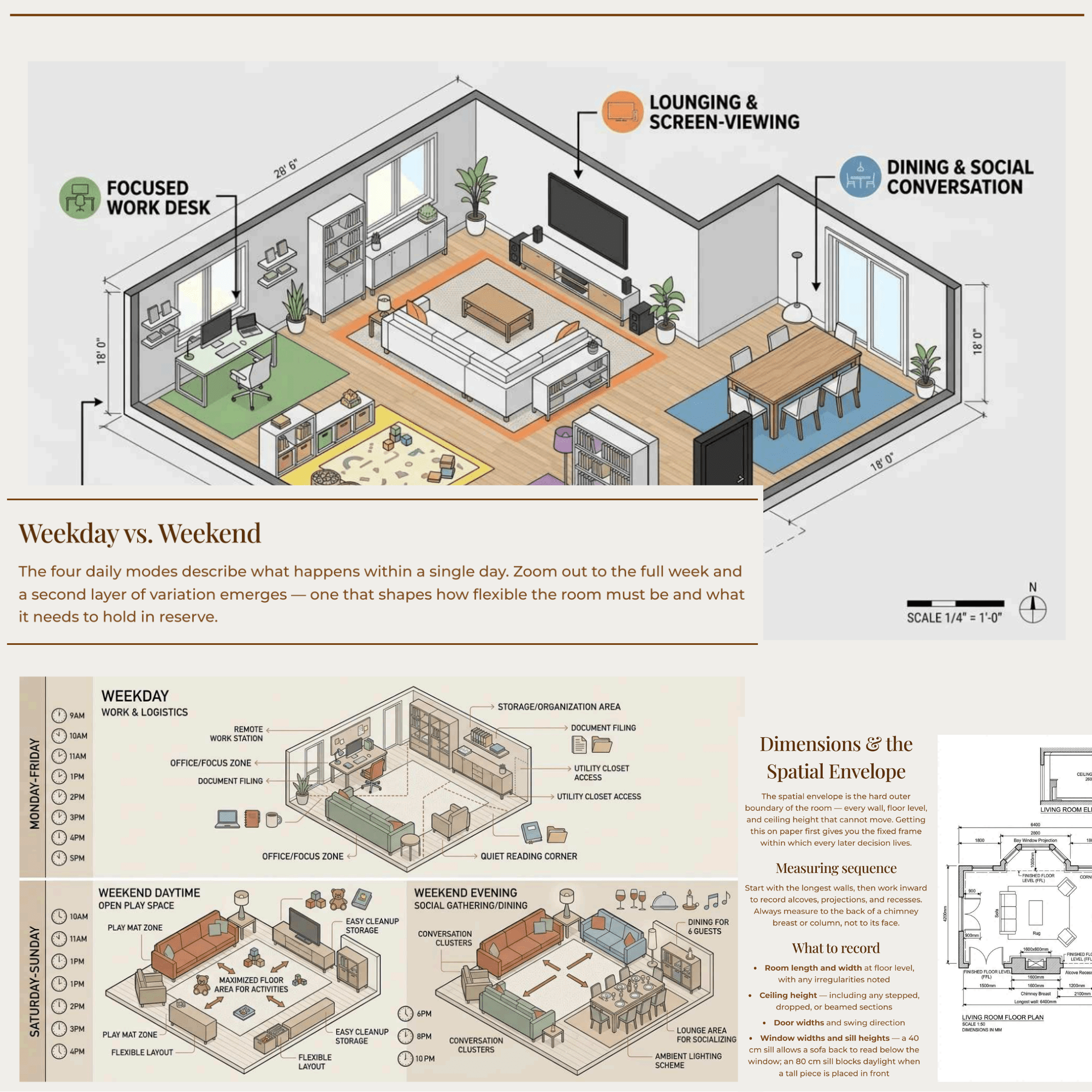
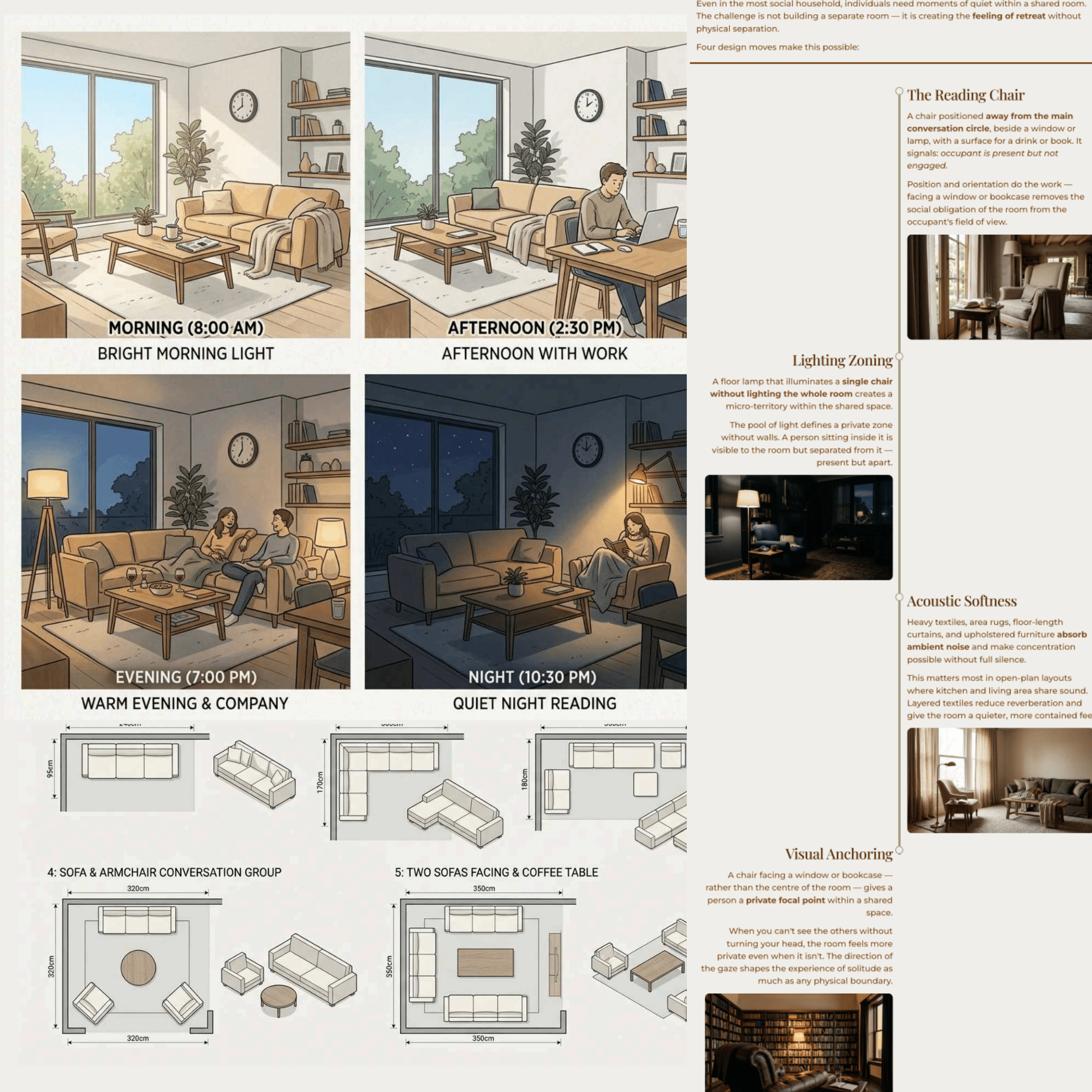
The living area is a defining feature of most homes, often serving multiple purposes such as gathering, retreating, working, or hosting. This course specifically addresses designing for coexistence within this space, emphasizing the importance of planning before furnishing, to avoid common failures where rooms were arranged without considering actual use or natural light. The method involves surveying the existing space—its light, structure, services, and outdoor connections—then creating a detailed living brief based on the activities and their shifting needs throughout the day and week. Space is zoned into dedicated areas for different functions, using circulation paths, sightlines, levels, lighting, and furniture as dividers instead of relying solely on walls. The course also covers how to select and furnish for coexistence, incorporating smart, convertible, dual-use furniture that maximizes functionality without compromising comfort or aesthetic coherence. Design continuity in material, lighting, and color across zones is emphasized, along with techniques for documentation and presentation suitable for client and contractor communication.
Because the nature of the living area varies widely, the course is broadly applicable, covering typical shared spaces such as living rooms, combined living-and-dining rooms, dedicated guest rooms, embedded home offices, and flexible rooms that serve multiple functions. It addresses spaces at different scales, whether compact apartments where space must be maximized or larger villas that allow more separation. The principles taught also extend to outdoor extensions like balconies and terraces, which are treated as integral parts of the living space, designed and aligned to enhance connectivity and functionality. By completing the course, students will be equipped to design any social or multipurpose space as a coherent, livable whole, and to produce professional documentation to a standard suitable for clients and builders. The Living Area course is part of the Rooms layer of The Design Key program and contributes towards the Course Certificate for the Master Programme.
Six modules, thirty lessons, and lifetime access provide a comprehensive method applicable to any shared or multipurpose space. This course ensures that design decisions are rooted in how the household actually lives, enabling effective and harmonious coexistence within any living area.