




Article by
M. Skipper
Founder & Lead · Craft'n Build Creator Studio
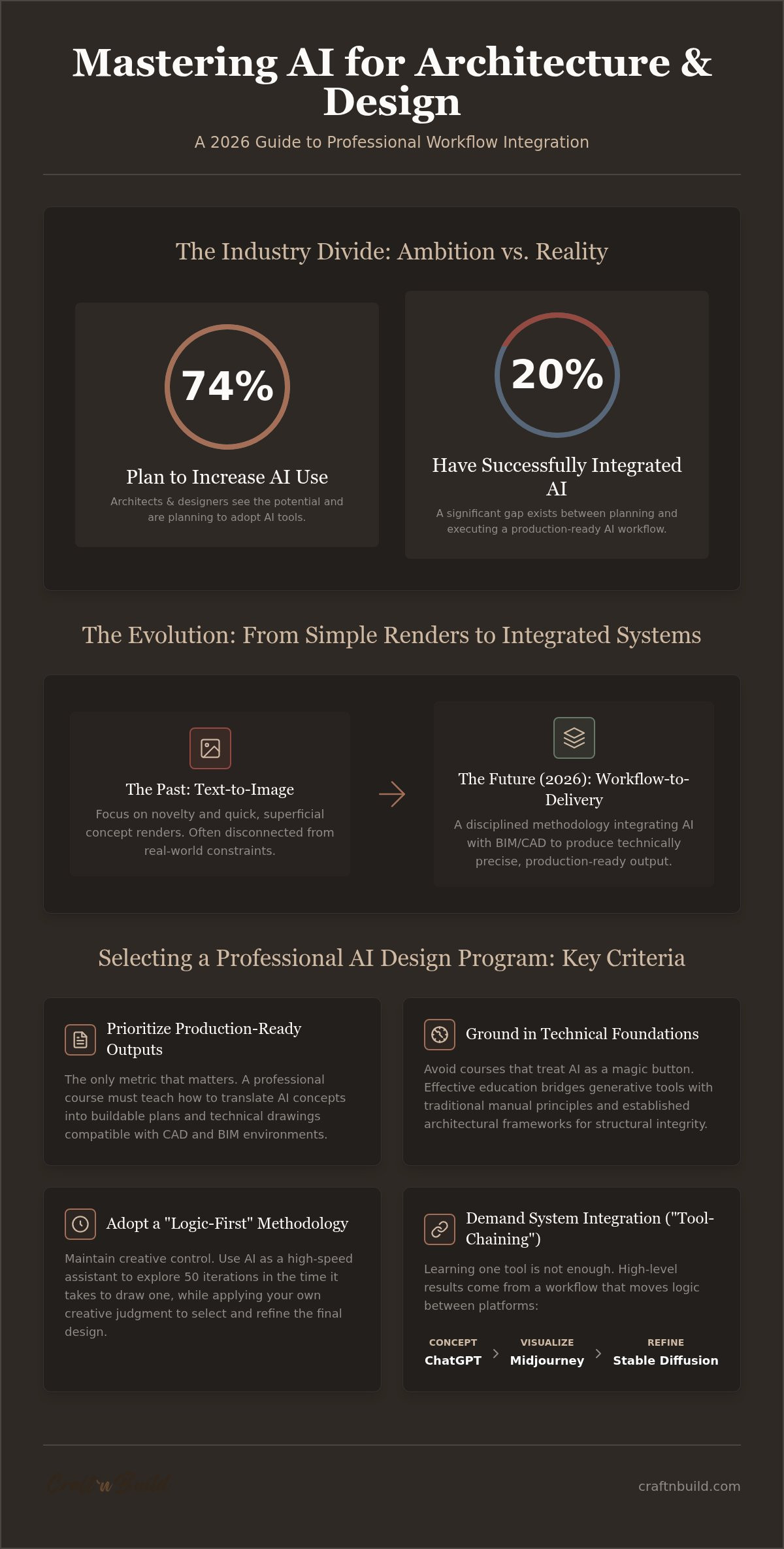
While 74% of architects and designers plan to increase their use of artificial intelligence this year, only 20% have successfully integrated these tools into their professional workflows. It's a frustrating divide. You likely feel the pressure of rapid tool releases yet remain skeptical of "black box" algorithms that seem disconnected from real-world technical requirements. The fear of losing creative control to a prompt is a valid concern for any serious practitioner who values craftsmanship and structural integrity.
This guide changes that narrative by helping you select the best ai for architecture & design courses to bridge the gap between experimentation and execution. You'll learn how to adopt a disciplined, logic-first approach that transforms AI from a novelty into a high-speed engine for production-ready design. We will evaluate the 2026 educational landscape, focusing on systematic frameworks that accelerate client workflows while enhancing your creative judgment through precise, AI-assisted iteration. By the end of this guide, you'll understand how to move from manual concepts to a professional, automated workflow without sacrificing the technical precision your craft demands.
Key Takeaways
- Understand the industry shift from simple text-to-image generation to integrated workflow-to-delivery systems that prioritize technical precision.
- Learn to evaluate ai for architecture & design courses by their ability to produce production-ready outputs rather than just superficial conceptual renders.
- Discover how the "Logic-First" methodology ensures you maintain creative control and structural integrity when using generative algorithms.
- Avoid common educational pitfalls by grounding your digital workflows in traditional manual principles and established architectural frameworks.
- Identify your specific professional bottlenecks to select a curriculum that delivers immediate value to your client delivery and documentation process.
The Evolution of AI for Architecture & Design Courses
The landscape of ai for architecture & design courses has undergone a fundamental transformation. In 2026, artificial intelligence is no longer viewed as a peripheral novelty or a "magic" button for quick renders. Instead, it has matured into a disciplined methodology. While the History of AI in Architecture began with simple parametric scripts and layout automation, modern systems focus on the transition from "text-to-image" generation to a comprehensive "workflow-to-delivery" pipeline. This shift is critical. According to the Chaos State of ArchViz Report 2025, 44% of architects already use AI for concept images, but the industry's focus is now moving toward tools that integrate directly with BIM and CAD environments. The goal isn't just to generate inspiration; it is to produce production-ready output that adheres to real-world constraints.
Beyond the Hype: AI as a Workflow Engine
Modern AI tools function as high-speed iteration partners that accelerate the design thinking process without bypassing human judgment. Success in this era requires more than just "prompt engineering." It demands a deep understanding of system design. You must treat the AI as a junior assistant that requires a rigorous framework to be useful. Before you can master these digital tools, you must first master professional interior design workflows. Without a manual foundation, AI-generated designs often lack the structural logic required for actual construction. Effective ai for architecture & design courses now emphasize how to embed these tools within existing pillars of professional practice, ensuring that every automated step serves a specific technical purpose.
Maintaining Professional Rigor in an Automated Era
Technical precision remains the ultimate arbiter of design quality. One of the greatest dangers in the current market is "black box" design, where the algorithm dictates the architectural outcome. This happens when designers relinquish creative control to the software. Professional rigor means using AI to validate aesthetic and structural choices rather than letting it make them for you. A disciplined innovator uses generative tools to explore 50 iterations of a floor plan in the time it used to take to draw one, but they apply their own creative judgment to select the one that works. It's about refinement. You're taking raw elements and turning them into finished, buildable products. This systematic approach ensures that the "why" behind a design remains firmly in your hands, even as the "how" becomes significantly faster.
What to Look for in a Professional AI Design Program
When selecting ai for architecture & design courses, look beyond the promise of speed. Superficial tutorials often prioritize "pretty" renders over technical depth. A professional program should be practitioner-led, focusing on how these tools solve specific design problems rather than just showcasing software features. The Future of AI in Design lies in its ability to drive efficiency without compromising the structural integrity of the final build. While 85% of AI users in architecture report time savings, only 20% have fully integrated these tools into their workflow. This gap exists because many courses fail to teach the technical rigor required for professional delivery.
Tool Mastery vs. System Integration
Learning Midjourney in isolation is insufficient for a professional studio. High-level results come from "tool-chaining," where you move logic between platforms like ChatGPT for conceptualizing, Midjourney for visualization, and Stable Diffusion for refinement. This methodical progression ensures that the creative spark is backed by a systematic logic. Ensure your chosen curriculum respects interior design technical drawing standards. If a course doesn't show you how to apply AI within a disciplined system, it's merely a hobbyist's guide. It's about building a workflow, not just clicking a button.
The Bridge to Reality: CAD and Technical Reference
Production-ready outputs are the only metric that matters in a commercial environment. An effective course must address how AI-generated concepts translate into 3D CAD formats. It should provide project templates that guide you through the transition from a flat image to a buildable model. Material knowledge remains vital. Your prompts must be guided by an understanding of wood movement, joinery, and manufacturing constraints. AI can't replace the master's eye; it can only amplify it. Programs that include technical reference guides help bridge the divide between a digital dream and a physical reality.
Look for programs that emphasize the "why" before the "how." A systematic logic for using AI in furniture and interior design ensures you maintain creative control throughout the iteration process. You can explore these methodologies deeper by reviewing our interior design programs, which prioritize technical precision over digital shortcuts.
The AI Implementation Trilogy: A Deep Dive into the Collection
While academic programs like the Harvard GSD AI & Machine Learning Course provide essential theoretical grounding for the built environment, practitioners require a systematic, logic-first framework to execute billable work. The AI Implementation Trilogy Vol 1-2-3 is designed to bridge this gap. It moves beyond the "pretty picture" trap often found in generic ai for architecture & design courses to build a production-ready engine for your studio. This three-volume curriculum treats AI as a disciplined extension of your existing professional methodology, ensuring that every digital output is grounded in structural reality.
Foundational Mastery: Volume 1 and 2
Volume 1 establishes the bedrock of your new workflow. It introduces the "Logic-First" prompt mindset, where you stop treating AI as a search engine and start treating it as a technical collaborator. You don't just ask for a "modern kitchen." Instead, you define the structural parameters, lighting requirements, and material constraints that govern the space. This foundational stage ensures you maintain total creative control over the algorithm.
Volume 2 elevates these principles into advanced client presentations and conceptual iteration. It focuses on mastering Midjourney and ChatGPT as high-speed research partners. You'll learn to execute the following tasks with precision:
- Create consistent visual languages across multiple rooms in a single project.
- Use AI to iterate through complex joinery details without losing the manual principles of craftsmanship.
- Develop a repeatable system for architectural research that informs your early-stage design thinking.
Integrated Systems: Volume 3 and Beyond
Volume 3 is engineered for the high-output design studio. It transitions from individual renders to full-scale system integration. At this level, you build "Production Engines" that automate the most tedious stages of the design process, such as early-stage spatial planning and documentation preparation. This volume shows you how to use AI to generate mood boards that align perfectly with professional color systems, ensuring aesthetic cohesion from the start.
The ultimate goal of this trilogy is to integrate AI with your professional documentation and project templates. It's not about replacing your skills; it's about refining raw elements into finished products with unprecedented speed. By adopting this hierarchical structure, you move from foundational concepts to advanced execution, mirroring the organized nature of a professional design workflow. You'll gain the quiet satisfaction that comes from mastery and structural integrity, knowing that your AI tools are serving your vision rather than dictating it.
Avoiding Common Mistakes in AI Design Education
Many practitioners fall into the trap of prioritizing "pretty" visuals over "buildable" solutions. This is the most prevalent error found in current ai for architecture & design courses. When you prioritize aesthetic flair without a foundation in structural logic, you produce renders that look impressive on screen but fail the test of manufacturing or on-site assembly. A disciplined innovator understands that AI is a tool for refinement, not a shortcut for fundamental knowledge. You must ensure every automated output is grounded in technical reality.
Another critical failure is ignoring the core principles of interior architecture methodology. If you don't understand wood movement, joinery, or load-bearing requirements, your AI prompts will remain superficial. You also risk treating the algorithm as a replacement for your own creative judgment. AI should function as a high-speed engine, but you must remain the driver. Without a repeatable, documented workflow, your successes will be accidental rather than systematic. Professional results require a logic-first mindset that values preparation and deep material knowledge.
The Trap of Homogenized Design
Generative systems tend toward the "average" because they're trained on massive datasets. If you don't provide specific technical references, the output will feel homogenized and lack a distinct signature. To maintain your "Design Key" identity, you must guide the AI with precise parameters. Use technical data, specific material specs, and historical design logic to pull the algorithm away from generic solutions. This ensures the results are unique to your studio's standard of craftsmanship and meet your client's specific technical requirements.
Overcoming the Learning Curve of Generative Systems
A "Logic-First" approach is the most effective way to reduce the frustration associated with AI's unpredictability. Many designers waste hours on random YouTube tutorials that offer "hacks" rather than a structured curriculum. Transitioning from a serious learner to an AI master practitioner requires a commitment to a rigorous methodology. A hierarchical learning path moves you from foundational concepts to advanced execution, mirroring the organized nature of a professional design workflow. By following a proven system, you replace the "black box" mystery with a transparent, repeatable path to success.
To master these transitions and avoid the common pitfalls of automated design, explore the structured curriculum within our interior design programs.
Choosing Your Path: Which AI Course is Right for You?
To select the most effective ai for architecture & design courses, you must first identify the specific bottlenecks in your current practice. Does your workflow stall at the conceptual stage, during client visualization, or within the technical documentation phase? Generalist courses often provide a broad overview that lacks the technical depth required for professional delivery. In contrast, a disciplined innovator looks for a curriculum that mirrors the hierarchical nature of a real-world design studio. Success requires a logic-first mindset that connects digital speed with manual precision, ensuring that high-level results are attainable through a rigorous methodology.
For the Solo Practitioner: Speed and Scale
If you are a solo practitioner, your primary goal is speed and scale. AI functions as a force multiplier, allowing one person to execute the conceptual workload of a five-person team. For this path, focusing on Volumes 1 and 2 of the AI Implementation Trilogy provides the most immediate impact. These volumes teach you to automate client presentations using professional templates while maintaining total creative control. You will master the systematic logic needed to move from raw prompts to refined, production-ready concepts. This approach brings the quiet satisfaction that comes from mastery, allowing you to iterate rapidly without losing the intrinsic value of craftsmanship.
For the Professional Studio: Integrated Delivery
For a professional studio, the focus shifts toward integrated delivery and studio-wide standardization. Moving toward Volume 3 of the trilogy allows you to build a cohesive AI system that ensures every output matches your technical drawing and CAD requirements. This level of mastery is about consistency and the refinement of raw elements into finished products. It ensures that every designer in the firm adheres to the same structural logic and aesthetic standards, reducing errors during the manufacturing phase. To achieve this, many studios bundle their AI training with The Design Key Master Programme. This combination ensures that the digital tools are always guided by a deep understanding of interior architecture methodology and material knowledge.
The transition from education to implementation requires a purposeful, steady pace. Start by applying AI to one specific phase of a project, such as mood board generation or early-stage spatial planning. As you gain confidence, expand your use of these tools into more complex technical areas. By adopting a structured curriculum rather than relying on random tutorials, you ensure a proven, repeatable path to success. You can begin this transition today by choosing the curriculum that aligns with your professional goals and long-term vision for your studio. Explore the AI for Architecture & Design Collection to find the right entry point for your practice.
Refining Your Architectural Practice through Systematic AI
The transition from manual concepts to a production-ready engine requires more than just new software. It demands a disciplined approach that respects the technical precision and intrinsic value of our craft. As you evaluate ai for architecture & design courses, prioritize curricula that bridge the gap between generative inspiration and buildable reality. By adopting a "Logic-First" methodology, you ensure that every digital iteration remains grounded in structural logic and professional methodology.
The AI Implementation Trilogy offers a hierarchical path designed for serious architects and designers. It moves deliberately from foundational generative tools to advanced, studio-wide systems. This structured curriculum empowers you to accelerate client delivery while enhancing your creative judgment through precise, AI-assisted iteration. You don't have to fear the "black box" when you possess the technical framework to guide it. It's time to refine your raw elements into finished products with unprecedented speed and accuracy.
Master Professional AI Workflows: Browse the Collection
Your commitment to mastery is the ultimate arbiter of your success. Step forward with confidence, knowing that a repeatable, proven path to innovation is within your reach.
Frequently Asked Questions
Do I need prior experience with AI to take these architecture courses?
Starting as a serious learner requires no previous digital expertise. Volume 1 of the Trilogy serves as your foundational entry point. It establishes the "Logic-First" prompt mindset, ensuring you understand the underlying principles before addressing the technical execution. The curriculum moves methodically from core concepts to advanced application, allowing you to build trust in your own ability to handle complex tasks. It's a structured, repeatable path for any dedicated professional.
Which AI tools are covered in the Craft'n Build Trilogy?
The Craft'n Build Trilogy covers a precise toolchain optimized for professional results. You'll master ChatGPT for research, Midjourney for conceptual visualization, and Stable Diffusion for technical refinement. These ai for architecture & design courses prioritize system design over superficial prompt engineering. By learning to chain these tools, you move from manual concepts to production-ready workflows that maintain the structural integrity and technical precision required in a professional studio.
Will AI replace architects and interior designers by 2026?
Artificial intelligence functions as a high-speed engine, not a replacement for human creative judgment. Industry bodies like the AIA emphasize that the licensed architect remains legally responsible for the work. These tools augment your capabilities, allowing you to explore more iterations while maintaining the master's eye. By 2026, the divide will be between designers who use a rigorous methodology and those who rely on "black box" algorithms without technical control.
How do these courses help with buildable, technical design?
These courses prioritize "buildable" outcomes by grounding every digital step in professional interior architecture methodology. You'll learn to use AI to validate, rather than just create, aesthetic and structural choices. This involves guiding the algorithm with technical references and material specs. The result is a workflow that translates conceptual renders into finished products, ensuring your digital vision respects the tactile nature of creation and the realities of construction.
Can I use the AI workflows for furniture design specifically?
The logic-first methodology is perfectly suited for furniture and interior design. You'll learn to define material constraints, joinery details, and manufacturing logic within your prompts. This ensures that the generated concepts are not just visually appealing but technically feasible. By treating the AI as a disciplined research partner, you can iterate through complex designs for cabinetry or bespoke pieces while maintaining the high standard of craftsmanship your brand demands.
What is the difference between Volume 1 and Volume 3 of the AI Trilogy?
Volume 1 establishes the foundational mindset and individual tool mastery necessary for a disciplined innovator. Volume 3 elevates this to the level of integrated systems for the high-output professional studio. While the first volume focuses on the "why" behind the process, the final volume builds studio-wide production engines that automate tedious stages of documentation. This hierarchical progression ensures that each stage of your project is vital and logically connected.
Do these courses provide templates for project documentation?
We provide project and moodboard templates to ensure your AI outputs align with professional documentation requirements. These templates act as philosophical anchors, standardizing your workflow so that it mirrors the organized nature of a traditional design office. By using these structured tools, you ensure transparency and clarity for your clients. This systematic approach allows you to move deliberately from foundational concepts to advanced execution without losing your unique design signature.
How long does it take to see a ROI on an AI architecture course?
ROI is realized through the immediate acceleration of your client workflows and the clearing of conceptual bottlenecks. By adopting a rigorous methodology, you reduce the time spent on manual research and early-stage iteration. This efficiency allows you to focus on high-level results and the refinement of your craft. The quiet satisfaction that comes from mastery and structural integrity is a direct result of replacing random experimentation with a proven, repeatable system.
Partners
Craft'n Build welcome affiliate marketers, https://craftnbuild.com/pages/affiliate-partner-programme-1


Share:
Furniture Design Methodology: A Professional Framework for Structural Logic
Furniture Design Methodology: A Professional Framework for Structural Logic