



Article by
M. Skipper
Founder & Lead · Craft'n Build Creator Studio
Why does a stunning concept sketch so often fail the moment it meets the reality of the workshop floor? You've likely felt the frustration of a design that looks flawless in a render but collapses under the weight of material physics or unpredictable wood movement. It's a common hurdle for designers who prioritize aesthetics over the hidden mechanics that hold a piece together. You want your work to be more than just a visual exercise; you want it to be a permanent, buildable reality that commands respect from every craftsman who handles it.
To bridge this gap, you must adopt a rigorous methodology centered on structural logic in furniture design. This article provides the engineering basis needed to transform creative intuition into technical mastery. We'll explore how a logic-first mindset ensures your furniture survives the manufacturing phase and maintains its integrity for decades. You'll learn the systematic steps to transition from a loose sketch to a professional CAD model that speaks the language of makers. By understanding the "why" behind every joint and support, you'll gain the confidence to execute complex interior architecture with disciplined precision.
Key Takeaways
- Understand why a resolved technical framework is essential for ensuring your aesthetic concepts survive the manufacturing process.
- Master the physics of load paths, tension, and compression to create pieces that remain stable under real-world stress.
- Develop a deep understanding of structural logic in furniture design to effectively manage the natural expansion and contraction of timber.
- Implement a systematic workflow that transitions your designs from concept sketches into professional-grade CAD models and accurate cut lists.
- Discover how to overcome the technical ceiling by adopting the comprehensive framework used in The Design Key master programme.
The Foundation of Structural Logic in Furniture Design
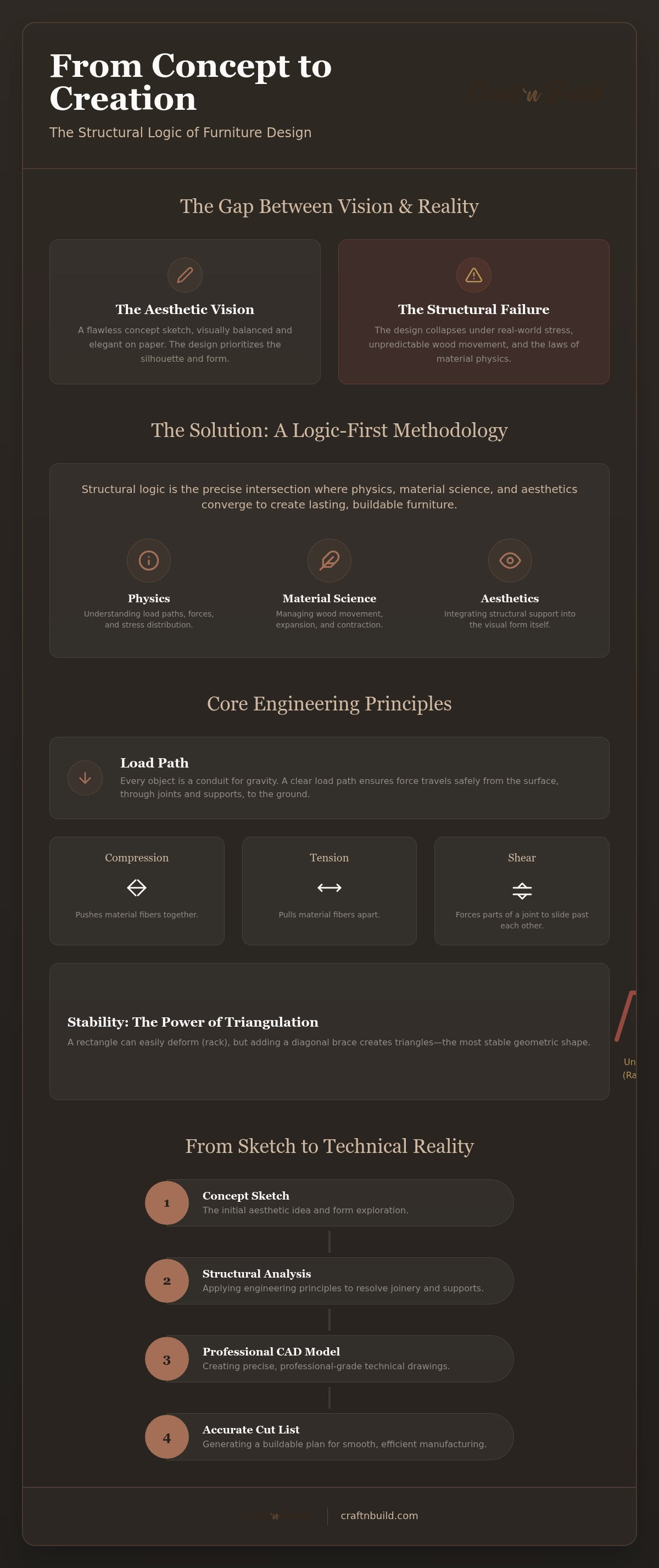
Furniture design is often mistaken for a purely aesthetic pursuit. While the visual silhouette captures the eye, the true value of a piece lies in its internal coherence. We define structural logic in furniture design as the precise intersection where physics, material science, and aesthetics converge. It is the invisible framework that dictates whether a design remains a functional object or becomes a structural failure. Without this foundation, a designer is merely decorating a surface rather than creating a lasting piece of interior architecture.
A beautiful sketch is often a liability. Without a resolved technical framework, an artistic concept remains a series of unanswered questions for the manufacturer. Relying on decorative thinking leads to designs that fail during production or, worse, in the client’s home. Shifting to a logic-first methodology allows you to anticipate stresses before they occur. This transition establishes your professional authority; makers respect a designer who understands the principles of furniture design and the practical constraints of the workshop. When the technical details are resolved early, the manufacturing phase becomes a smooth execution of your vision rather than a series of compromises.
Aesthetics vs. Structural Integrity
Visual balance does not always equate to physical stability. A cantilevered desk might look elegant on paper, but without calculating the center of gravity or the shear strength of the joinery, it's destined to tip or sag. Ignoring structural constraints during the early concept phase creates a technical debt that must be paid during manufacturing. Often, this results in clunky, last-minute additions like unsightly brackets or oversized supports that ruin the original aesthetic. True minimalist design succeeds only when the structural logic is so refined that the support is integrated into the form itself, allowing the piece to appear effortless while remaining incredibly strong.
The Designer as a Master Practitioner
To excel, you must adopt the mindset of a master practitioner. This requires moving beyond surface-level trends to embrace deep material knowledge and rigorous preparation. Understanding how a specific timber reacts to moisture or how a mortise and tenon joint distributes load isn't just technical detail; it's the foundation of your craft. This disciplined approach is a core pillar of The Design Key Full Master Programme. When you master these refined secrets, you're no longer just drawing furniture; you're engineering interior architecture. This knowledge empowers you to execute complex tasks with a sense of steady reliability and the quiet satisfaction that comes from structural integrity.
Core Engineering Principles: Load, Tension, and Compression
While many designers focus on where a piece of furniture sits within a room, the professional must prioritize how it stands up. This is the essence of structural logic in furniture design. Every object acts as a conduit for energy. Gravity exerts a constant downward force, and your design determines the specific path that force takes to reach the ground. If the path is interrupted or poorly conceived, the piece will eventually fail.
Understand the load path clearly. Weight travels from the horizontal surface, through the connection points, and down the vertical supports to the floor. Along this journey, the material experiences three primary forces: tension, compression, and shear. Compression pushes fibers together; tension pulls them apart. Shear forces attempt to slide one part of a joint past another. Mastering these forces is a cornerstone of any professional design curriculum, as it separates conceptual art from functional interior architecture.
Triangulation remains the silent hero of stability. A simple rectangle is prone to racking, a condition where the joints fold under lateral pressure. Adding a diagonal brace or a solid back panel creates triangles, which are geometrically incapable of changing shape without material failure. When calculating spans for shelving or seating, you must also account for deflection. A shelf that sags under its own weight fails the logic test before a single book is placed upon it. Use stiffeners or reduce the span to maintain a crisp, professional profile.
Gravity and the Human Scale
Static weight is only half the battle. You must design for dynamic loads. A chair doesn't just hold a person; it holds a person sitting down, leaning back, or shifting their weight. These movements multiply the force applied to joinery. Professional engineering requires generous safety margins. We don't design for the average user; we design for the extreme to ensure steady reliability over decades of use.
Structural Joints and Connection Points
Joinery serves as the critical logic point. It's the location where the load path is most vulnerable. While mechanical fasteners offer speed and ease of assembly, traditional wood-to-wood joinery often provides superior surface area for bonding and better long-term stability. You can dive deeper into these technicalities by exploring our guide on Furniture Joinery Design Principles. Developing this level of technical insight is what allows a designer to command the workshop floor. If you're ready to refine your methodology, consider exploring our interior design programs to master these engineering foundations.
Material Intelligence: Designing for Wood Movement and Stress
Timber is a biological material that never truly reaches a state of static rest. Unlike steel or glass, wood remains hygroscopic throughout its service life, constantly absorbing and releasing moisture to reach equilibrium with its environment. This cellular reality dictates the structural logic in furniture design. If you attempt to fight this movement with rigid joinery, the material will eventually self-destruct. Professionals don't resist these natural forces; they design systems that accommodate them.
Managing expansion and contraction is particularly critical in solid wood casegoods. A wide tabletop can fluctuate in width by several millimeters between seasons. If that top is glued or screwed tightly to a fixed frame, the internal stress will result in a catastrophic split. Engineered materials like plywood or MDF offer a stable alternative because their cross-laminated or composite structures neutralize movement. However, they lack the long-term structural span strength and repairability of solid timber. You must weigh these structural trade-offs against the intended service life and aesthetic requirements of the project.
Preventing Structural Failure
Common failure points, such as cracked tops or drawers that seize in the summer, are almost always the result of ignoring seasonal movement. To prevent these issues, you must implement "floating" components. Use Z-clips, desktop fasteners, or slotted screw holes that allow the wood to slide across the grain without losing its connection to the base. For certain projects, advanced stabilization techniques are required. Utilizing Ammonia Fuming of Hardwoods can alter the chemical composition of the timber, reacting with tannins to provide a unique finish while occasionally aiding in the long-term material characterization. Always ensure your technical documentation specifies these movement-tolerant details clearly for the workshop.
Technical Reference for Material Choice
Selecting the right species involves more than just picking a color. You must evaluate hardness versus flexibility based on the component’s function. A chair leg requires high compressive strength and impact resistance, whereas a curved backrest might prioritize a species with excellent steam-bending properties. Grain orientation also dictates strength. Tangential surfaces (flat-sawn) move more than radial surfaces (quarter-sawn), making the latter the superior choice for stable door stiles and drawer fronts. Wood movement is the primary variable in technical failure.
From Sketch to Technical Reality: Implementing Systematic Workflows
A sketch captures an idea, but a professional workflow validates it. Moving from a hand-drawn concept to a technical model is where you apply structural logic in furniture design. This phase isn't just about digitizing a shape; it's about interrogating every joint and material thickness. Systematic documentation ensures that your intent survives the transition to the workshop. Without this rigor, you're leaving the structural integrity of your work to chance or the interpretation of a maker who may not share your vision.
The cut list serves as the ultimate test of structural logic in furniture design. It's a precise inventory of every component required for assembly. If you cannot produce an accurate cut list, your design is likely unresolved. This document forces you to account for grain direction, joinery allowances, and material yields. Standardizing this documentation creates a bridge of trust between the designer and the workshop. It demonstrates that you've considered the reality of the build, which reduces errors and material waste.
CAD as a Tool for Structural Discovery
3D modeling is essential for resolving complex intersections that are impossible to visualize in 2D. CAD allows you to check for interference and simulate how weight travels through the frame. It's a virtual prototype. You can explore these technical standards by reviewing our Design Concepts in 3D CAD format. These resources show how to build models that serve as reliable blueprints for manufacturing, ensuring that your aesthetic vision remains buildable.
The Role of AI in Modern Design
AI is no longer a futuristic concept; it's a tool for technical accuracy. Beyond generating imagery, AI can automate the creation of technical specifications and preliminary cut lists. This automation allows you to focus on the creative "why" while the software handles the repetitive "how." To master these modern tools, explore our AI Implementation for Architects and Designers series. Adopting these workflows elevates your practice from enthusiast to professional practitioner.
To develop a repeatable, logic-first methodology for your own projects, join our professional interior design programs and master the transition from sketch to buildable reality.
Mastering the Design Key: Bridging the Gap to Professionalism
Many self-taught designers eventually encounter a technical ceiling. You might have a refined eye for color and form, but without a deep understanding of structural logic in furniture design, your ability to execute complex projects remains limited. This barrier often appears when a design requires intricate joinery or must support significant architectural loads. Breaking through this ceiling requires a shift from intuitive guessing to a disciplined, engineering-based methodology. It's the difference between being an enthusiast and an authoritative expert who can command a project from the initial brief to the final installation.
The Design Key provides this necessary framework. It isn't merely a collection of tips; it's a comprehensive curriculum for professional interior architecture. By adopting this system, you ensure that every element in a room is grounded in technical reality. Whether you're designing a custom kitchen island with heavy stone surfaces or built-in bedroom wardrobes with expansive spans, the same principles of logic apply. This systematic approach allows you to solve problems before they reach the workshop, providing the quiet satisfaction that only comes from knowing your work is structurally sound.
A Curriculum for Serious Designers
True mastery requires looking at the room as a whole. The Design Key series guides you through the critical technical layers that most designers overlook. You'll master floor plans, lighting, and ventilation, ensuring your furniture exists within a perfectly resolved environment. Moving from an amateur mindset to that of a professional practitioner means embracing these technical reference guides. To start this journey, explore The Design Key - Full Master Programme and begin building your professional foundation.
Your Next Steps in Design Mastery
Mastery is a choice. It requires you to adopt a rigorous methodology today to secure your success tomorrow. Don't settle for "good enough" when you can achieve structural integrity that lasts generations. Investing in professional-grade tools and knowledge is the most direct path to long-term success in this trade. Now is the time to refine your craft and bridge the gap between concept and buildable reality. Elevate your technical skills with our professional design programs and transform your practice into a disciplined, innovative design studio.
From Conceptual Vision to Structural Mastery
Mastering the structural logic in furniture design is the definitive step toward professional authority. By moving beyond surface-level aesthetics, you've learned to anticipate load paths, manage the biological reality of timber movement, and implement systematic technical workflows. These principles ensure that your creative vision isn't just a beautiful render; it's a buildable, enduring reality that commands respect in the workshop. True craftsmanship isn't found in the absence of constraints but in the disciplined resolution of them.
Your growth as a designer depends on adopting a rigorous methodology that bridges traditional skills with modern digital precision. Our curriculum provides master practitioner mentorship and professional-grade CAD concepts to help you break through the technical ceiling. You don't have to navigate these complexities alone. Master Professional Interior Architecture with The Design Key and gain access to a technical precision focused curriculum designed for serious innovators. Take the next step in your professional journey today and experience the quiet satisfaction of achieving total structural integrity in every piece you create.
Frequently Asked Questions
What is the core difference between furniture design and furniture engineering?
Design defines the aesthetic intent and user experience, while engineering focuses on the load paths and material limits that make the design viable. In a professional methodology, these are not separate phases. Engineering provides the technical "how" that allows the aesthetic "what" to function. Mastering this intersection ensures your creative concepts remain buildable and safe throughout their intended service life.
How does structural logic affect the cost of furniture manufacturing?
Applying structural logic in furniture design significantly reduces costs by eliminating manufacturing errors and material waste. While the initial technical resolution takes more time, it prevents expensive prototype failures and post-installation repairs. Precise documentation allows workshops to provide accurate quotes. It removes the uncertainty that often leads makers to increase prices for unresolved or risky designs.
Can I use AI to help with the structural logic of my furniture designs?
AI is an effective tool for automating technical specifications and simulating material stress. You can utilize AI to analyze load distribution or generate preliminary cut lists from 3D data. However, you must treat AI as a supportive assistant rather than a replacement for material knowledge. You still need to understand the underlying physics to validate and refine the AI's technical outputs.
Why is wood movement such a critical factor in professional furniture design?
Timber is a biological material that expands and contracts as it reaches equilibrium with environmental humidity. Ignoring this reality leads to cracked tops and seized drawers. Professional designers use floating joinery and slotted fasteners to accommodate this seasonal shift. This material intelligence prevents internal stresses from destroying the piece, ensuring long-term structural integrity regardless of the climate or setting.
What are the most common structural mistakes made by interior designers?
The most frequent errors include ignoring the center of gravity in cantilevered forms and failing to calculate deflection in long shelving spans. Many designers also overlook grain orientation, which is vital for component strength. These mistakes often result in furniture that appears stable in a 3D render but sags, tips, or fails once it's subjected to real-world dynamic loads.
Is it necessary to learn CAD to master structural logic?
CAD is an essential tool for resolving complex intersections and validating a design's internal logic. It functions as a virtual prototype where you can check for interferences and precise tolerances before any material is cut. While sketching is important for ideation, CAD provides the technical precision required to communicate with modern workshops and ensure your designs are manufactured accurately.
How do I create a professional furniture cut list from a concept sketch?
Begin by translating your concept sketch into a detailed 3D model where every part is a discrete object. Resolve all joinery within the model, accounting for tenon lengths and material thicknesses. Once the model is technically sound, extract the exact dimensions of each component. This systematic workflow ensures your cut list is a reliable blueprint that leads to a successful, error-free build.
Partners
Craft'n Build welcome affiliate marketers, https://craftnbuild.com/pages/affiliate-partner-programme-1


Share:
Interior Design Technical Guide: Structural Logic
Space Planning Methodology: A Professional Guide to Logical Layouts