




Article by
M. Skipper
Founder & Lead · Craft'n Build Creator Studio
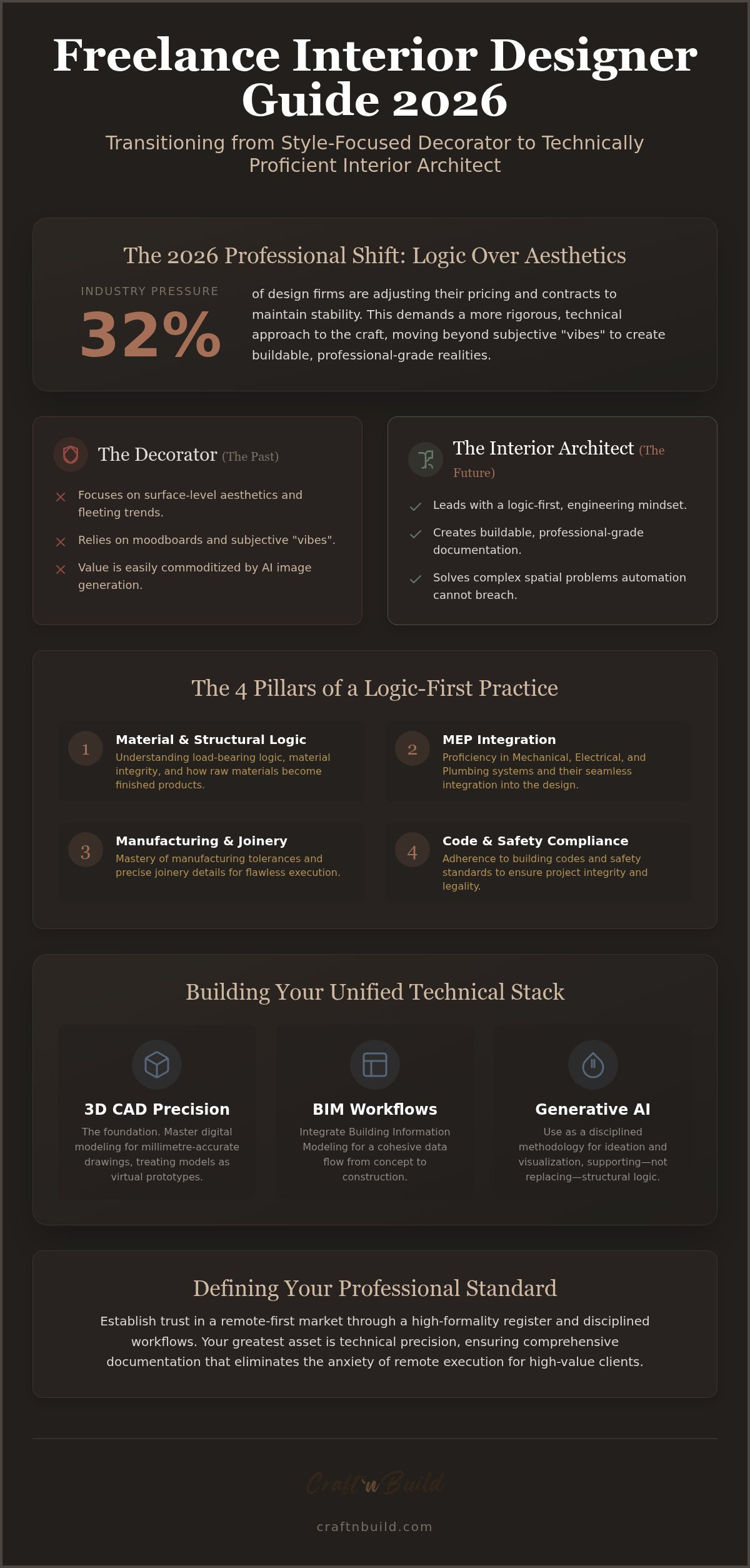
The distinction between an influencer with a moodboard and a professional designer has never been more stark. With 32% of design firms currently adjusting their pricing and contract terms to maintain stability, the industry is demanding a more rigorous, technical approach to the craft. This freelance interior designer guide 2026 serves as your roadmap to move beyond the surface. It's time to transition from a style-focused decorator to a technically proficient interior architect who leads with structural logic.
You already understand that "picking colors" isn't enough to command premium fees or ensure precision in a remote project environment. We'll show you how to master technical CAD workflows and integrate AI as a disciplined methodology for creating buildable, professional-grade documentation. This guide provides a clear progression from foundational principles to advanced digital execution. You'll learn how to build a sustainable practice that prioritizes technical rigour over fleeting trends, ensuring your work stands up to the scrutiny of contractors and high-value clients alike.
Key Takeaways
- Adopt a logic-first philosophy to transition from a style-focused decorator to a technically proficient interior architect.
- Use this freelance interior designer guide 2026 to master the integration of AI-driven workflows with professional CAD and BIM standards.
- Establish a high-fee professional practice by creating buildable, professional-grade project documentation that ensures structural integrity.
- Position your freelance brand as an authoritative expert to differentiate yourself from influencer-level decorators in a remote-first market.
- Identify the specific educational pathways, such as specialized kitchen and bathroom design, necessary for scaling your professional practice.
The 2026 Freelance Shift: From Decorator to Interior Architect
Aesthetic intuition is no longer a unique selling proposition. In a market saturated by AI-generated imagery, the ability to "pick a vibe" has become a commodity. This freelance interior designer guide 2026 advocates for a fundamental pivot: moving from the role of a surface-level decorator to that of a technically proficient interior architect. This shift requires a logic-first approach where every design decision is rooted in structural feasibility and manufacturing precision rather than subjective taste. You aren't just choosing a chair; you're specifying a component within a complex spatial system.
The distinction is profound. While a decorator might focus on the tactile qualities of a textile, an interior architect considers the structural logic of the joinery and the integration of mechanical systems. Interior design as a professional discipline demands more than just an eye for beauty; it requires an understanding of how raw materials are refined into finished products. You must learn to view furniture and space planning through the lens of engineering. This requires a mastery of several core pillars:
- Material integrity and load-bearing logic.
- Mechanical, electrical, and plumbing (MEP) integration.
- Manufacturing tolerances and joinery details.
- Building code compliance and safety standards.
Why Methodology Trumps Style in 2026
AI tools have democratized basic aesthetics. Today, clients can generate high-quality visualizations with minimal effort. Your value now lies in the "why" behind the "how." A logic-first mindset ensures that your designs aren't just beautiful images but buildable realities. Adopting a rigorous methodology allows you to solve complex spatial problems that software cannot yet navigate. To succeed, you must learn how to think like an interior designer, prioritizing technical reference and material knowledge over fleeting trends. This intellectual rigour builds a moat around your practice that simple automation cannot breach.
Defining Your Professional Standard
Establishing a disciplined workflow is essential for building trust in a remote-first market. Your practice should mirror the precision of high-end architectural studios. This means moving away from casual communication and toward a high formality register in both your documentation and client interactions. Technical precision is your greatest asset. This freelance interior designer guide 2026 emphasizes that your drawings must be accurate to the millimetre. When your project documentation is comprehensive, you eliminate the anxiety of remote execution. Professionalism in 2026 is defined by your ability to provide a clear, repeatable path to project success, grounded in structural logic and systematic refinement.
Building Your Technical Stack: CAD, AI, and Professional Workflows
Efficiency in the current market depends on a unified technical ecosystem. This freelance interior designer guide 2026 emphasizes that software must serve structural logic rather than marketing hype. Your stack should integrate Computer-Aided Design (CAD), Building Information Modeling (BIM), and generative AI into a single, cohesive workflow. This isn't about collecting tools; it's about establishing a rigorous digital environment where project data flows seamlessly from concept to construction. You must choose software that supports the systematic refinement of raw elements into finished products.
The Foundation: 3D CAD and Technical Precision
Professional freelancers must now master design concepts in 3D CAD format to remain competitive. The era of the 2D sketch as a primary deliverable has ended. Digital modeling provides the precision required for project feasibility and manufacturing accuracy. According to the Occupational Outlook Handbook, the ability to use specialized software to create technical drawings is a core requirement for modern designers. This transition ensures that your spatial solutions are grounded in physical reality.
Technical accuracy is the bedrock of client trust. If a drawing is imprecise, the project's structural integrity is compromised. You should treat your digital models as virtual prototypes. Every joint, material thickness, and clearance must be accounted for. Mastering these tools allows you to bridge the gap between creative vision and buildable reality, ensuring that your documentation meets the highest architectural standards. It's a move from decorative visualization to structural engineering.
AI as a Strategic Design Partner
Generative tools are often misunderstood as mere rendering shortcuts. True professional mastery involves AI implementation for design workflows that accelerate space planning and material iteration. Use AI to automate administrative tasks and generate rapid prototypes of complex layouts. This allows you to reclaim time for deep design thinking and material research.
You must maintain the human "Design Key" throughout the process. Don't let the software dictate the logic; use it to test your own structural hypotheses. This strategic integration increases your project capacity without diluting the quality of your output. It's about refinement rather than replacement. Following this freelance interior designer guide 2026 will help you create a system where AI handles the data while you handle the architectural intent. As you refine your technical stack, consider how advancing your professional design education can further sharpen your competitive edge. A disciplined innovator knows that the tool is only as effective as the methodology behind it.
The Business of Design: Project Documentation and Methodology
Professional documentation is the tangible evidence of your technical expertise. It transforms a creative vision into a contractual reality that contractors and manufacturers can follow with precision. This freelance interior designer guide 2026 emphasizes that your output must be more than just visually appealing; it must be buildable. Every project should begin with a rigorous Brief, a foundational document that dictates the structural and functional requirements of the space. Without this anchor, the design process lacks the necessary constraints to produce a professional result.
Utilizing professional interior design project templates ensures that no technical detail is overlooked. These frameworks provide a repeatable methodology that mirrors the standards of established architectural firms. Organizations like the American Society of Interior Designers (ASID) advocate for these high standards of practice to maintain the integrity of the profession. When your documentation is thorough, you reduce the risk of onsite errors and establish yourself as a reliable partner in the construction process.
Mastering the Floor Plan and Space Planning
Successful space planning is rooted in the "hidden math" of a room. You must apply systematic logic to layouts, ensuring that circulation, ergonomics, and clearances are mathematically sound. Using The Floor Plan Design Key allows you to translate abstract concepts into accurate technical drawings. Contractors respect a designer who understands the physical requirements of a build. Focus on the structural logic of the layout. Every wall placement and furniture orientation should serve a functional purpose that enhances the inhabitant's experience while respecting the building's shell.
Developing Professional Moodboards and Palettes
A moodboard shouldn't be a simple collage of "vibes" found on social media. It's a technical communication tool used to convey material knowledge and tactile intent. Move beyond superficiality by using professional moodboard templates that organize your thoughts into a coherent narrative. This systematic approach extends to your color choices. Developing colour systems and professional palettes requires an understanding of light reflectance values and material chemistry. Your digital presentations must communicate the weight, texture, and durability of your selections. This level of detail reassures clients that your aesthetic choices are backed by structural logic and material expertise.
Client Acquisition and Management in a Remote-First Market
Positioning yourself as an authoritative expert is the only way to survive a market where 39% of firms are now aggressively pivoting toward new client acquisition strategies. This freelance interior designer guide 2026 suggests that your brand should function as a disciplined guide for the serious-minded client. A discovery call shouldn't be a casual conversation about aesthetic "vibes." It's a technical audit. Ask about structural constraints, mechanical integration, and load-bearing requirements. This immediate focus on precision filters out low-value leads and establishes your respect for the craft from the first minute.
You must decide between the "Do It With You" (DIWY) and Full-Scope Virtual models. The DIWY model focuses on technical coaching and strategic consultation, while the Full-Scope model provides the comprehensive documentation required for a complete build. Regardless of the model, you must establish a steady, purposeful communication rhythm. Avoid the trap of constant, frantic messaging. Instead, adopt a methodical schedule of updates that reassures the client of your progress and structural integrity. This disciplined approach builds a foundation of reliability that justifies premium fees.
Building a Portfolio of Methodology, Not Just Photos
Show your workings. A portfolio filled only with polished "after" photos suggests you're a decorator. To be seen as an interior architect, you must include technical drawings, 3D CAD models, and detailed joinery sections. Case studies should highlight specific problem-solving scenarios where you applied structural logic to overcome a spatial hurdle. When you demonstrate the "why" behind a design choice, you're not just selling a look; you're selling a systematic refinement process. This transparency is vital for justifying high-end project rates in 2026.
Remote Project Logistics and Installation
Coordinating with trades from a distance requires a level of detail that leaves no room for interpretation. Your digital assets are the only bridge between your design and the physical installation. This is where the use of comprehensive technical reference guides becomes mandatory. These documents provide contractors with the exact specifications needed to execute your vision without you being on-site. Precision in your documentation eliminates the anxiety of remote execution and ensures the final product meets your rigorous standards. To master these high-level methodologies, you can advance your professional practice with our comprehensive design programs.
Scaling Your Practice with Professional Education
Stagnation is the greatest risk in a shifting market. This freelance interior designer guide 2026 identifies continuous learning as the primary driver of career longevity. You can't rely on the skills of yesterday to solve the technical challenges of tomorrow. Investing in a professional interior architecture curriculum provides a measurable return on investment by allowing you to command higher fees for specialized knowledge. Transitioning from a generalist to a specialist is a strategic move that separates you from the noise. Mastering Kitchen Design or Bathroom Design positions you as an expert in high-complexity zones that demand rigorous technical precision.
Niche Specialisation: The Path to Premium Fees
Specialization allows you to move beyond the competitive middle market where aesthetic "vibes" are common. By mastering specific modules like Lighting Design or Ventilation, you offer a level of technical depth that generalists cannot match. This expertise is further enhanced by deep material knowledge. Understanding specialized processes, such as the Ammonia Fuming of Hardwoods, demonstrates a reverence for craftsmanship and structural integrity. Clients seek out designers who understand the physical and chemical properties of the materials they specify. Building a reputation for technical excellence in specific room types creates a sustainable practice built on mastery rather than marketing hype.
Commitment to Mastery
Adopting the mindset of a disciplined innovator is the final step in your professional evolution. It's about finding the quiet satisfaction that comes from structural integrity and refined execution in every project. The Design Key - Full Master Programme provides the ultimate freelance roadmap for those serious about this transition. It bridges the gap between traditional manual skills and modern digital tools, offering a structured path to success. Don't settle for superficiality in a market that rewards precision. Embark on your professional journey with Craft'n Build and transform your practice into a logic-first interior architecture studio today.
Master the Architecture of Your Practice
Building a sustainable business in this evolving market requires a commitment to technical rigour. This freelance interior designer guide 2026 has outlined the essential shift from aesthetic intuition to structural logic. By mastering 3D CAD concepts and integrating professional AI frameworks, you create a moat around your practice that simple automation cannot replicate. Your value lies in the systematic refinement of raw materials into buildable, architectural realities. It is about the quiet satisfaction of creating something that is both beautiful and structurally sound.
True mastery is a journey of disciplined innovation. It's time to move beyond the surface and establish a practice grounded in authentic architectural methodology. You have the potential to deliver high-level results that contractors respect and clients trust. Master professional interior architecture with The Design Key Full Master Programme and gain access to professional-grade technical references and comprehensive AI implementation workflows. The path to a high-fee, professional practice is through the mastery of the craft. Your evolution begins with a single, purposeful step toward expertise. We're here to guide you through every technical refinement.
Frequently Asked Questions
Do I need a degree to be a freelance interior designer in 2026?
While legal requirements vary by region, a degree isn't the only path to a professional practice. In 2026, the market prioritizes technical mastery and a logic-first methodology over traditional credentials alone. Clients seek designers who can provide buildable documentation and structural precision. Success often depends on adopting a rigorous curriculum that bridges the gap between manual skills and digital tools, ensuring your work meets architectural standards.
What is the best software for freelance interior designers starting out?
Professional designers should focus on a stack that supports 3D CAD and BIM integration. AutoCAD remains the industry standard for technical drafting, while SketchUp Pro or Revit are essential for modeling. For those following a freelance interior designer guide 2026, integrating AI implementation tools for rapid iteration is equally vital. Avoid software that only offers decorative visualization; prioritize tools that allow for the systematic refinement of raw elements into finished products.
How do I set my fees as a freelance interior designer?
You should move away from purely hourly rates and toward value-based or flat-fee pricing for specific room types. In 2026, many professionals charge between $150 and $500 per hour depending on expertise, but flat fees for design-only services offer more transparency. Base your fees on the technical complexity of the project and the level of documentation provided. Professionals who lead with structural logic and technical reference often command significantly higher project rates.
Can I really run a full interior design project remotely?
Yes, remote project execution is a standard practice in 2026 when supported by precise technical documentation. You must provide contractors with comprehensive technical reference guides and 3D CAD concepts to eliminate ambiguity. Digital assets serve as the primary bridge between your design and the physical site. Success depends on a disciplined communication rhythm and a rigorous methodology that ensures every clearance and material specification is accurate to the millimeter.
How do I find clients for my freelance design business in 2026?
Finding high-value clients requires a portfolio that demonstrates your methodology rather than just aesthetic results. Use your website as a sales system that explains your logic-first approach and technical precision. Digital marketing strategies like SEO and targeted social media are essential for building a consistent lead flow. Position yourself as an authoritative expert guide who solves complex spatial problems, rather than a decorator who simply selects furniture and colors.
What is the difference between an interior designer and an interior architect in a freelance context?
The distinction lies in the level of technical involvement and structural logic applied to the space. An interior designer often focuses on the tactile and aesthetic layers of a room. In contrast, an interior architect addresses the structural integrity, mechanical systems, and manufacturing tolerances of the environment. In a freelance interior designer guide 2026 context, shifting toward an architectural methodology allows you to handle complex renovations and work more effectively with building contractors.
How is AI changing the freelance interior design industry in 2026?
AI is shifting the designer's role from manual drafting to strategic oversight and rapid iteration. It has democratized basic aesthetics, making your technical expertise and material knowledge more valuable. Use AI implementation for design workflows to automate administrative tasks and test spatial hypotheses quickly. This technology allows you to increase project capacity while maintaining a focus on deep design thinking and the refinement of complex structural elements through systematic logic.
What should be included in a professional interior design project proposal?
A professional proposal must move beyond a simple price quote to outline a structured project trajectory. It should include a clear Brief, a detailed scope of work, and a timeline for technical deliverables like floor plans and elevations. Specify the professional project templates you'll use to ensure consistency across the workflow. Your proposal should communicate your methodology and respect for craftsmanship, reassuring the client that you have a proven, repeatable path to success.
Partners
Craft'n Build welcome affiliate marketers, https://craftnbuild.com/pages/affiliate-partner-programme-1


Partager:
How to Start an Interior Design Business: A Professional Architectural Framework
Creating a Professional Interior Design Portfolio: A Framework for Interior Architects