



Artikel af
M. Skipper
Grundlægger og kreativ leder · Craft'n Build Creator Studio
Hvad nu, hvis de timer, du bruger på at kuratere æstetiske moodboards, i virkeligheden fjerner dig fra en legitim karriere inden for design? Det er en svær sandhed at se i øjnene, når du brænder for stil, men branchen i 2026 kræver mere end et godt farveøje. Du spørger sandsynligvis: Er et kursus i indretning pengene værd på et marked, der værdsætter teknisk præcision højere end simpel æstetik? Virkeligheden er, at kløften mellem en hobbyudsmykker og en professionel interiørarkitekt aldrig har været større. Udsmykning fokuserer på overfladen, mens ægte design kræver en dyb forståelse af strukturel logik, bygningsreglementer og teknisk udførelse.
Du føler sandsynligvis presset for at mestre kompleks software, samtidig med at du frygter, at dine færdigheder kan blive forældede, før du overhovedet bliver færdiguddannet. Vi forstår den tøven. Denne artikel skræller overfladiskheden væk fra kurser i "livsstil" for at undersøge fagets professionelle virkelighed. Du vil opdage, hvordan du opbygger en gentagelig arbejdsgang, der integrerer AI som et værktøj til effektivisering snarere end en erstatning for kreativitet. Ved at fokusere på teknisk CAD-kompetence og ingeniørprincipper kan du omdanne din passion til en fremtidssikret karriere, der aftvinger respekt og leverer resultater i den virkelige verden.
Vigtigste pointer
- Skeln mellem overfladisk udsmykning og professionel interiørarkitektur for at sikre, at din uddannelse opbygger strukturel logik frem for blot æstetisk sans.
- Afgør, om et kursus i indretning er pengene værd, ved at vurdere, om pensum prioriterer teknisk CAD-kompetence og virkelighedsnære ingeniørprincipper.
- Mestr overgangen fra traditionelle manuelle færdigheder til moderne digitale værktøjer gennem en disciplineret, logikbaseret professionel metode.
- Fremtidssikr din karriere ved at lære, hvordan implementering af AI kan automatisere administrative arbejdsgange og samtidig udbygge din unikke designfaglighed.
- Få selvtillid til at gennemføre komplekse projekter ved at indføre en gentagelig arbejdsgang, der bygger bro mellem konceptuel idéudvikling og teknisk udførelse.
Æstetikmyten: Hvorfor indretning er mere end stil
Mange håbefulde designere tror, at en medfødt sans for stil er deres største fordel. Det er en almindelig misforståelse. Selvom æstetisk intuition er værdifuld, er den blot det yderste lag i en kompleks disciplin. En omfattende oversigt over indretning viser, at faget rummer langt mere end blot farvepaletter og stofprøver. Det kræver en dyb forståelse af menneskelig adfærd, bygningsreglementer og strukturel logik. Hvis du overvejer, om et indretningskursus er pengene værd for din karriere, afhænger svaret ofte af, om pensum lærer dig at se under overfladen. Den sande professionelle værdi findes ikke i et moodboard. Den findes i evnen til at løse rumlige problemer gennem teknisk stringens.
Indretning vs. indretningsarkitektur
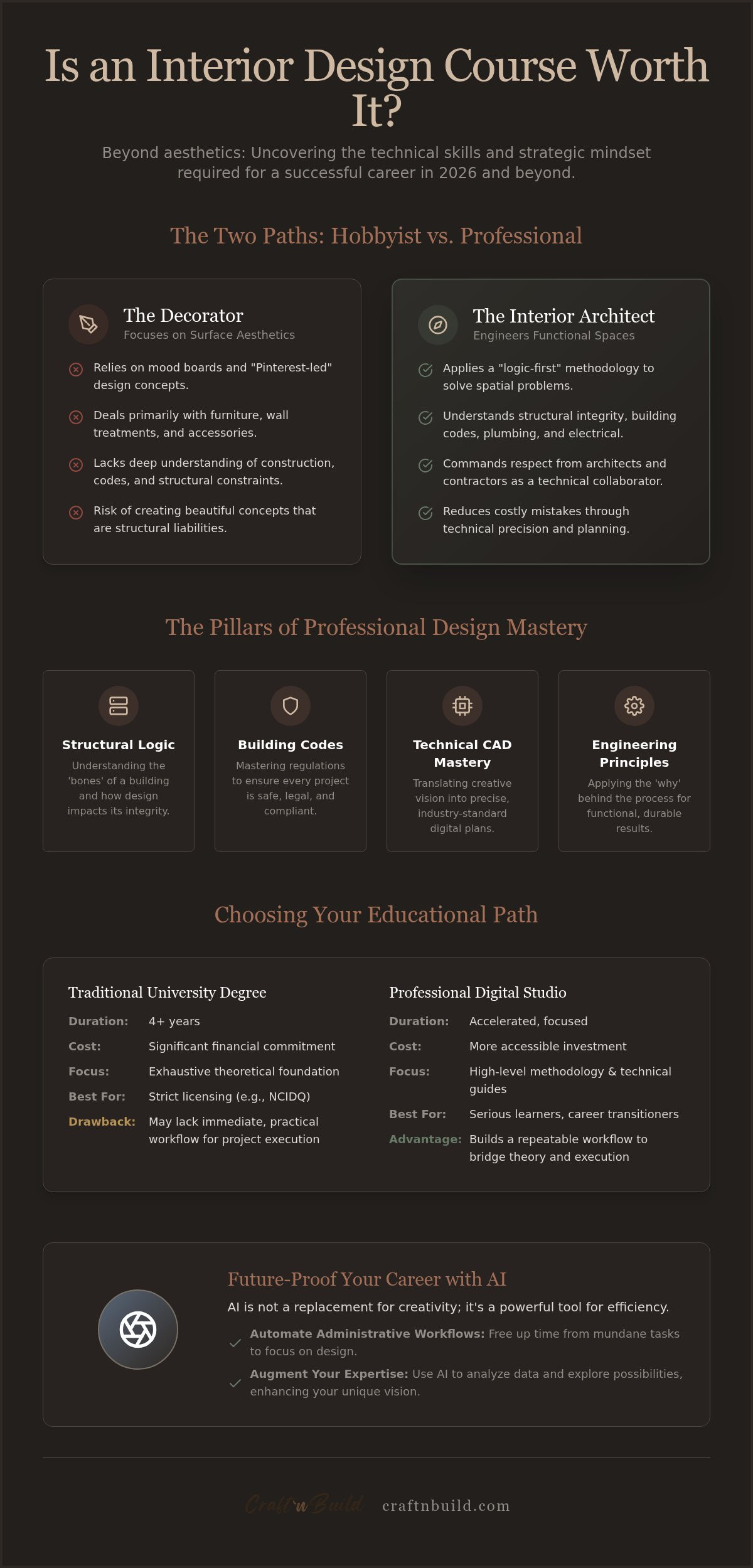
Indretning fokuserer på "stylingen" af et rum. Det handler om møbler, vægbeklædninger og tilbehør. Indretningsarkitektur beskæftiger sig derimod med et rums strukturelle integritet og funktionelle ydeevne. Fagfolk skal tage højde for elektricitet, VVS og begrænsninger i forbindelse med bærende konstruktioner, før de overhovedet overvejer en malingsfarve. At basere design på "Pinterest" er en farlig vej i virkelighedens byggeri. Uden teknisk viden kan et smukt koncept hurtigt blive en konstruktionsmæssig belastning eller en overtrædelse af bygningsreglementet. Et professionelt kursus bør bygge bro over denne kløft. Det skal bevæge sig ud over valg af møbler og ind i arkitektonisk logik.
Investeringsafkastet af teknisk viden
Teknisk præcision er den mest effektive måde at reducere kostbare fejl på under gennemførelsen af et projekt. Når du forstår, hvordan en væg er opbygget, eller hvordan belysningskredsløb fungerer, opnår du respekt hos arkitekter og entreprenører. De har ikke brug for en stylist. De har brug for en samarbejdspartner, der forstår byggemekanikken. En tilgang, hvor "logikken kommer først", sikrer, at hvert designvalg understøttes af funktionelle nødvendigheder. Denne tilgang er grundlaget for et professionelt investeringsafkast. Hvis du virkelig vil udmærke dig, skal du lære at tænke som en indretningsarkitekt ved at prioritere metodik frem for flygtige trends. Et indretningskursus er kun pengene værd, hvis det giver dig den tekniske dybde, der kræves for at lede en byggeplads med autoritet.
Sammenligning af uddannelsesveje: Uddannelse vs. online-studie
At vælge det rigtige uddannelsesforløb er en strategisk beslutning, der fastlægger din professionelle udvikling. Du skal vurdere, om et indretningskursus er pengene værd, baseret på de specifikke færdigheder, du ønsker at tilegne dig. Traditionelt var branchen opdelt mellem flerårige universitetsuddannelser og overfladiske hobbycertifikater. Fremkomsten af modellen Professional Digital Studio har imidlertid skabt et mellemtrin for dem, der værdsætter teknisk dybde højere end institutionel prestige. Denne vej er udformet til den seriøse kursist, der kræver en avanceret metodik uden overflødighederne i et traditionelt akademisk skema.
Den traditionelle uddannelsesvej
En fireårig uddannelse giver et omfattende teoretisk fundament. Den er fortsat den primære vej for dem, der søger NCIDQ-certificering eller arbejder i stater, hvor autorisation er strengt reguleret. Den økonomiske forpligtelse er dog betydelig. Når man analyserer karrieremulighederne for indretningsdesignere, står den gennemsnitlige årsløn på cirka 60.000 $ ofte i skarp kontrast til de høje studieafgifter. Studerende dimitterer ofte med en stor mængde abstrakt viden, men mangler den praktiske, gentagelige arbejdsgang, der kræves for straks at kunne gennemføre projekter. I moderne designfirmaer er færdigheder altafgørende. En portefølje, der demonstrerer teknisk kunnen, vejer ofte tungere end et stykke papir.
Fordelen ved Professional Digital Studio
Seriøse kursister, der allerede arbejder i branchen eller skifter fra beslægtede fagområder, oplever ofte, at universiteternes tidsplaner er for langsomme. Hobbykurser giver derimod ikke den strukturelle logik, der er nødvendig for byggeri i den virkelige verden. Modellen Professional Digital Studio fokuserer på avanceret metodik og tekniske referencevejledninger. Programmer som The Design Key - Full Master Programme bygger bro over dette gab ved at tilbyde et struktureret pensum, der logisk bevæger sig fra grundlæggende begreber til specifikke anvendelser. Denne vej prioriterer processens "hvorfor" og sikrer, at du forstår de ingeniørmæssige principper, der understøtter din kreative vision.
Effektivitet er kendetegnet for en professionel. Hvis dit mål er at gennemføre projekter med selvtillid og strukturel integritet, har du brug for et pensum, der afspejler en professionel arbejdsgang. Du behøver ikke årsvis af teori for at lære at udarbejde en teknisk plantegning; du har brug for en stringent metodik. For dig, der er klar til at bevæge dig ud over det grundlæggende, kan det at udforske avancerede designuddannelser give dig den tekniske fordel, der er nødvendig for at konkurrere på et overfyldt marked. Denne målrettede tilgang gør et indretningskursus pengene værd ved at sikre, at din investering giver et direkte afkast i form af fakturerbare professionelle færdigheder.
Teknisk kunnen: Den skjulte værdi i designuddannelse
Software er blot en digital blyant. Mange begyndere forveksler softwarefærdigheder med designekspertise, men et værktøj er kun så effektivt som den logik, der styrer det. Hvis du overvejer, om et kursus i indretning er pengene værd, bør du se på undervisningsplanens tekniske dybde. Du har brug for et program, der behandler 3D-CAD som en forlængelse af ingeniørmæssige principper. Det er nemt at lære knapperne i et program. At lære, hvorfor en bestemt samling er nødvendig for at understøtte en tung bordplade af sten, er kendetegnet på en professionel fagperson. Det er denne tekniske kunnen, der adskiller dem, der blot dekorerer, fra dem, der skaber innovation.
Når man ser på jobmulighederne for indretningsdesignere, er det tydeligt, at branchen værdsætter dem, der kan omsætte kreative visioner til brugbar projektdokumentation. Professionelle skabeloner og standardiserede arbejdsgange er de bedst lønnede designeres hemmelige våben. De sikrer ensartethed og forhindrer, at man bliver stemplet som "amatør", når man præsenterer sit arbejde for entreprenører eller luksusejendomsudviklere som Pimlico Homes. Uden et system til gentagelig dokumentation gætter du dig blot frem. En struktureret uddannelse giver de tekniske referencevejledninger, der er nødvendige for at gennemføre projekter fra den virkelige verden med autoritet og stabil pålidelighed.
Præcision i teknisk tegning
En plantegning er mere end en tegning. Det er et teknisk og ofte juridisk dokument, der bestemmer, hvordan et rum fungerer, og hvordan det skal bygges. Overgangen fra løse skitser til professionel dokumentation kræver en stringent tilgang. Ved at mestre metoden The Floor Plan Design Key lærer du at kommunikere præcist. Det handler ikke om at få tingene til at se pæne ud på papir. Det handler om at sikre, at hver væg, dør og stikkontakt placeres med et strukturelt formål. Når du afleverer et sæt tegninger til en byggeleder, repræsenterer disse linjer dit professionelle omdømme. De skal være fejlfri og logisk gennemarbejdede.
Strukturel logik i møbler og snedkerarbejde
Fremtidssikring: AI og moderne designarbejdsgange
Frygten for, at AI vil gøre kreative fag overflødige, er udbredt, men også i høj grad misforstået. AI erstatter ikke designeren. Det erstatter den fagperson, der mangler en stringent metode. I 2026 afhænger spørgsmålet om, hvorvidt et interiørdesignkursus er det værd, af dets evne til at lære dig at styre disse digitale værktøjer. Hvis et pensum ignorerer AI, forbereder det dig på en fortid, der ikke længere findes. Hvis det lærer dig at integrere AI i en professionel arbejdsgang, giver det dig en konkurrencemæssig fordel. Det giver dig mulighed for at fokusere på arkitektur på højt niveau frem for gentagne administrative opgaver.
Faget bliver stadig mere teknisk. Designere, der anlægger en logikbaseret tilgang, ser AI som en partner i præcision. Det er en måde at styrke menneskelig kreativitet på ved at automatisere de datatunge dele af projektstyringen. Denne overgang kræver en disciplineret tilgang til at lære nye systemer, samtidig med at man bevarer en dyb respekt for traditionelt håndværk. Du skal lære at bygge bro mellem manuelle færdigheder og moderne digital udførelse for at forblive relevant på et marked i hastig udvikling.
AI som accelerator for arbejdsgange
AI fungerer som en effektiv accelerator for arbejdsgange. Professionel indsigt tyder på, at implementering af AI kan automatisere cirka 40 % af de administrative opgaver og idéudviklingen. Det omfatter blandt andet generering af indledende moodboards ud fra tekstprompter og optimering af plantegninger baseret på specifikke parametre. Ved at benytte AI-implementering for arkitekter og designere går du fra at være manuel tegner til at blive designansvarlig. Du bruger mindre tid på det tekniske tegningsarbejdes "hvordan" og mere tid på designets "hvorfor". Dette skift er afgørende for at forblive konkurrencedygtig. Det sikrer, at du kan levere resultater af høj kvalitet i et tempo, der imødekommer moderne kunders forventninger.
Den centrale menneskelige værdi: Design Thinking
En designers kerneværdi er fortsat forankret i "Design Thinking". Selvom AI kan optimere en planløsning, kan den ikke efterligne menneskelig empati eller den nuancerede logik i rumlig planlægning. Et stringent kursus skærper de beslutningsevner, som algoritmer ikke kan efterligne. Det lærer dig at forstå materialernes taktile egenskaber og den følelsesmæssige resonans i et fysisk rum. For at mestre denne balance skal du tage et kursus i indretningsmetodik, der prioriterer professionel logik. AI er et værktøj, ikke en erstatning for din visions strukturelle integritet. Ægte mestring kommer af at vide, hvordan du styrer maskinen med menneskelig hensigt.
For at opbygge en fremtidssikret karriere skal du anvende en metode, der udnytter moderne værktøjer uden at ofre teknisk dybde. Udforsk vores omfattende uddannelsesprogrammer i indretning for at mestre samspillet mellem menneskelig kreativitet og digital innovation.
Konklusion: Er The Design Key den rigtige investering for dig?
At afgøre, om et kursus i indretning er det værd, kræver et grundlæggende perspektivskifte. Du må bevæge dig væk fra idéen om uddannelse som en samling æstetiske tips og hen imod opfattelsen af en stringent professionel metode. En investering, der er pengene værd, giver mere end inspiration; den leverer teknisk dybde, strukturel logik og effektiv arbejdsgang. På det nuværende marked er det de designere, der kan gennemføre komplekse projekter med arkitektonisk præcision, som opnår den største respekt og de højeste honorarer. Craft'n Build-programmerne er specifikt udviklet til den seriøse studerende, der værdsætter den stille tilfredsstillelse ved at mestre faget højere end overfladisk styling. Ægte uddannelse er investeringen værd, når den lærer dig at tænke dig gennem et rumligt problem i stedet for blot at fortælle dig, hvad du skal vælge fra et katalog.
Succes på dette område er ikke et resultat af held eller af "at have øje for det". Det er resultatet af en disciplineret, gentagelig proces. Ved at anlægge en logikbaseret tilgang sikrer du, at din kreative vision altid understøttes af strukturel integritet. Denne tilgang ændrer den måde, du samarbejder med entreprenører, arkitekter og kunder på. Du holder op med at være en stylist, der anmoder om ændringer, og bliver i stedet en professionel, der styrer forfinelsen af rå elementer til et færdigt produkt. Denne grad af autoritet kan kun opnås gennem en forpligtelse til dybdegående materialekendskab og teknisk præcision.
Evaluering af dine karrieremål
Du skal beslutte, om du forfølger en kreativ hobby eller opbygger et professionelt arkitektonisk fundament. Der er en klar forskel mellem et almindeligt "kursus" og en "professionel ramme". Et kursus viser dig måske, hvordan du kombinerer teksturer i lag, men en ramme giver en systematisk tilgang til projektdokumentation og byggepladsstyring. For dem, der søger branchestandarden for 2026, tilbyder The Design Key en struktureret vej, der bygger bro mellem traditionelle manuelle færdigheder og moderne digitale værktøjer. Det er et disciplineret miljø for dem, der er klar til at gennemføre projekter fra den virkelige verden med fuld sikkerhed. Hvis dit mål er at blive førende i branchen, har du brug for en uddannelse, der prioriterer teknisk investeringsafkast.
Næste skridt for seriøse designere
Ekspertise opbygges gennem en logisk progression af færdigheder. Hvis du ikke er klar til et komplet masterprogram, kan du begynde med specialiserede moduler, der tager hånd om specifikke tekniske udfordringer. Overvej at forfine din ekspertise med et kursus i køkkendesign eller mestre belysningens nuancer gennem serien The Lighting. Disse målrettede investeringer giver dig mulighed for at opbygge et teknisk referencebibliotek, samtidig med at du hurtigt kan se resultater i din professionelle arbejdsgang. Forpligt dig til en disciplineret tilgang i dag. Hvert projekt, du udfører, afspejler din underliggende metodik. Sørg for, at din er bygget på et fundament af strukturel integritet og professionel grundighed. Se professionelle programmer i indretningsdesign for at begynde din overgang fra dekoratør til arkitektonisk designer.
Styrkelse af din professionelle praksis
At gå fra en hobbypræget tilgang til et professionelt arkitektonisk fundament er den eneste måde at sikre langtidsholdbarhed på i 2026. Du har opdaget, hvordan teknisk tegning og strukturel logik udgør rygraden i en succesfuld karriere. Ved at integrere AI som en accelerator i arbejdsgangen snarere end en erstatning for design tænkning placerer du dig selv i branchens frontlinje. Dette skift fra at vælge finish til at designe systemer er det, der definerer den moderne ekspert.
Et kursus i indretning er kun pengene værd, når det går videre end overfladisk æstetik og giver en gentagelig, professionel ramme. Vores masterpensum anvendes af professionelle arkitekter og designere, som kræver teknisk præcision og CAD-koncepter på professionelt niveau. Gennem omfattende vejledninger i AI-implementering og et fokus på ingeniørprincipper hjælper vi dig med at gennemføre komplekse projekter med fuld sikkerhed. Du opnår færdighederne til pålideligt at bygge bro mellem traditionelt manuelt håndværk og moderne digital innovation.
Mestr den professionelle metode med vores indretningsprogrammer. Ekspertise er et bevidst valg. Anlæg en logikbaseret tilgang i dag, og opbyg en karriere, der er kendetegnet ved konstruktiv integritet og den stille tilfredsstillelse ved ægte håndværk.
Ofte stillede spørgsmål
Er et certifikat i indretning nok til at få et job?
Et certifikat kan sikre begynderstillinger inden for styling eller detailhandel, men professionelle arkitektstillinger kræver dybere tekniske kompetencer. I 2026 er indretning et reguleret område i 31 delstater, hvor der ofte kræves bestemte uddannelsesmæssige kvalifikationer for at arbejde selvstændigt. Arbejdsgivere prioriterer en portfolio, der demonstrerer en stringent metode og evnen til at udarbejde teknisk dokumentation på professionelt niveau, frem for et simpelt gennemførelsescertifikat.
Kan jeg selv lære indretning uden at tage et kursus?
Du kan selv lære indretningens overfladiske æstetik, men teknisk design kræver struktureret vejledning. Selvlærte mangler ofte en grundlæggende forståelse af bygningsreglementer, konstruktionsprincipper og elektriske systemer. Et professionelt kursus giver det disciplinerende pensum, der er nødvendigt for at mestre komplekse ingeniørprincipper. Uden denne formelle uddannelse risikerer du at begå kostbare fejl i virkelige byggemiljøer.
Hvad koster et professionelt kursus i indretning i 2026?
Omkostningerne varierer afhængigt af, hvor omfattende en uddannelse du vælger. En online bacheloruddannelse koster typisk mellem 36.000 og 91.000 USD i samlet studieafgift. Specialiserede onlinebaserede erhvervsuddannelser koster ofte fra cirka 990 EUR til flere tusinde dollars. Vurder, om et kursus i indretning er pengene værd, ved at sammenligne den tekniske dybde og CAD-kompetence, du opnår, med det potentielle investeringsafkast i din karriere.
Hvad er forskellen mellem indretning og indretningsarkitektur?
Indretning fokuserer på et rums funktionelle og æstetiske oplevelse, mens interiørarkitektur omhandler den strukturelle logik i bygningens indre. Arkitektur kræver håndtering af bærende konstruktioner, VVS-installationer og ventilationssystemer. Det kræver en logikbaseret tilgang og evnen til at udarbejde tekniske CAD-koncepter. Design beskæftiger sig ofte med videreudviklingen af disse rum gennem materialer, farvesystemer og valg af møbler.
Vil AI erstatte indretningsdesignere i de næste par år?
AI vil ikke erstatte designere, der anvender en professionel metode; det vil erstatte dem, der udfører gentagne administrative opgaver. Du kan bruge AI til at automatisere op til 40 % af din arbejdsgang, herunder generering af moodboards og teknisk informationssøgning. Den centrale menneskelige værdi ligger i designtænkning og rumlig empati. Det er egenskaber, som algoritmer ikke kan genskabe i komplekse, stedsspecifikke arkitektoniske projekter.
Er en uddannelse bedre end et online professionelt kursus?
En uddannelse er den traditionelle vej og kræves ofte til specifikke licenser og NCIDQ-certificering. Et online professionelt kursus fra et digitalt studie tilbyder dog ofte mere praktisk træning i moderne arbejdsgange. Hvis du prioriterer teknisk kunnen og øjeblikkelig projektudførelse frem for institutionel prestige, kan et specialiseret kursus være den bedre investering. Dit valg bør stemme overens med dine specifikke juridiske krav og karrieremål.
Hvilke færdigheder er vigtigst for en professionel indretningsdesigner?
Teknisk tegning, 3D-CAD-kompetencer og materialekendskab er de vigtigste færdigheder for professionelle designere. Du skal forstå, hvordan hårdttræ reagerer på luftfugtighed, og hvordan samlinger understøtter strukturelle belastninger. Præcis dokumentation sikrer, at din vision omsættes korrekt på byggepladsen. En succesfuld fagperson forener disse tekniske ingeniørfærdigheder med en raffineret æstetisk intuition og tydelig kommunikation.
Hvor lang tid tager det at gennemføre et professionelt designprogram?
Traditionelle bacheloruddannelser kræver fire års fuldtidsstudier for at blive gennemført. Professionelle digitale programmer tilbyder større fleksibilitet og giver ofte seriøse studerende mulighed for at mestre specifikke tekniske moduler på seks til tolv måneder. Tidsrammen afhænger af pensumdybden og din eksisterende brancheerfaring. Prioritér programmer, der bygger logisk fra grundprincipper til avanceret udførelse, så du opnår en grundig forståelse af faget.
Partnere
Craft'n Build byder affiliate-marketingfolk velkommen, https://craftnbuild.com/pages/affiliate-partner-programme-1


Del:
Kursus i indretningsmetodik: Beherskelse af professionel logik og arkitektur
Onlinekurser i indretningsdesign: Aflivning af myterne om æstetisk intuition