




THE DESIGN KEY SERIES
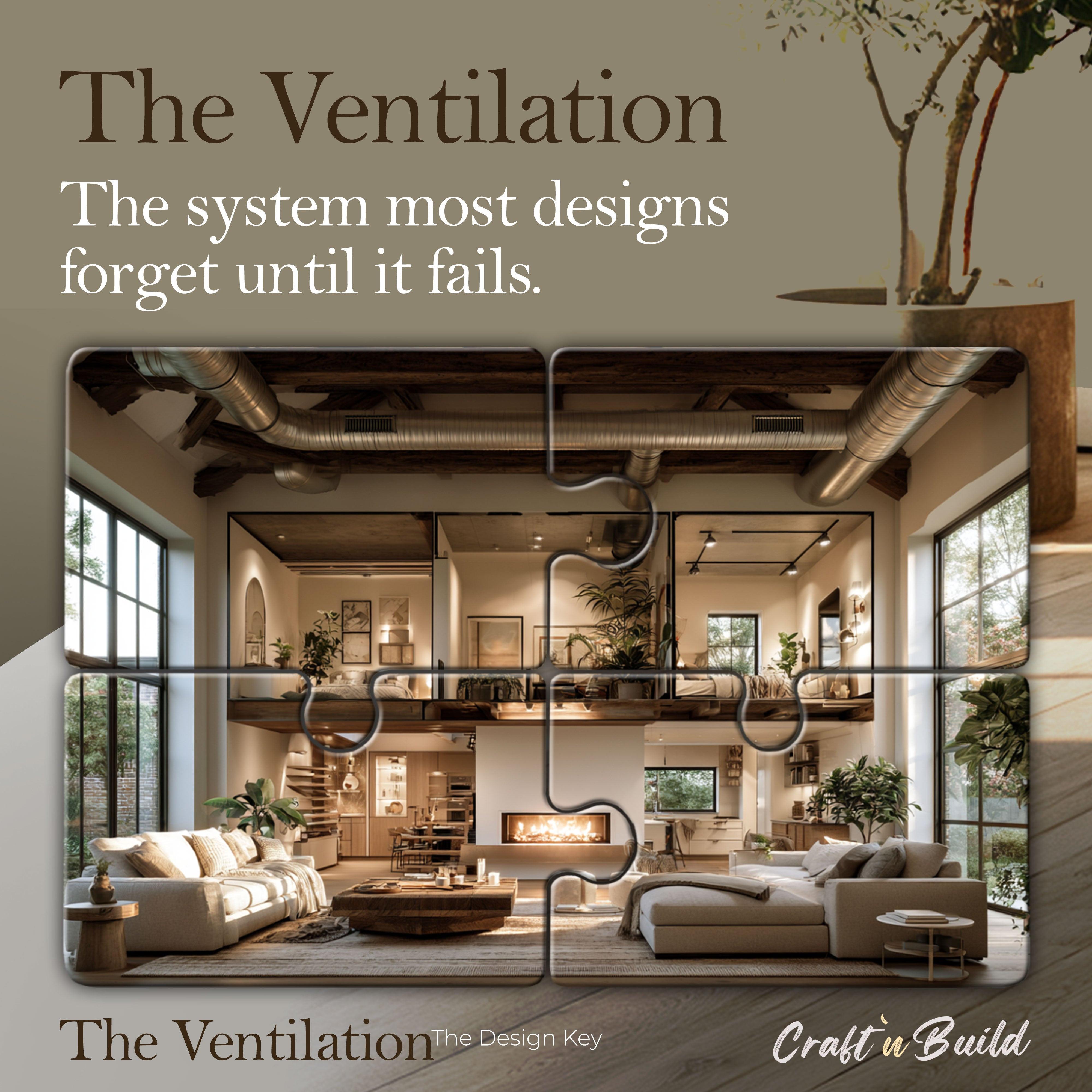
The Ventilation
Secure checkout — all major payment methods accepted
The Design Key — Master Programme
1 of 12 courses toward the Master Programme. Every course counts.Every single course counts towards the full Master Programme.
Pairs well with
What You'll Learn
-
Get the one system every other decision depends on
-
Read air the way an engineer does
-
Diagnose a building from the signals it gives
-
Choose the right system, not the default one
-
Design a system you'll never hear
-
Assign airflows room by room, place the unit, intake and exhaust, and size ductwork for low velocity so the system performs without the hum, whistle, or draught that makes people switch it off.
Four starting points — one method.
Who is this course for

Working designers
Put a repeatable method under the instinct you already have, and sharpen the process you use every day.

Aspiring designers
Build real professional skills from the ground up. No degree, no prior experience needed.

Project owners
Understand the process well enough to brief sharply, judge the work, and manage the people delivering it.

Homeowners
Approach your own space the way a professional would, and stop guessing on decisions that cost real money.
No credentials required. No experience assumed. Just a commitment to learn how design actually works — because the method is the same for all of you.
How to get the most from this course
Four steps to turn watching into doing.
Set up to work, not just watch
Have pen and paper beside you. This is a course you do, not one you passively watch — the method only sticks when you work it by hand.

Have pen and paper beside you. This is a course you do, not one you passively watch — the method only sticks when you work it by hand.
Take one module at a time
Each module is a complete idea. Work through one per sitting, finish its exercise before moving on, and let it settle rather than racing to the end.

Apply it to a real space as you go
Use your own home, a past project, or an imagined brief. Run each method on something real so it becomes a skill, not just notes.

Expect about a week, at your pace
Most people complete a course in around a week at a relaxed module-a-day rhythm — faster if you push, slower if you savour it. There's no clock; lifetime access means you set the speed.

See the actual work
Not slides. Not tips. These are real pages from inside the courses — the kind of professional documentation The Design Key teaches you to produce.
01
The Brief
Every project begins by defining what it actually is. The Brief teaches the four-dimension framework that stops a project breaking down before it's finished — documented the way a working studio does it.

02
The Moodboard
The difference between a professional moodboard and a Pinterest board, made explicit. You learn to build a strategic visual document that directs a project — not a folder of images you happen to like.

03
The Lighting
Light designed as a system, not chosen as a fixture. The Lighting teaches you to read how daylight enters a room hour by hour, and to plan an artificial scheme that works with it instead of fighting it.

04
The Kitchen
Where the method meets millimetres. The Kitchen takes you into real fabrication-level decisions — joint placement, material limits, service coordination — the technical depth that separates a finished room from a styled one.

FAQ
What is "The Design Key"?
The Design Key is a series of professional methodology courses from Craft'n Build, each covering one core discipline of interior design — the Brief, the Mood Board, the Floor Plan, Lighting, the Kitchen, and more. It teaches how working designers actually think, plan and execute, through the same rigorous framework used in real practice. It's about method, not aesthetics or inspiration.
Who is this for?
Anyone who wants to learn professional interior design method, whatever their starting point — working designers, students and career-changers, homeowners approaching their own space properly, and project owners who need to brief and judge the work. No credentials or prior experience required. The method is the same for everyone.
What do I get, and how do I access it?
Everything is online and yours the moment you buy — instant access, no waiting, nothing shipped. You watch the course in your browser on any device and download the accompanying course material to keep. Access doesn't expire.
Is the course video, text, or both?
Both. Each course combines video lessons with a downloadable written guide and practical exercises, so you can watch, read, and work through the method by hand — which is how it's designed to be learned.
Do I need any experience or special software?
No. The courses assume no prior experience and no expensive software — just a willingness to work through the method. Where a tool is useful, the course shows you accessible options. The method matters more than the software.
How long do I have to complete a course?
As long as you like — access is for life, with no deadline. Most people work through a course in about a week at a relaxed module-a-day pace, faster if they push. You set the speed and can return to the material whenever you need it.
Do I get a certificate?
Yes. Complete any course and you earn a Certificate for that discipline. Complete all twelve and pass the final synthesis exam — which tests your ability to solve real problems across several disciplines at once — and you earn the Design Key Diploma, a credential that reflects mastery of the whole method, not just course completion.
What is "The Master Programme"?
The Master Programme is the full path: all twelve courses together, leading to the Design Key Diploma. You don't commit up front — every single course you take counts toward it. Start with one; the whole programme stays open to you.
Can I just buy one course, or do I have to take the whole series?
Start with a single course — most people do. There's no obligation to take more, but everything you complete counts toward the Master Programme and the Diploma, so a single course is also a first step if you decide to go further.
Do you offer a refund?
Yes — if a course isn't right for you, contact us and we'll make it right.
THE DESIGN KEY
About the Programme

Start with one course
Learn a complete discipline — the Brief, the Mood Board, a room — and earn its Certificate. One course is a real skill on its own.

Build toward the whole
Every course you complete counts toward the Master Programme. You're never starting over — always adding to the same path.

Earn the Diploma
Complete all twelve and pass the synthesis exam to earn the Design Key Diploma — proof you can integrate the whole method, not just finish the courses.
The Design Key Master Programme

€75,95


€75,95


€75,95

€75,95


€75,95


€75,95


€75,95


€75,95

€75,95


€75,95


€75,95


€75,95
The Design Key — Master Programme
1 of 12 courses toward the Master Programme. Every course counts.Every single course counts towards the full Master Programme.
Description
Short description
Full description
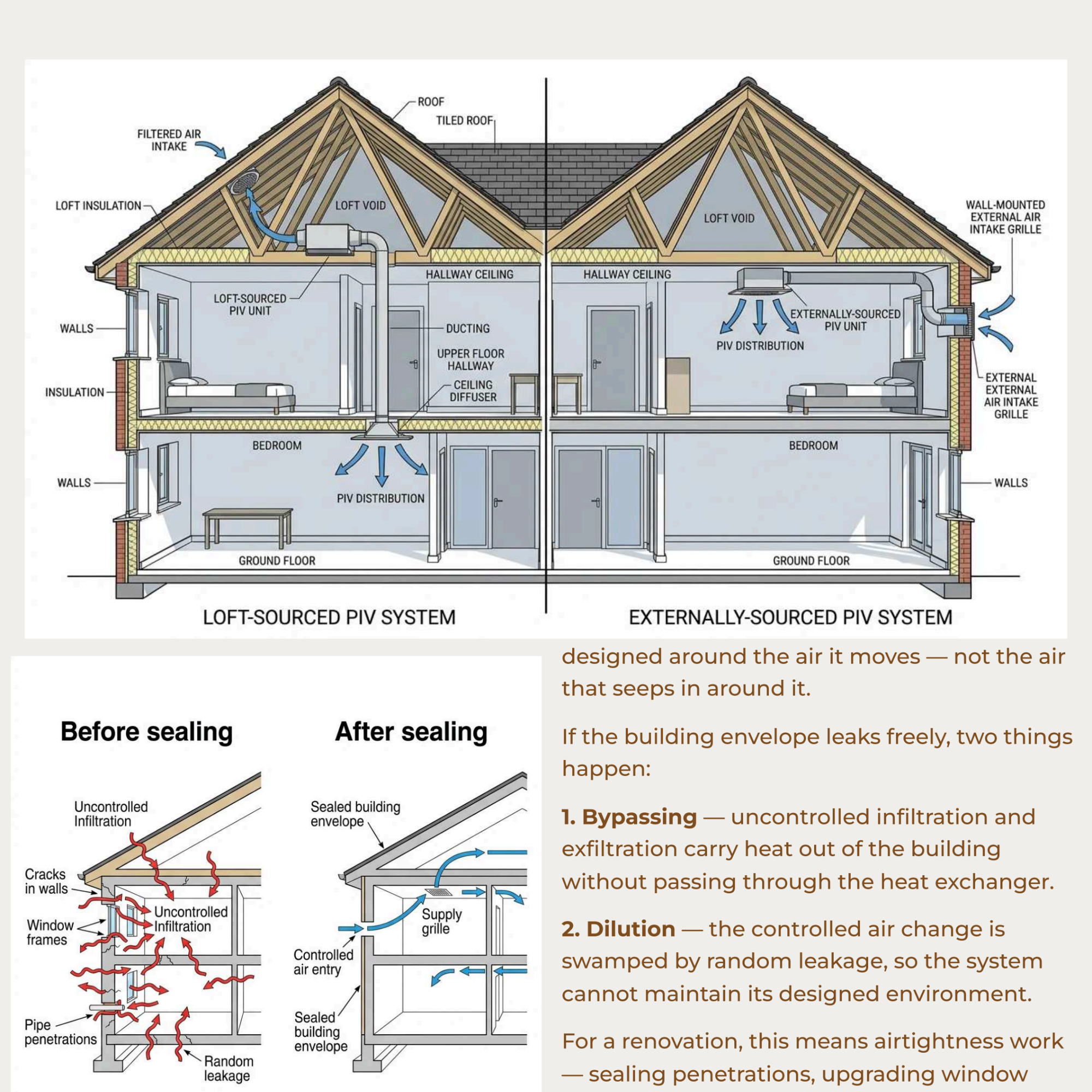
The Design Key — Ventilation is a professional course that teaches interior designers and renovation professionals how to treat ventilation as a primary design system rather than an afterthought. It follows a renovation-first method across six modules: understanding why air governs both a building's lifespan and its occupants' health, learning the science of moisture and indoor pollutants, surveying and diagnosing an existing building, choosing between ventilation strategies — natural, mechanical extract, positive input, and balanced heat recovery — sizing and designing the system room by room for performance and silence, and finally integrating, commissioning, and documenting it. The course centres on one principle: improving a building's envelope removes the uncontrolled air change it used to get through its leaks, so a renovation that tightens a building without deliberately replacing its ventilation creates condensation and mould. Students finish able to assess a building's air, choose a strategy, size a system, hide it in the architecture, and prove it works.
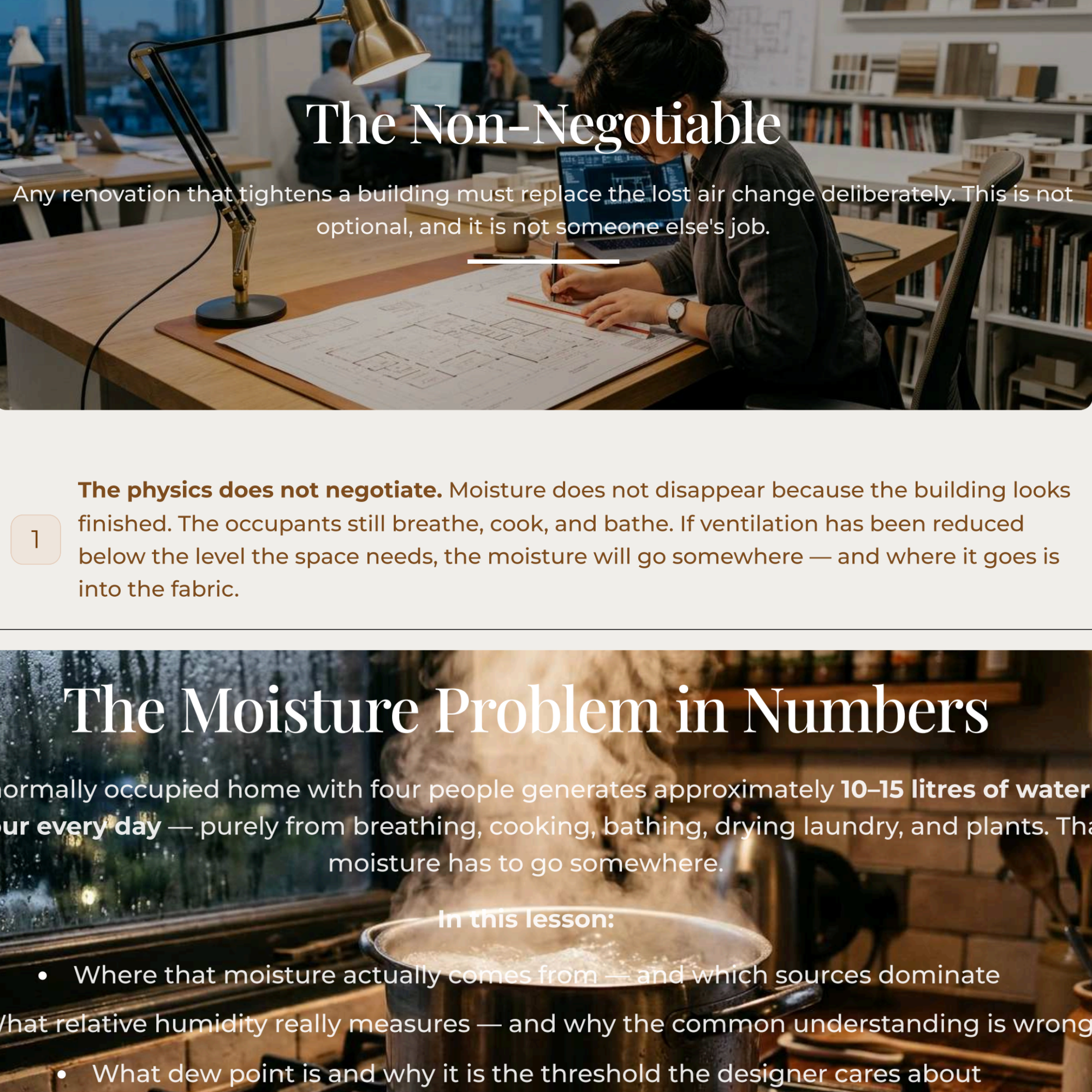
Ventilation is the discipline that decides whether everything else survives. A great kitchen, a beautiful bathroom, a calm bedroom — each one can still be considered a failure if the air around it was never resolved. Moisture has to go somewhere. Cooking, bathing, drying laundry, and breathing load a home with water vapour and pollutants every day, and a building that cannot clear them quietly turns that load against itself: condensation on cold surfaces, black mould in corners and behind furniture, finishes that fail early, and air that leaves the people inside sleeping badly and breathing worse.
Most practitioners were never taught to take responsibility for this. Air gets left to a contractor's default — an extract fan here, a trickle vent there — and the result is a building that looks finished and performs poorly. This course replaces that default with a method.
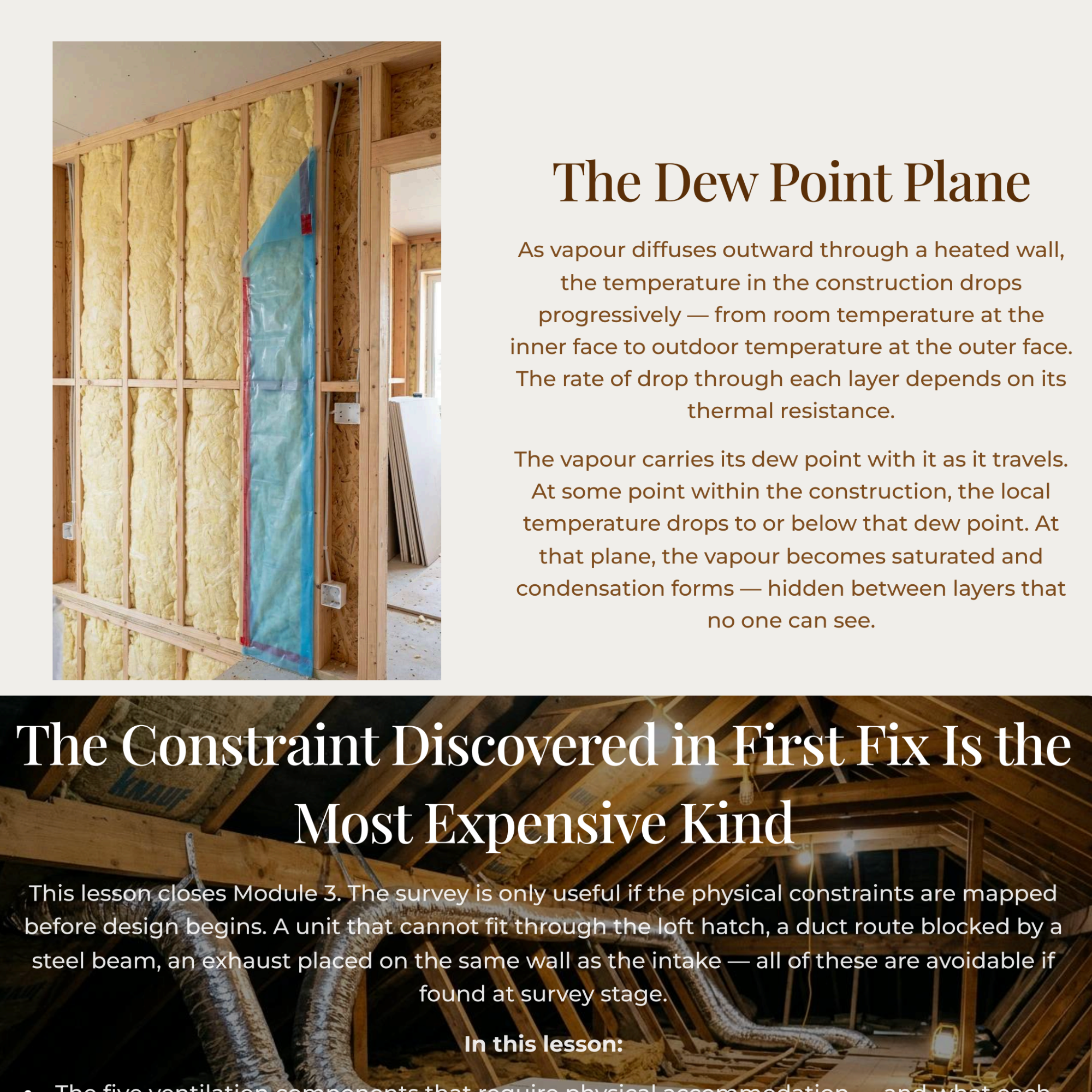
You begin with the why. Module one makes the case that ventilation governs both the lifespan of the building fabric and the health of its occupants, and introduces the renovation trap that runs through the whole course. Module two gives you the working science — air change, relative humidity and dew point, condensation forming hidden inside the construction, and the pollutants (CO₂, VOCs, fine particulates, radon) that come from occupancy and from the materials you specify. This is the knowledge that lets you reason about any space instead of copying rules of thumb.
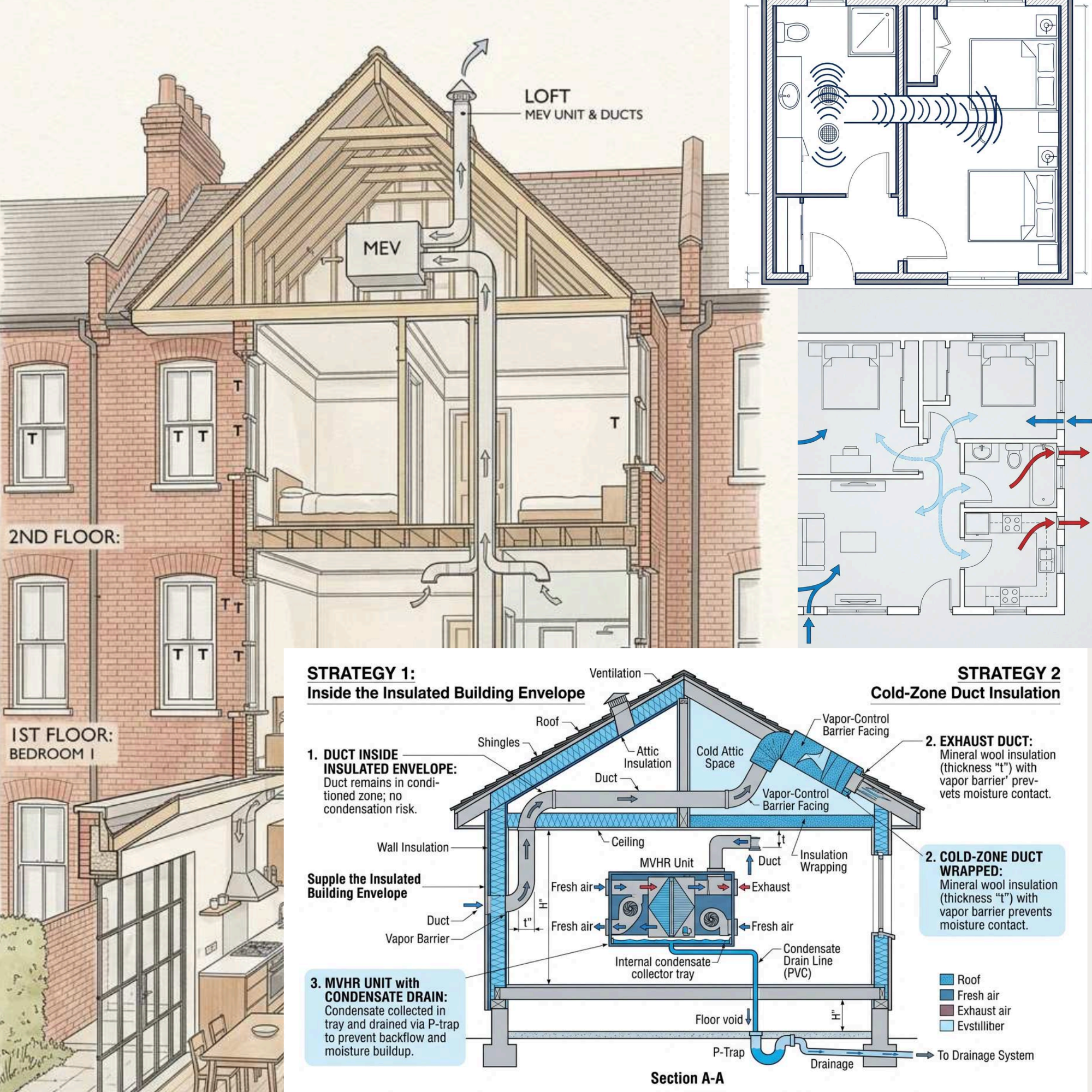
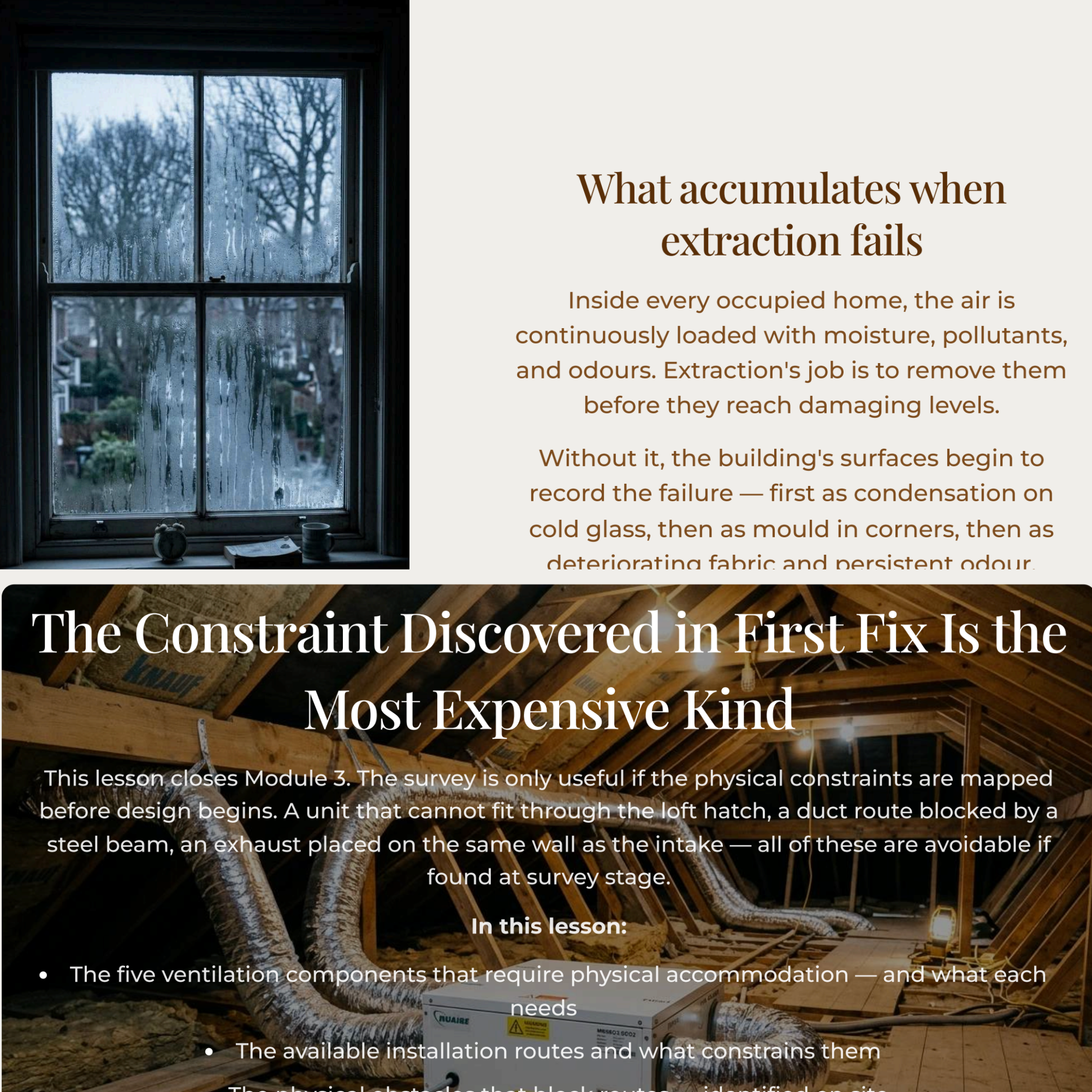
Module three takes you on site. You learn to read the signals a building gives — mould patterns, condensation on glass, musty smells, seasonal complaints — and diagnose the faults behind them, assess how tight or leaky the envelope is, and find where ducts and units can realistically go. Module four lays out the real options honestly, with the trade-offs that decide which one suits a given building, climate, and budget.
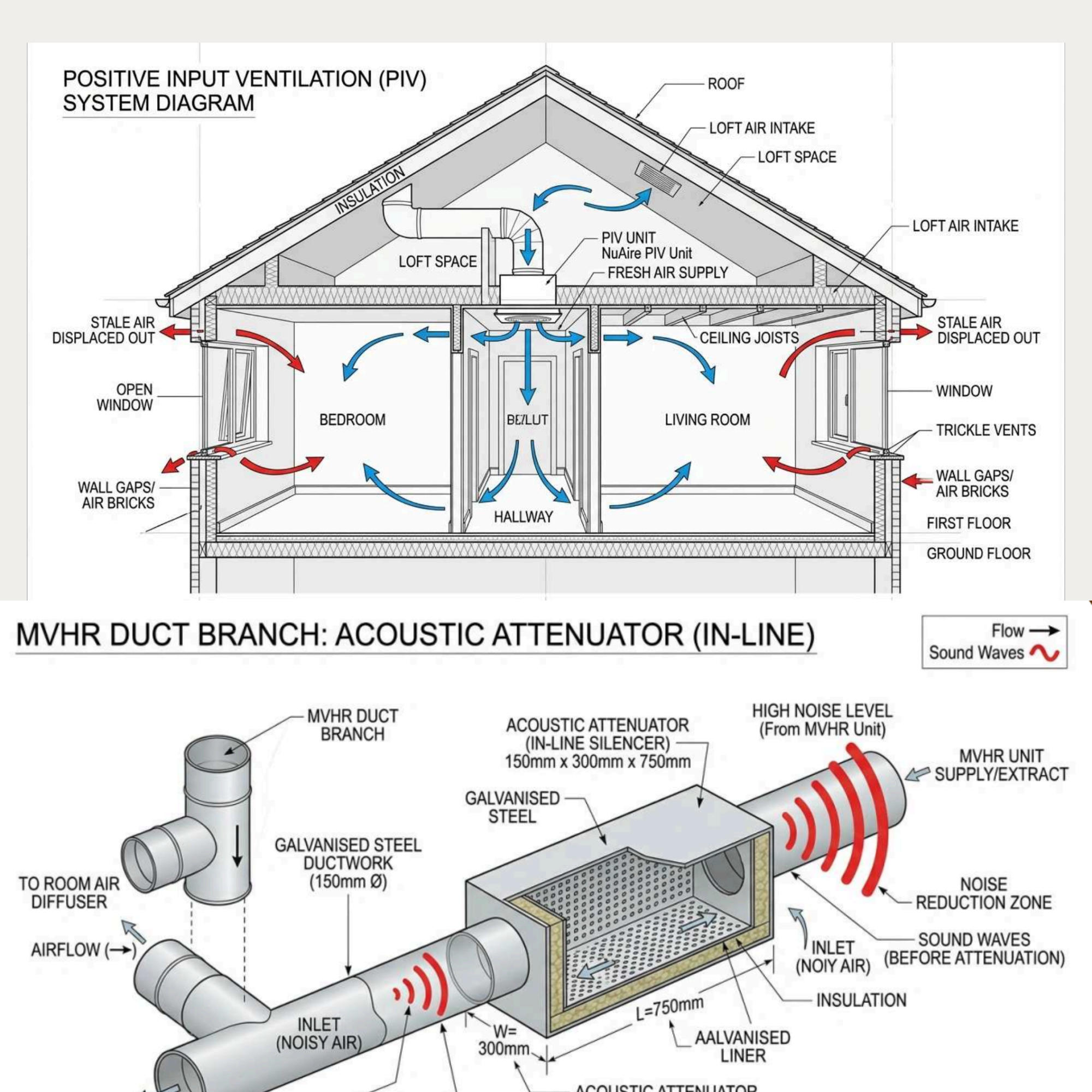
Module five is where strategy becomes a real design. You assign extract rates to wet rooms and supply rates to habitable ones, balance the whole dwelling, place the unit, intake, and exhaust, and design ductwork for low velocity so the system stays quiet — then handle noise, crosstalk, condensation inside the ducts, and filtration. Module six makes the system disappear: coordinating duct routes with ceilings, bulkheads, and joinery; selecting and placing grilles and diffusers as deliberate design elements; commissioning and balancing so the airflows are real and not just drawn; and handing the client a system they understand and will maintain — documented as part of the project's specification register.
This is a Systems course in The Design Key. It does not sit beside the room courses as another room — it sits beneath them, as the system that protects every room decision you make. Read alongside The Kitchen and The Bathroom, it converts "put an extract fan in the wet room" into a coordinated, whole-building decision.
The building will change, the client will change, the budget will change — the order will not. That order is the method. It is the same method you will apply to the next renovation, and to every building after.
Six modules. Lifetime access. A Course Certificate counting toward the Master Certificate.