




THE DESIGN KEY SERIES
The Lighting
Secure checkout — all major payment methods accepted
The Design Key — Master Programme
1 of 12 courses toward the Master Programme. Every course counts.Every single course counts towards the full Master Programme.
Pairs well with
What You'll Learn
-
Know what the building will let you do
-
Daylight & Wiring.
-
Light the way people really live
-
Build a scheme where every fixture earns its place
-
Control the light, don't just install it
-
Hand over a plan an electrician can build from
Four starting points — one method.
Who is this course for

Working designers
Put a repeatable method under the instinct you already have, and sharpen the process you use every day.

Aspiring designers
Build real professional skills from the ground up. No degree, no prior experience needed.

Project owners
Understand the process well enough to brief sharply, judge the work, and manage the people delivering it.

Homeowners
Approach your own space the way a professional would, and stop guessing on decisions that cost real money.
No credentials required. No experience assumed. Just a commitment to learn how design actually works — because the method is the same for all of you.
How to get the most from this course
Four steps to turn watching into doing.
Set up to work, not just watch
Have pen and paper beside you. This is a course you do, not one you passively watch — the method only sticks when you work it by hand.

Have pen and paper beside you. This is a course you do, not one you passively watch — the method only sticks when you work it by hand.
Take one module at a time
Each module is a complete idea. Work through one per sitting, finish its exercise before moving on, and let it settle rather than racing to the end.

Apply it to a real space as you go
Use your own home, a past project, or an imagined brief. Run each method on something real so it becomes a skill, not just notes.

Expect about a week, at your pace
Most people complete a course in around a week at a relaxed module-a-day rhythm — faster if you push, slower if you savour it. There's no clock; lifetime access means you set the speed.

See the actual work
Not slides. Not tips. These are real pages from inside the courses — the kind of professional documentation The Design Key teaches you to produce.
01
The Brief
Every project begins by defining what it actually is. The Brief teaches the four-dimension framework that stops a project breaking down before it's finished — documented the way a working studio does it.

02
The Moodboard
The difference between a professional moodboard and a Pinterest board, made explicit. You learn to build a strategic visual document that directs a project — not a folder of images you happen to like.

03
The Lighting
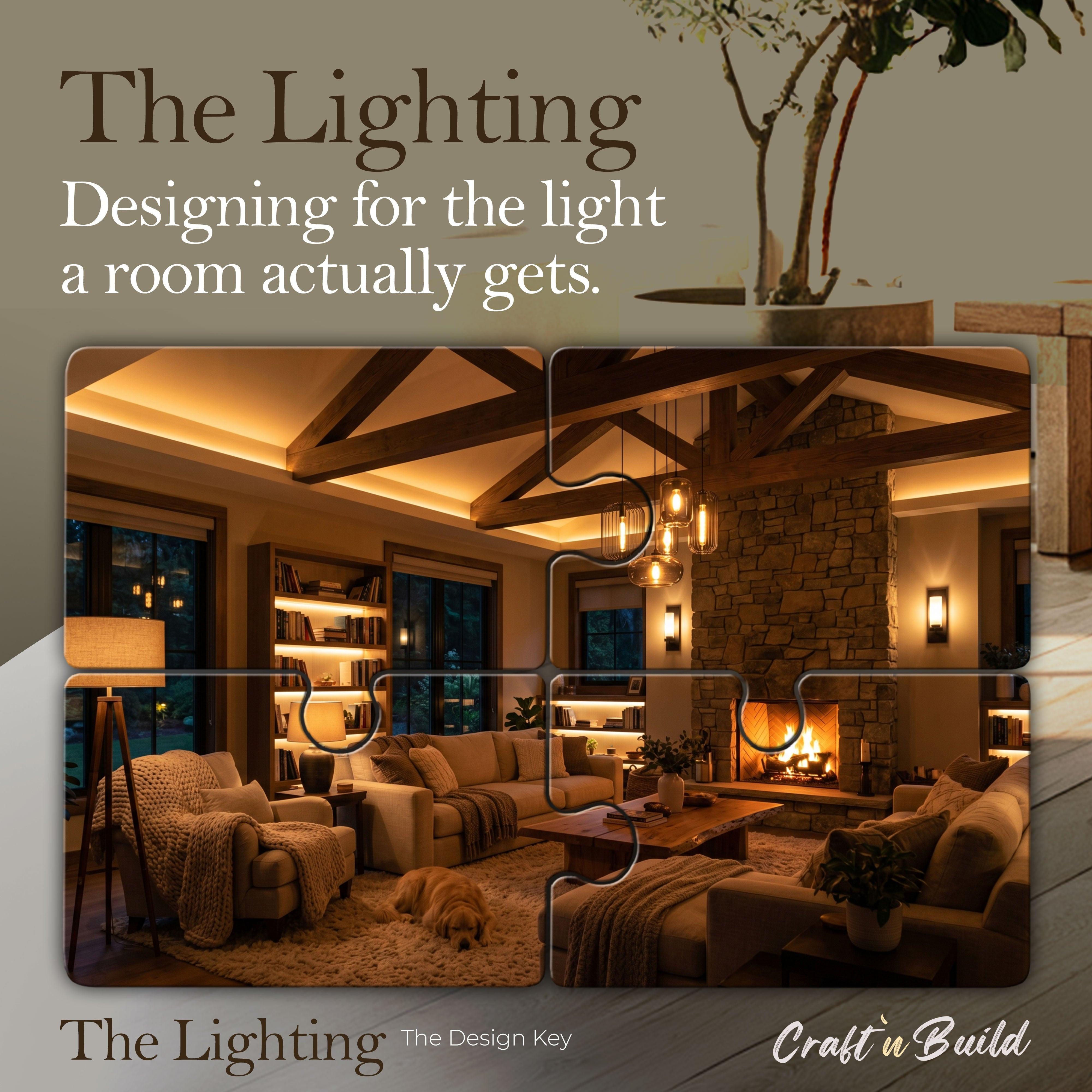
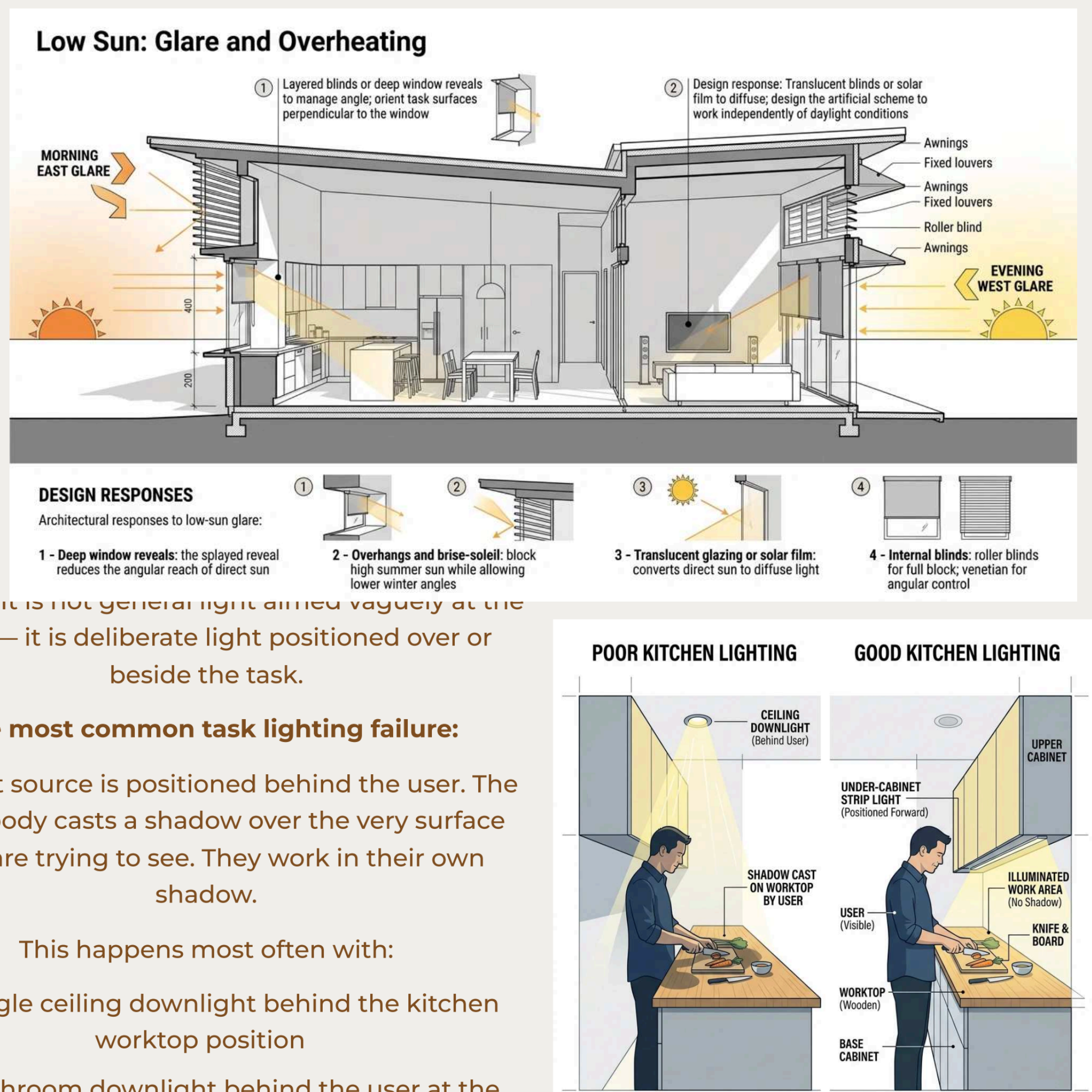
Light designed as a system, not chosen as a fixture. The Lighting teaches you to read how daylight enters a room hour by hour, and to plan an artificial scheme that works with it instead of fighting it.

04
The Kitchen
Where the method meets millimetres. The Kitchen takes you into real fabrication-level decisions — joint placement, material limits, service coordination — the technical depth that separates a finished room from a styled one.

FAQ
What is "The Design Key"?
The Design Key is a series of professional methodology courses from Craft'n Build, each covering one core discipline of interior design — the Brief, the Mood Board, the Floor Plan, Lighting, the Kitchen, and more. It teaches how working designers actually think, plan and execute, through the same rigorous framework used in real practice. It's about method, not aesthetics or inspiration.
Who is this for?
Anyone who wants to learn professional interior design method, whatever their starting point — working designers, students and career-changers, homeowners approaching their own space properly, and project owners who need to brief and judge the work. No credentials or prior experience required. The method is the same for everyone.
What do I get, and how do I access it?
Everything is online and yours the moment you buy — instant access, no waiting, nothing shipped. You watch the course in your browser on any device and download the accompanying course material to keep. Access doesn't expire.
Is the course video, text, or both?
Both. Each course combines video lessons with a downloadable written guide and practical exercises, so you can watch, read, and work through the method by hand — which is how it's designed to be learned.
Do I need any experience or special software?
No. The courses assume no prior experience and no expensive software — just a willingness to work through the method. Where a tool is useful, the course shows you accessible options. The method matters more than the software.
How long do I have to complete a course?
As long as you like — access is for life, with no deadline. Most people work through a course in about a week at a relaxed module-a-day pace, faster if they push. You set the speed and can return to the material whenever you need it.
Do I get a certificate?
Yes. Complete any course and you earn a Certificate for that discipline. Complete all twelve and pass the final synthesis exam — which tests your ability to solve real problems across several disciplines at once — and you earn the Design Key Diploma, a credential that reflects mastery of the whole method, not just course completion.
What is "The Master Programme"?
The Master Programme is the full path: all twelve courses together, leading to the Design Key Diploma. You don't commit up front — every single course you take counts toward it. Start with one; the whole programme stays open to you.
Can I just buy one course, or do I have to take the whole series?
Start with a single course — most people do. There's no obligation to take more, but everything you complete counts toward the Master Programme and the Diploma, so a single course is also a first step if you decide to go further.
Do you offer a refund?
Yes — if a course isn't right for you, contact us and we'll make it right.
THE DESIGN KEY
About the Programme

Start with one course
Learn a complete discipline — the Brief, the Mood Board, a room — and earn its Certificate. One course is a real skill on its own.

Build toward the whole
Every course you complete counts toward the Master Programme. You're never starting over — always adding to the same path.

Earn the Diploma
Complete all twelve and pass the synthesis exam to earn the Design Key Diploma — proof you can integrate the whole method, not just finish the courses.
The Design Key Master Programme

687,50 kr


687,50 kr


687,50 kr

687,50 kr


687,50 kr


687,50 kr


687,50 kr


687,50 kr

687,50 kr


687,50 kr


687,50 kr


687,50 kr
The Design Key — Master Programme
1 of 12 courses toward the Master Programme. Every course counts.Every single course counts towards the full Master Programme.
Description
Short description
Full description
Professional lighting design is the practice of designing light as a system rather than selecting fixtures at the end of a project. The method runs in a fixed order: understand the medium (lumens and lux, colour temperature, colour rendering, beam and glare), read the existing conditions (the daylight across the day and the building's wiring and ceilings), write a brief based on how people actually use light (by task, time of day, age and mood), compose the scheme from four layers (ambient, task, accent and decorative), resolve the controls (zoning, switching and dimming), and document everything in a reflected ceiling plan, switching plan, fixture schedule and written specification. The Design Key — The Lighting teaches this complete method, from first principles to a scheme an electrician can install and a client can sign off.
Lighting is the one material in an interior you specify without ever holding it, and the one that decides whether every other material in the room reads as intended. This is why it cannot be the last decision. A grid of downlights dropped onto a finished plan, every fixture wired to a single switch, no dimming and no layers — this is how most rooms are lit, and it is why most rooms feel flat after dark, glare in the wrong places, and leave the work surfaces in shadow. The Design Key — The Lighting exists to replace that default with a method.
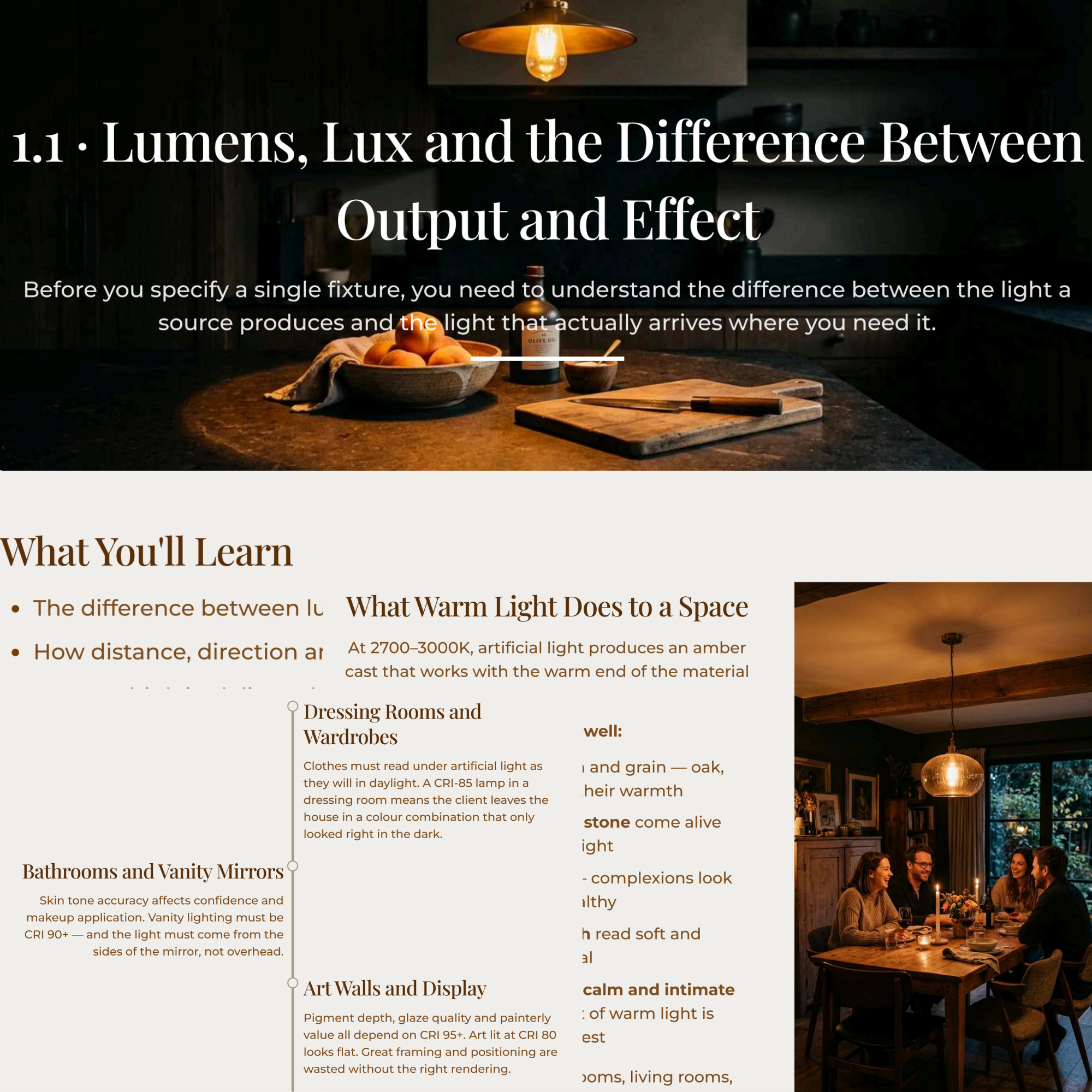
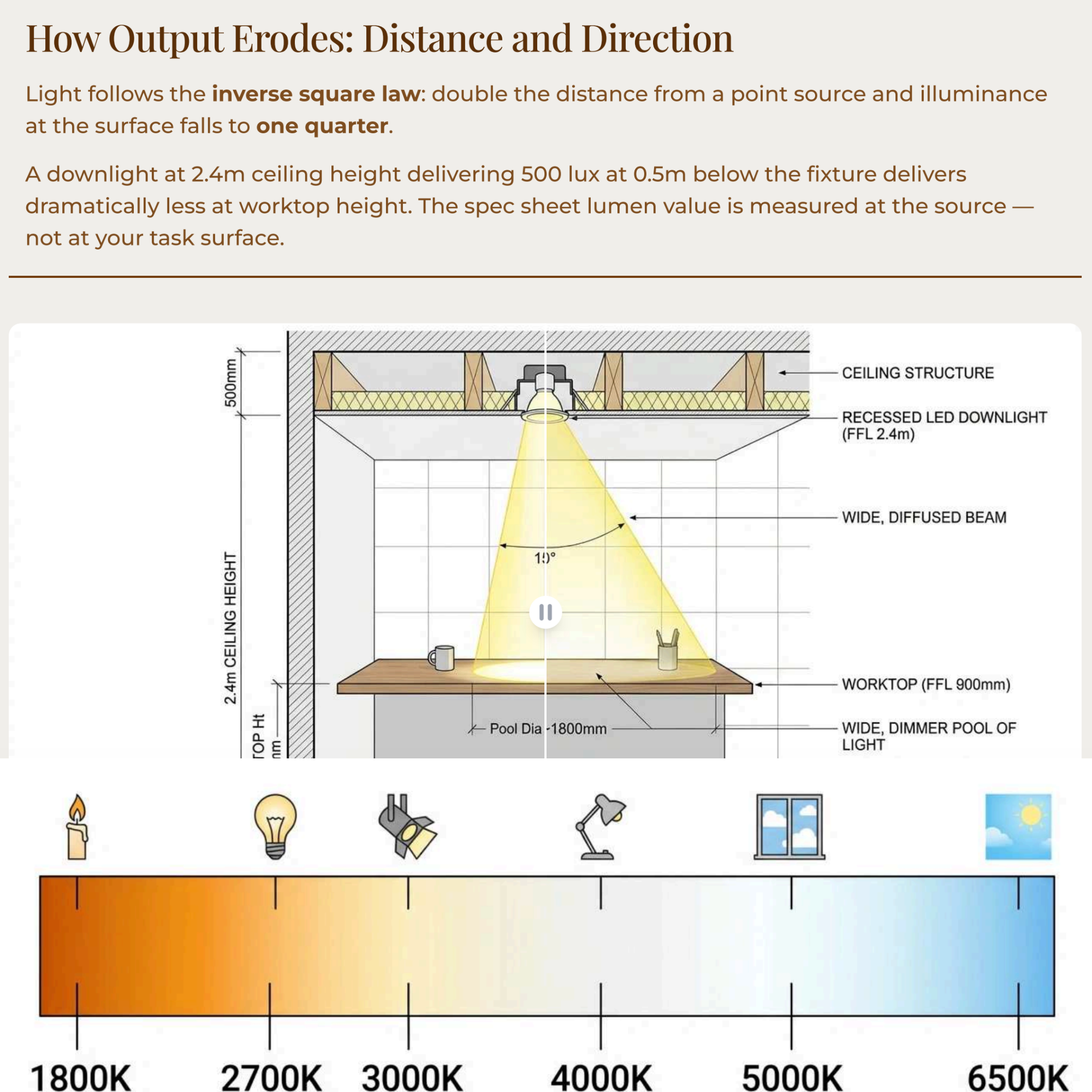
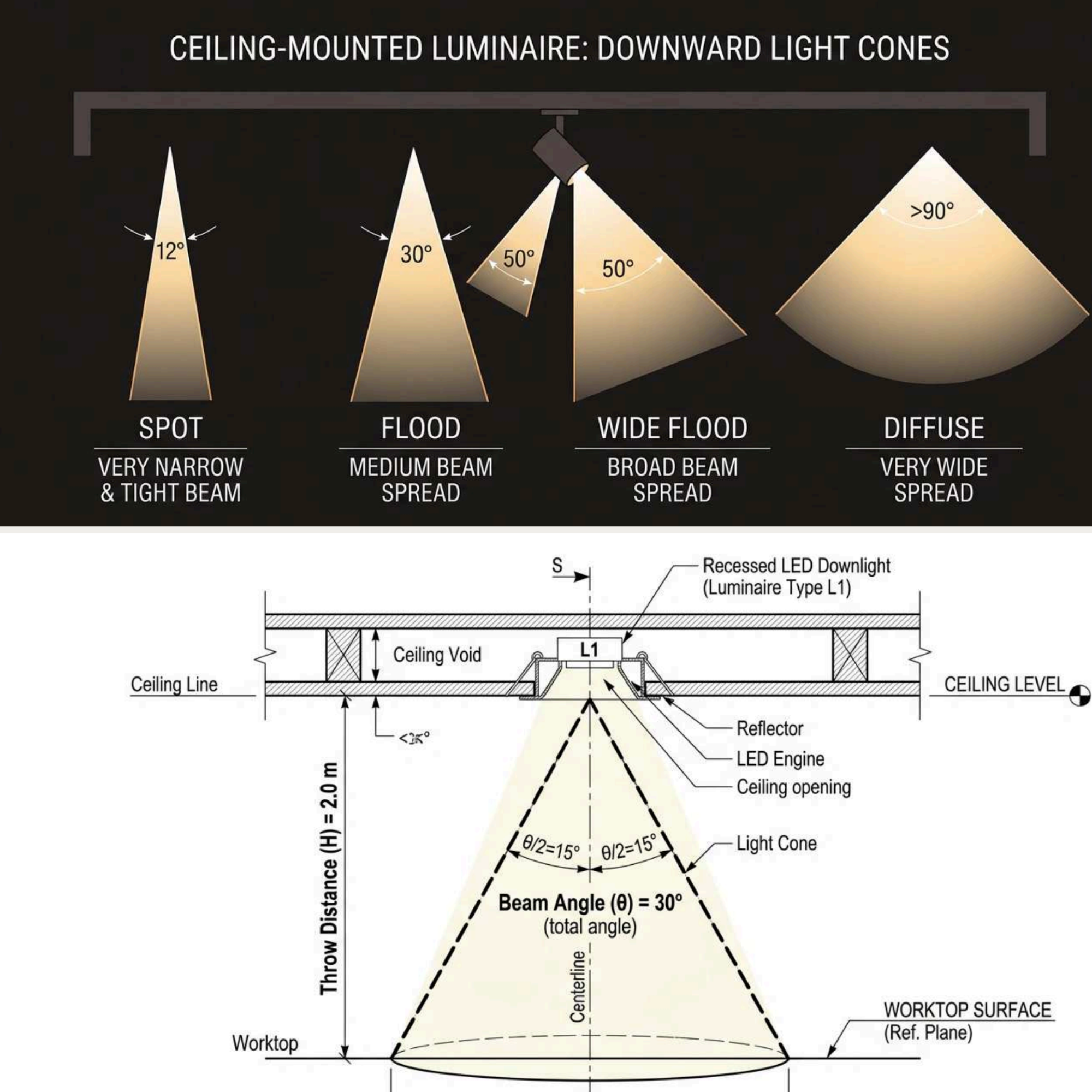
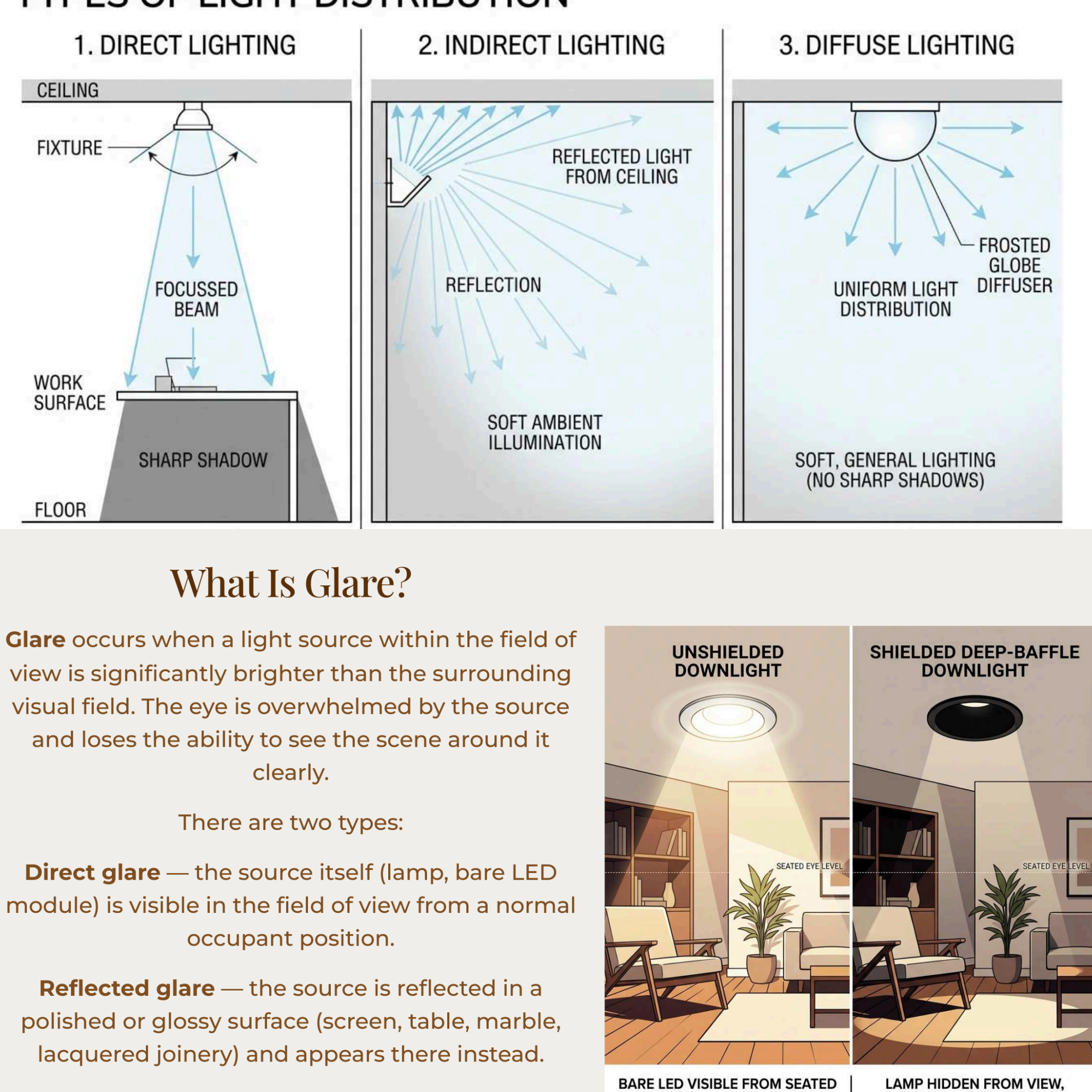
You begin with the medium itself. Before reading a room or choosing a fixture, you learn to describe light precisely: the difference between lumens (what a source produces) and lux (what actually lands on a surface); colour temperature and where each range belongs; colour rendering and why a cheap lamp can quietly ruin an expensive palette; beam angle and distribution; and the glare and contrast that make a technically bright room uncomfortable to be in. You learn to read a fixture's specification critically and predict its effect before it is switched on.
Then you read what is already there. You assess the daylight — orientation, aperture, the daily and seasonal arc — and identify the hours and zones natural light cannot reach, which is exactly where the artificial scheme has to carry the room. You read the building's electrical reality — the panel, the spare capacity, the existing circuits — and the ceiling construction that decides what can be recessed and what cannot. This is the renovation-first discipline of The Design Key applied to light.
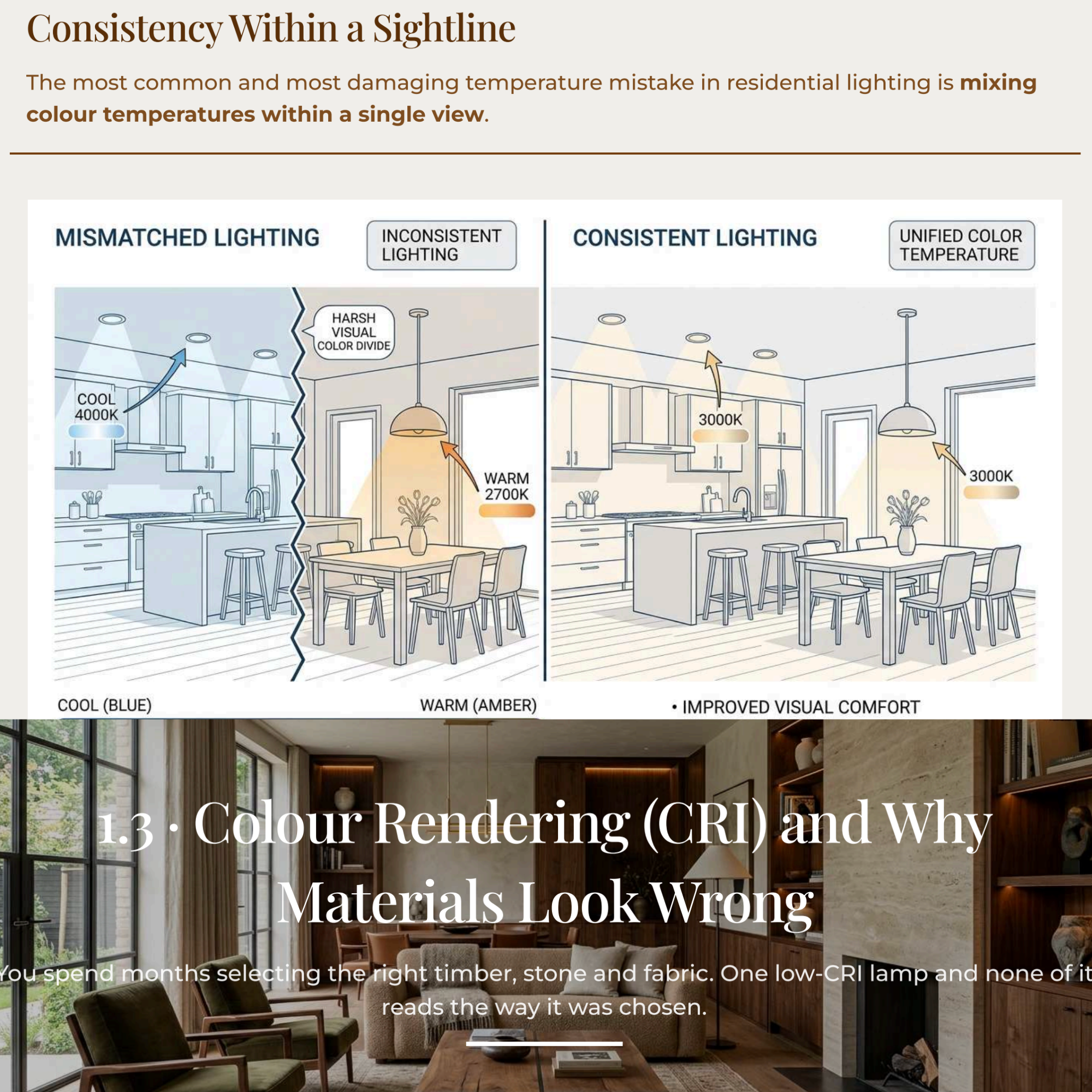
You will learn to write a lighting brief built on how a household actually lives: the tasks performed in each room, the way the same space needs different light in the morning, the evening and the middle of the night, the way older eyes need substantially more light and suffer more from glare, and the atmosphere the home is meant to hold after dark. You will learn to compose the scheme from its four layers — ambient, task, accent and decorative — into a coordinated, room-by-room plan in which nothing sits on the ceiling without a job. You will learn to select fixtures from function backwards, and to keep colour temperature and rendering consistent within every sightline.
You will learn to resolve the controls before the scheme is finalised — how to zone and circuit a scheme so the layers operate independently, where switches belong relative to how people move through a room, why dimming so often flickers or buzzes and how to specify dimming that works, and when scene-based or smart control earns its complexity. And you will learn to document all of it — a reflected ceiling plan, a switching and circuit plan, a fixture schedule and a written specification — to a standard an electrician can install from, finishing with the commissioning walk-through that makes the finished scheme deliver what was designed.
The course is written for one audience: anyone who wants to design lighting using real professional methodology. Whether you are a homeowner planning your own renovation, a designer formalising your process, or a tradesperson who wants to think upstream of the electrician, the content does not change. The decisions are the same. The order is the same. The drawings are the same.
The Lighting sits in the Systems layer of The Design Key, alongside The Ventilation, and the method runs underneath every Rooms course in the Programme. It is a stand-alone course with its own Course Certificate, counting toward the Master Certificate of the full Design Key Master Programme. The fixtures will change, the home will change, the budget will change — the order will not. That order is the method. It is the same order you will apply to the next scheme, and to every room you light after.