
-
Lifetime access.
-
Professional methodology
-
Learn at your pace
-
No experience needed
-
Immediate course access
-
Real-world application
-
Taught by practitioner
-
Constantly updated content
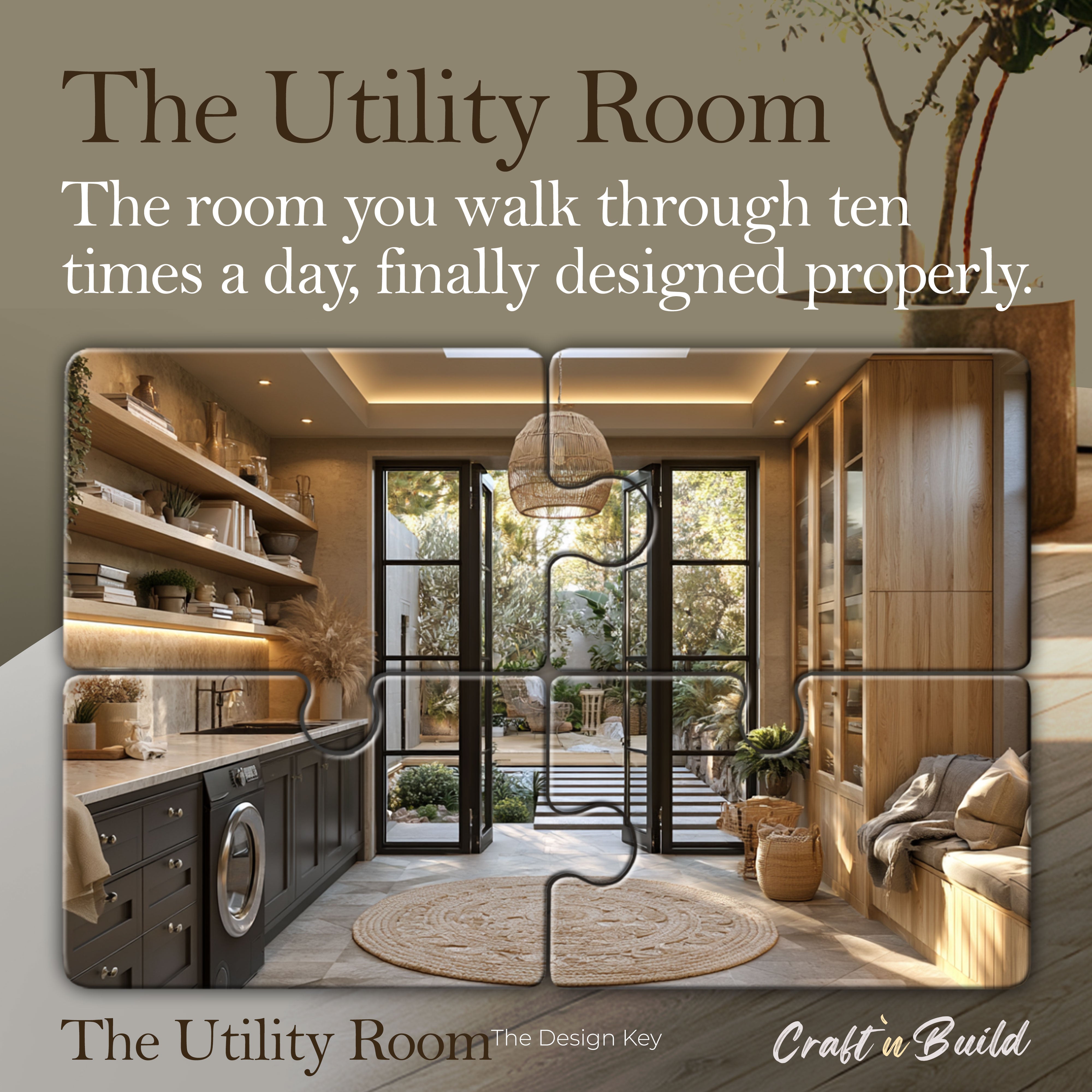
The Utility Room- The Design Key Series.

ALL.
Secure checkout — all major payment methods accepted
Pairs well with
The Utility Room- The Design Key Series.
What our students say.


Color-Material-Finish

Color-Material-Finish

Color-Material-Finish

Color-Material-Finish

Color-Material-Finish

Color-Material-Finish
What You'll Learn
-
Systems-First Planning
-
The Laundry Workflow
-
Moisture and Drying
-
One Discipline, Any Scale
-
The Back-Entrance Boundary
-
From Surfaces to Schedule
If you have any questions, you are always welcome to contact us. We'll get back to you as soon as possible, within 24 hours on weekdays.
-
Shipping Information
Use this text to answer questions in as much detail as possible for your customers.
-
Customer Support
Use this text to answer questions in as much detail as possible for your customers.
-
FAQ’s
Use this text to answer questions in as much detail as possible for your customers.
-
Contact Us
Use this text to answer questions in as much detail as possible for your customers.
Description
Short description
Full description
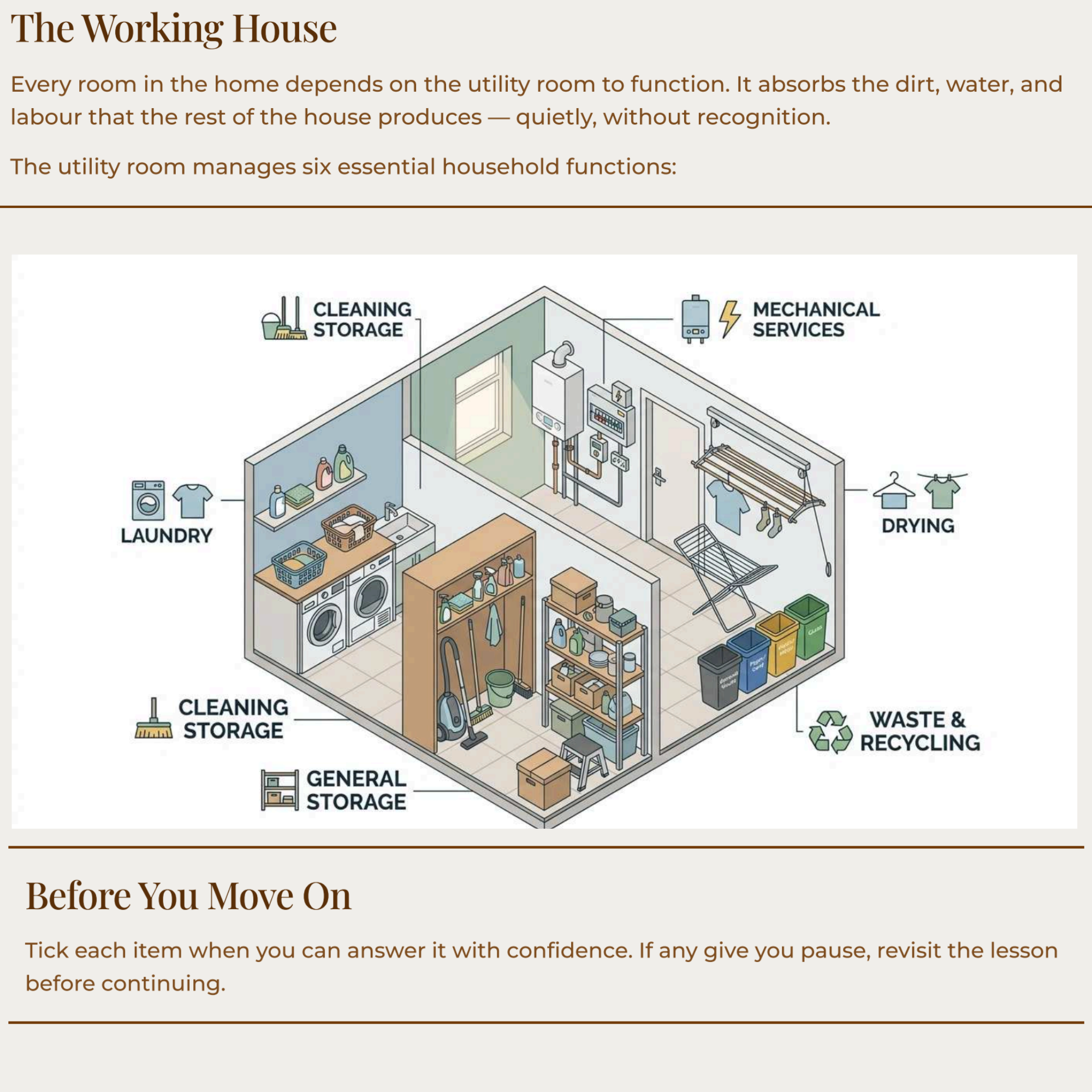
The Design Key — The Utility Room is a professional interior design course that teaches how to design a utility or laundry room — the working house that manages laundry, cleaning, waste, drying, storage, and the home's mechanical services. It uses a systems-first method: survey the existing services, build a brief from the household's workload, resolve water, drainage, power, ventilation, and heat before any fitting is placed, then plan the room around the work that flows through it and specify it for years of hard use. The course treats the dedicated villa room and the compressed apartment cupboard as one discipline at different scales. It is six modules and twenty-nine lessons with lifetime access, earning a Course Certificate toward The Design Key Master Programme.
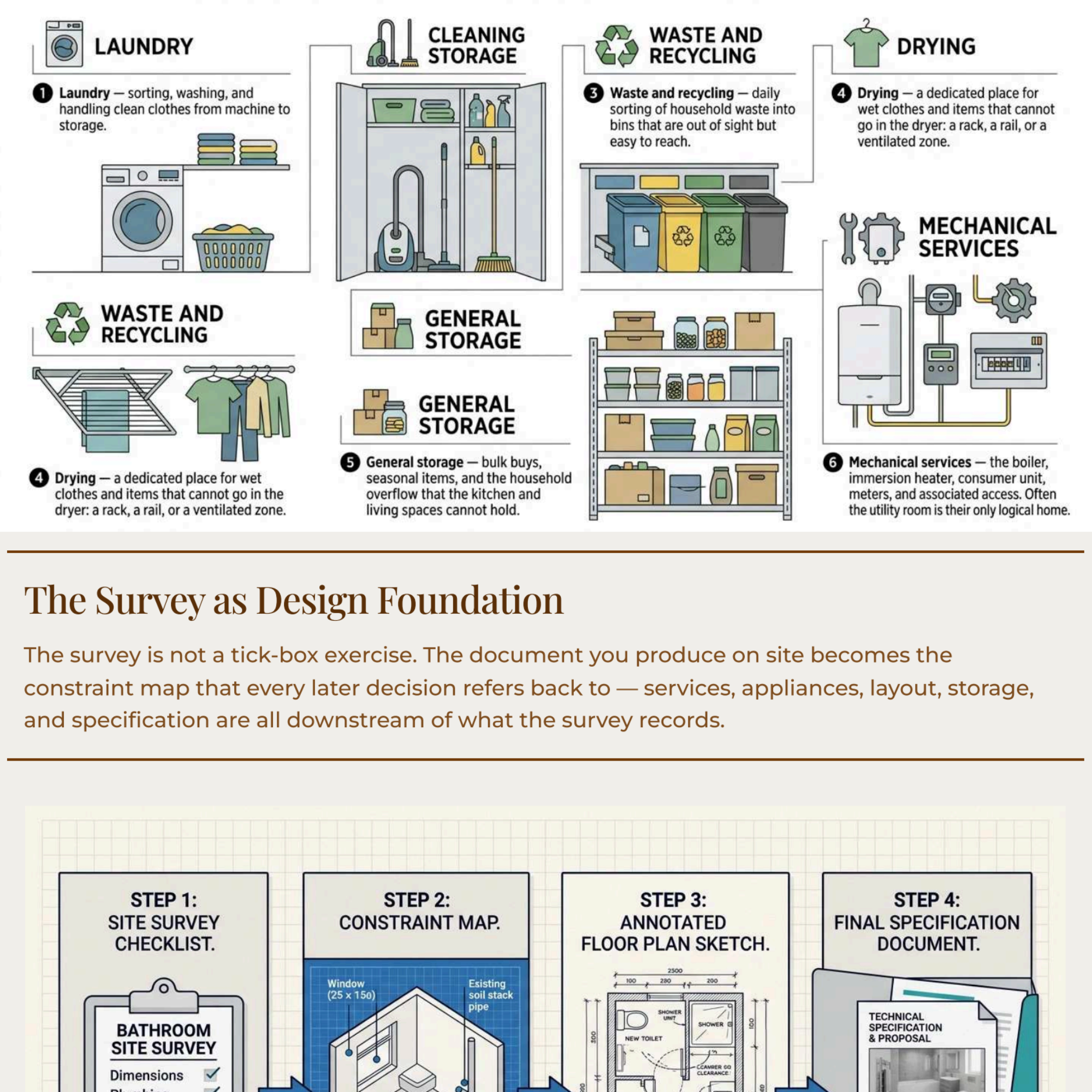
The utility room is the room a home cannot do without and rarely designs on purpose. A kitchen gets months of attention; a bathroom gets a mood board. The utility room gets whatever space is left over — and then it is asked to wash the family's clothes, dry them, store the cleaning equipment, sort the recycling, hide the boiler, and often serve as the back door used every single day. It is the engine room of the house, and most homes treat it as a closet.
This course treats it as a discipline. The skill it teaches is not decoration but resolution: getting the services, the workflow, and the durability right so that the hardest-working room in the home actually works, quietly, for years.
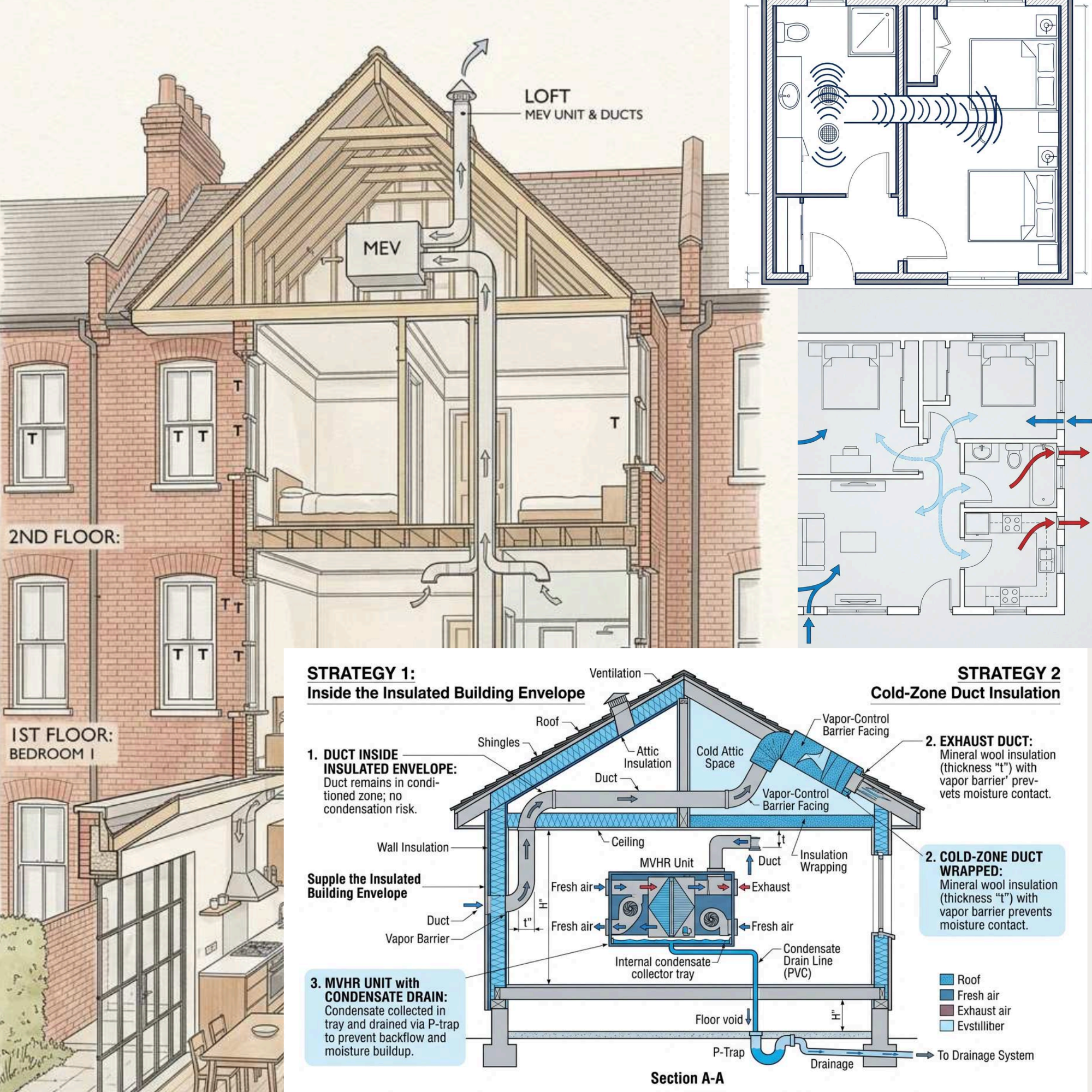
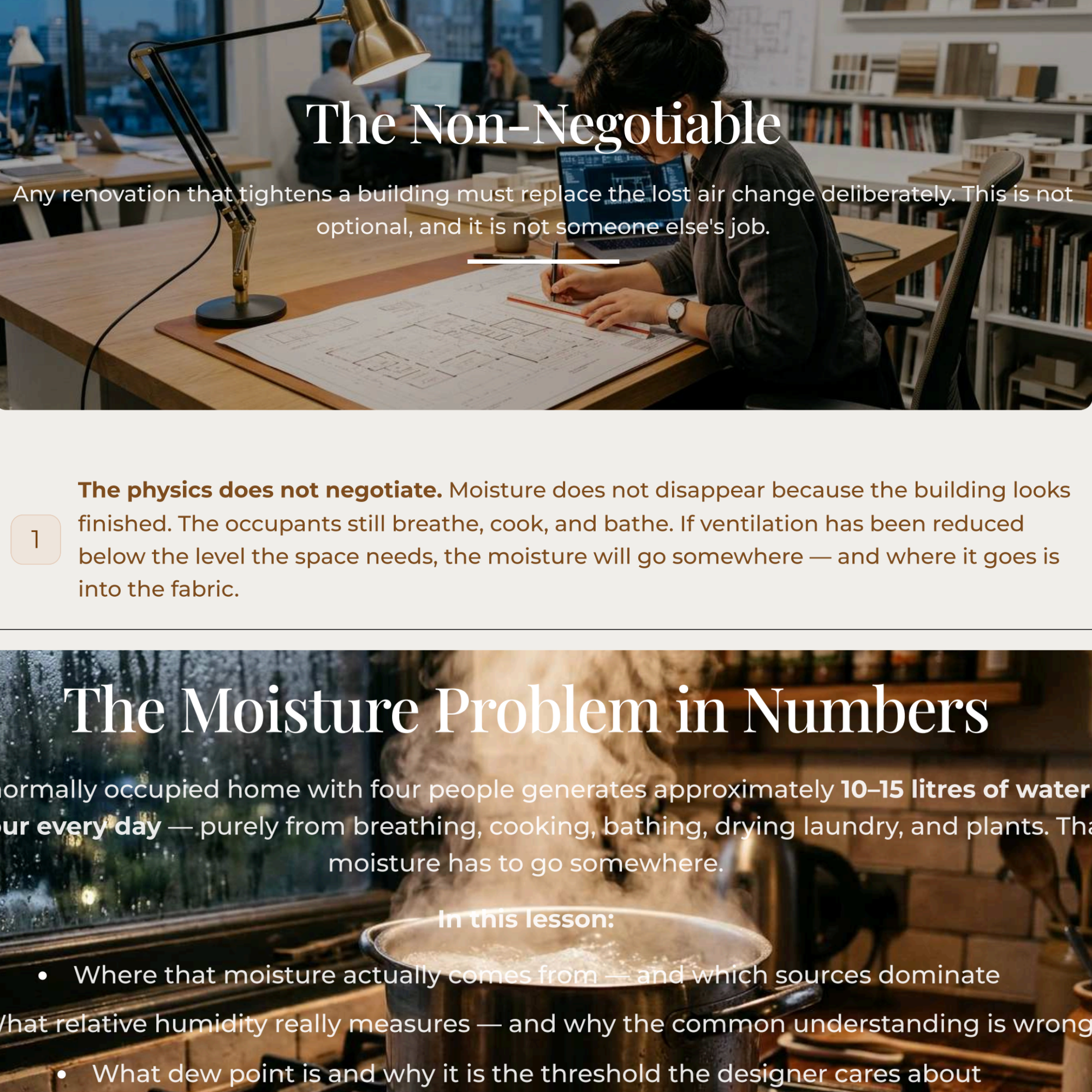
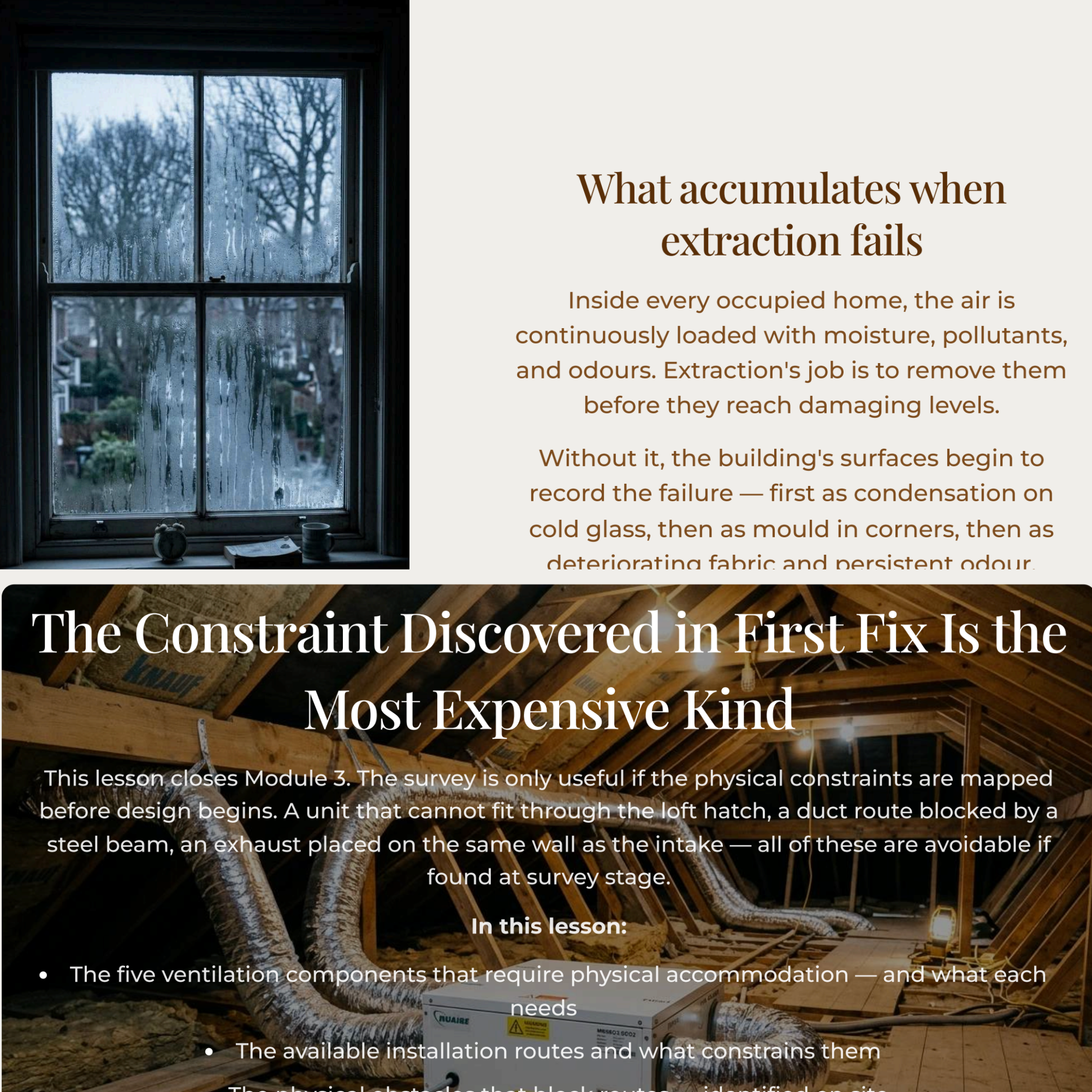
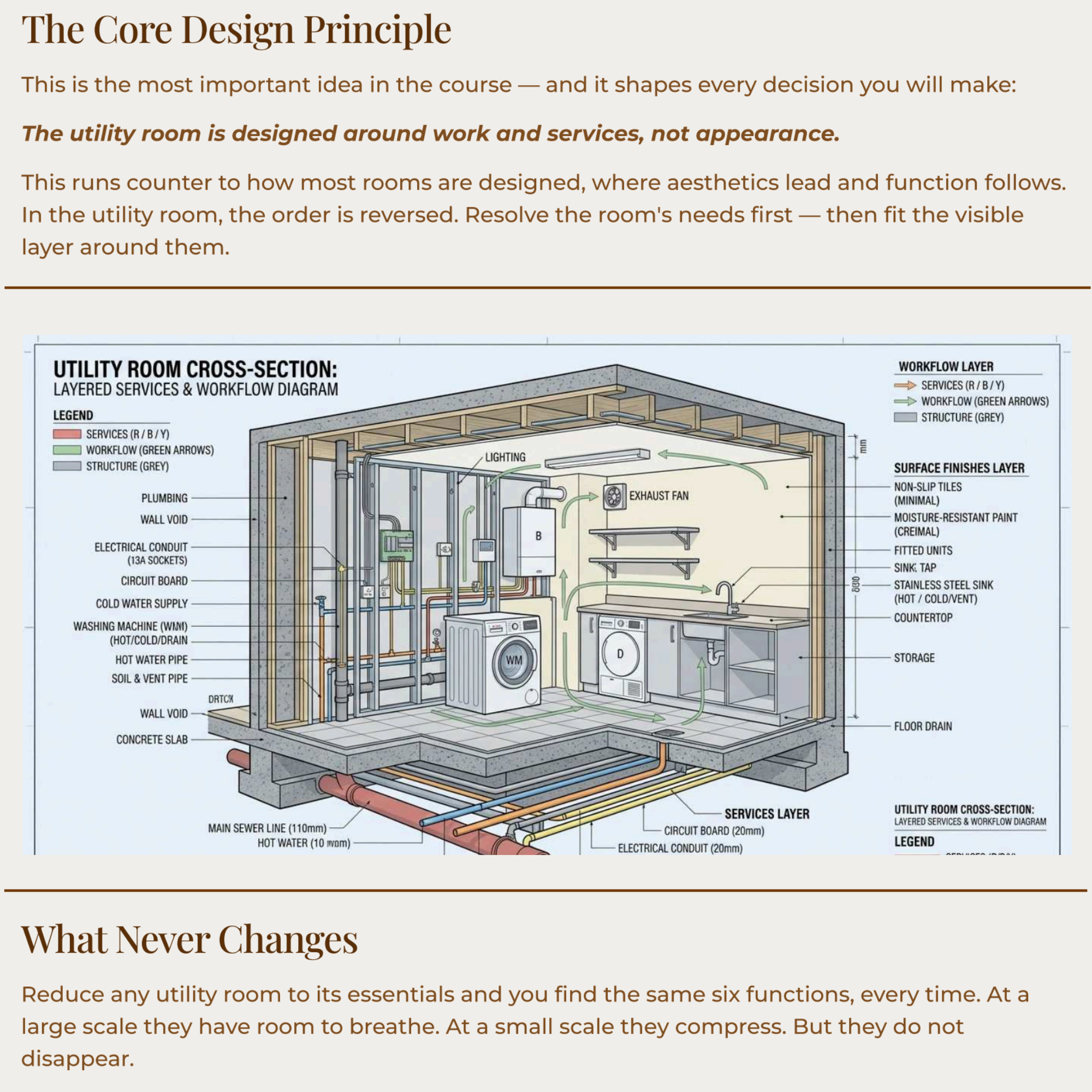
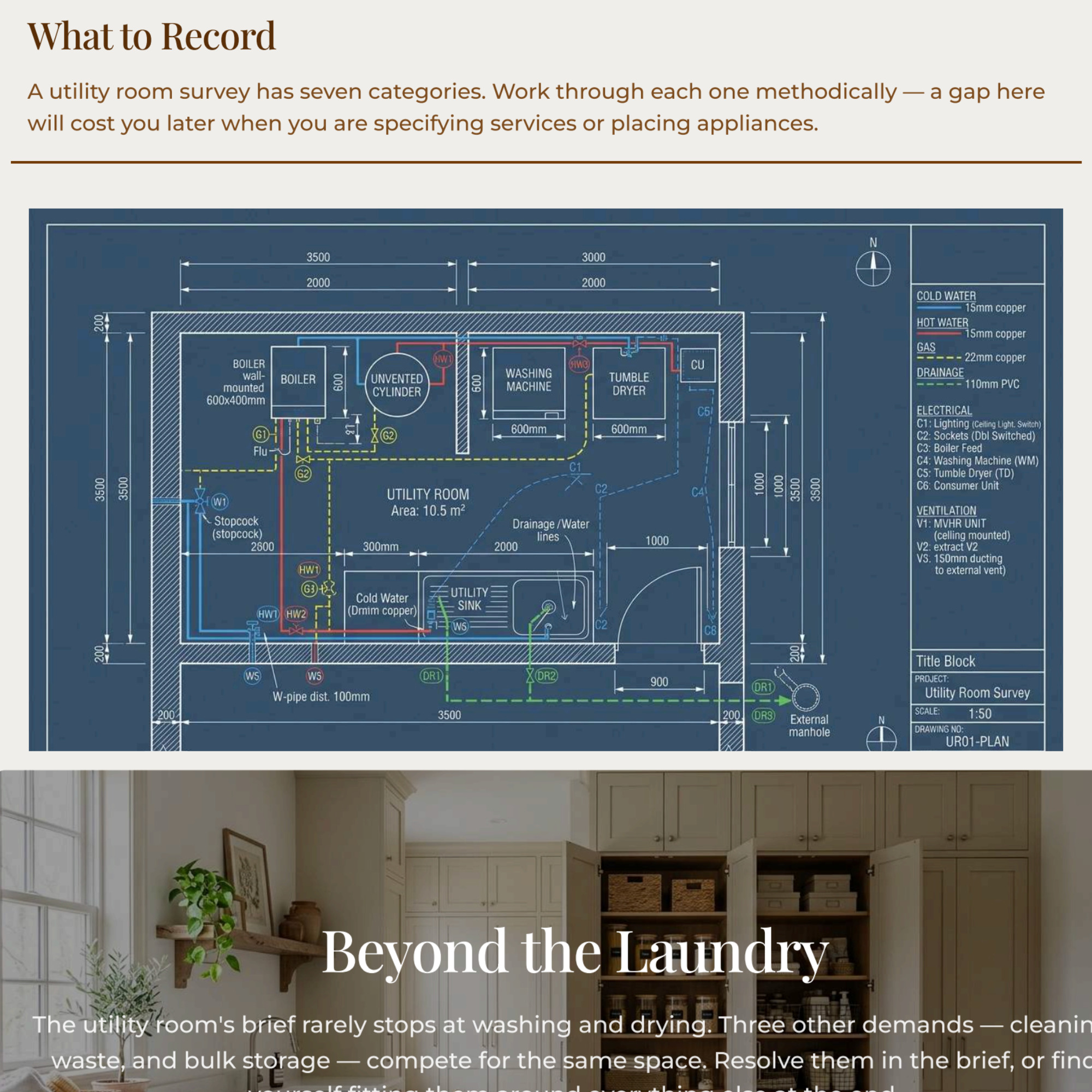
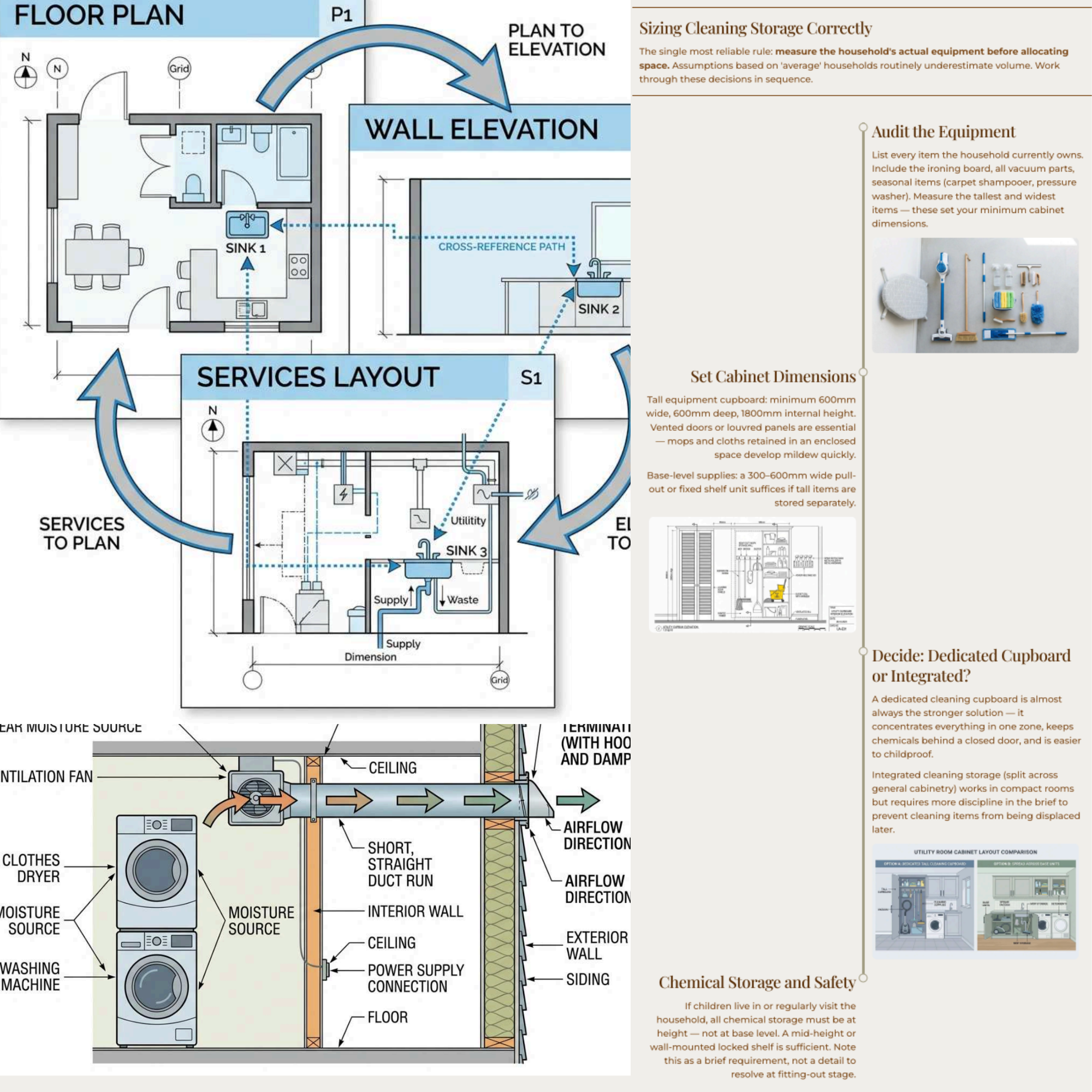
Because the utility room is wet and serviced, it follows the same order as the kitchen and the bathroom, where decisions made in the wrong sequence are the most expensive to undo. You begin by surveying the existing space — its water supply and drainage, electrical capacity, ventilation, heat sources, and the location of the home's mechanical services. You build a brief from the work the household genuinely does: how much laundry, how often, how many people, pets, sport, and outdoor life. Then you resolve the systems. Water and drainage for the washing machines and the utility sink. Dedicated circuits for high-draw appliances. Ventilation and moisture control — because a room that dries laundry generates humidity that will damage the house if it has nowhere to go. A drying strategy that suits the household. And a proper home for the boiler, cylinder, consumer unit, and meters that so often share the space.
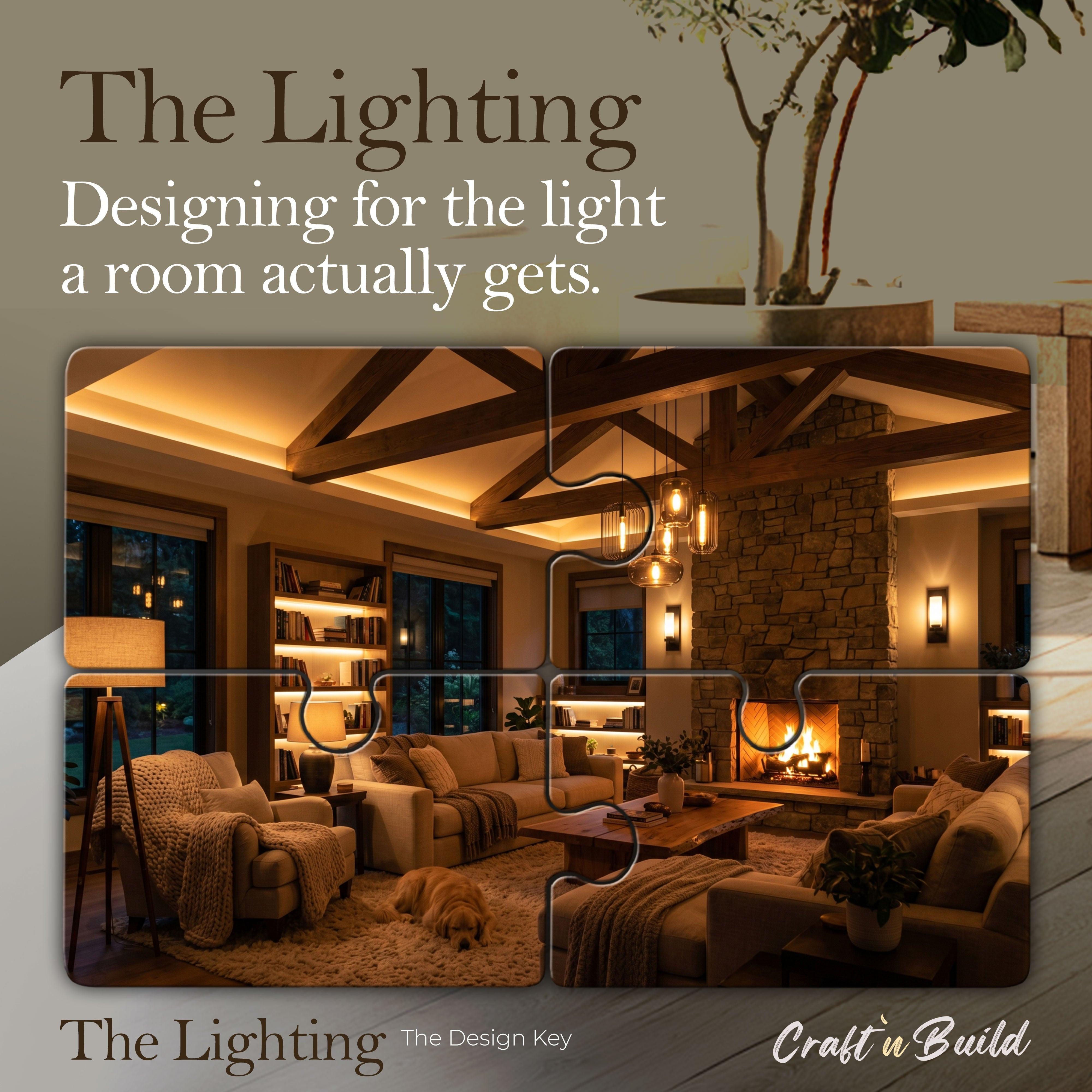
Only once the services are settled do you plan the visible room. You design the laundry workflow as a sequence of stations — sort, wash, dry, fold, store — so the work moves without backtracking, the way a kitchen is planned around cooking. You place the appliances, the sink, and the worktop at workable heights. You give cleaning equipment, waste, and recycling proper, contained homes instead of letting them spill into the kitchen and hallway. Then you specify a material envelope built to take water, dirt, and constant use: floors that survive being wet, walls and worktops that wipe clean, lighting bright enough for close work, and details that stay hygienic and serviceable for years.
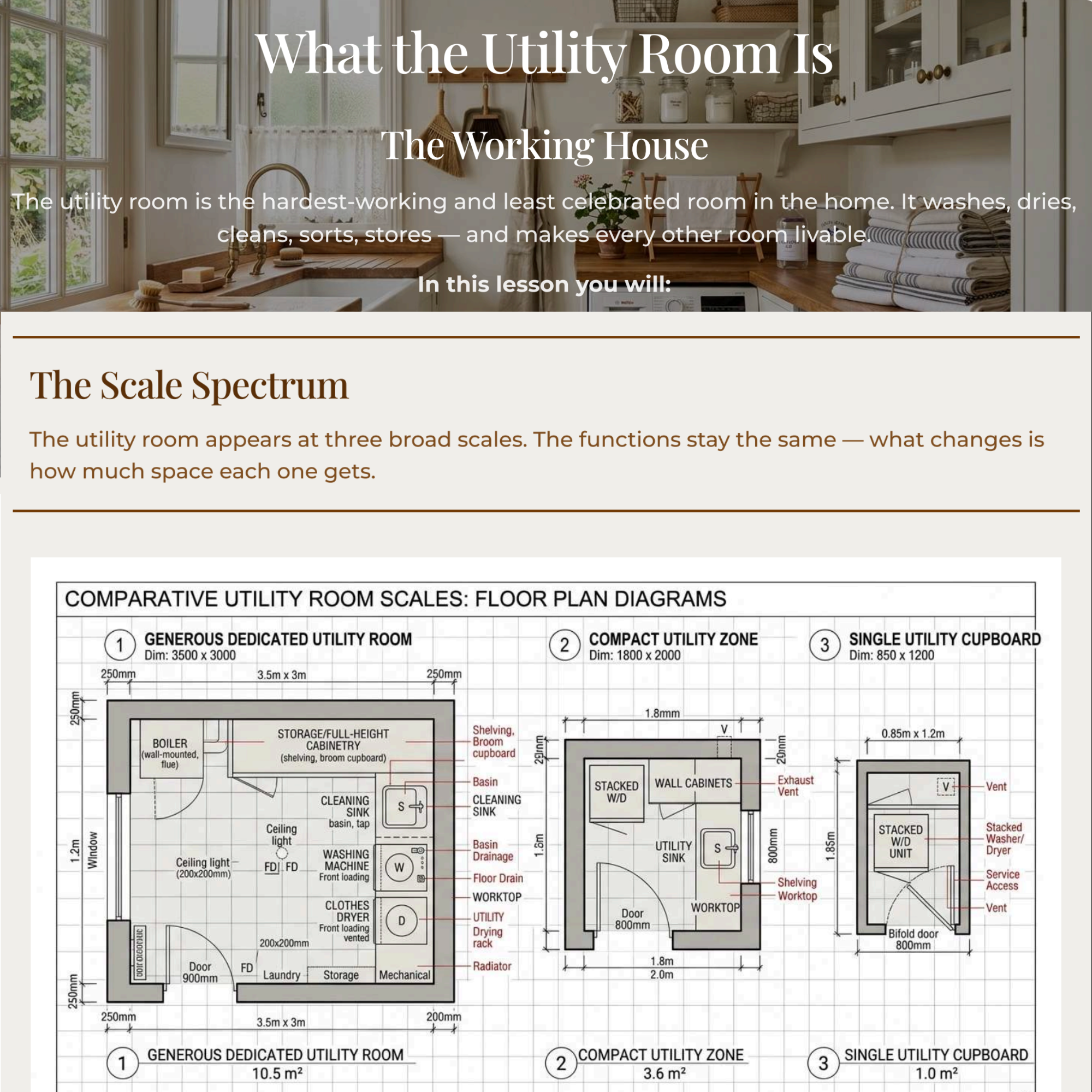
The course holds at any scale. The same functions are designed whether you have a generous dedicated room in a villa or a single tall cupboard, a stacked washer-dryer, or a kitchen-adjacent zone in an apartment — the apartment simply compresses what the villa can spread out. And where the utility room doubles as a back entrance, as it does across much of Europe, you design the wet and dirty side of that threshold: boot and pet wash, drip and dry-off, and the containment of mud and water tracked in from outside. The welcome, the outerwear, and the arrival side of that threshold belong to The Entry, so the two courses meet cleanly at the back door without overlapping.
By the end, you can design a utility room — at any scale, with or without a back-entrance role — that absorbs the working life of the whole home and survives years of it, and document it to a standard a contractor can price and build. The Utility Room sits in the Rooms layer of The Design Key and earns a Course Certificate counting toward the Master Programme.
Six modules. Twenty-nine lessons. Lifetime access. One method you apply to every utility room that follows.
Who is this for
Whether you're a working designer looking to sharpen your process, a design student building professional skills, or a homeowner who wants to approach their own space the way a professional would — the methodology is the same.
No credentials required. No prior experience assumed. Just a commitment to learning how design actually works.
About the Series
The Design Key is a professional methodology series from Craft'n Build. Each course covers a core discipline of interior design practice — taught through the same rigorous, real-world framework used by working designers.
This is not a series about aesthetics. It is a series about method. How professionals think, plan, and execute — and how those skills are available to anyone willing to learn them.
Color, Material & Finish is the first course in the series. Floor Plan, Bathroom, Kitchen and more follows.