



Why most bathroom renovations feel wrong six months later (and the brief question that prevents it)
Most bathroom renovations photograph beautifully on completion day and start to feel wrong by the time the homeowner has lived in them through one full season. The tiles are still pristine. The fixtures still work. Nothing has failed. But something is off, and nobody can quite name it.

The cause is almost never the bathroom itself. It's a decision that should have been made three steps earlier, in the brief — and skipping it is why so many otherwise capable bathroom designs end up as rooms people use efficiently but never enjoy.
What "feels wrong" actually means
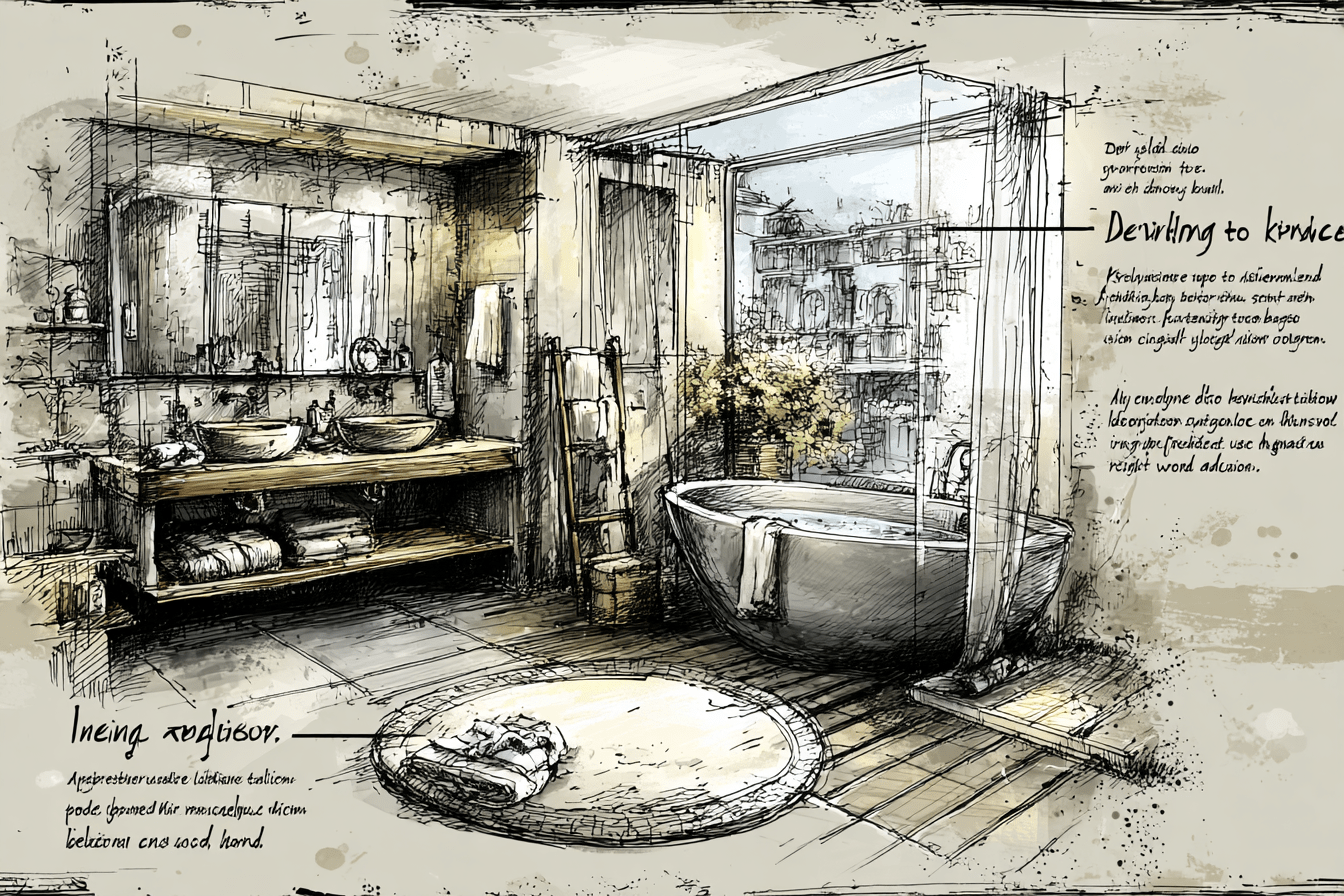
Walk into any of these bathrooms and you'll find the same pattern. The vanity is the right size but in the wrong place for the morning light. The shower is well-built but its glass shows every water mark within hours. The storage looks generous but holds nothing the household actually owns. The materials are individually beautiful but together they create a room that reads as colder, or busier, or flatter than the renderings suggested.
These aren't construction failures. They're brief failures. The designer was given a request — "modern bathroom, walk-in shower, double vanity if it fits" — and built faithfully against it. What was missing was the upstream work: the questions that would have shaped what "modern" meant for this household, in this house, used at these times of day.

Why this happens
A bathroom is a room that fails quietly. Unlike a kitchen, where workflow problems become obvious within a week of cooking, bathroom problems take months to surface. The light is wrong only on grey mornings. The storage is undersized only when guests stay over. The material choice feels heavy only after the novelty wears off.
This delay is why bathroom briefs tend to be thin. The household can't easily articulate what they need because they haven't yet experienced what they don't have. So the brief defaults to features — fixtures, finishes, layout preferences — and the real questions never get asked.
The fix isn't a longer brief. It's a brief built around the questions that surface what features can't.
I've covered the full structure for this kind of brief in The Brief course, but the short version applies specifically to bathrooms in a way worth walking through here.
Three brief questions that prevent the six-month problem

1. What is the bathroom's actual rhythm across a full day?
Not "who uses it" — that's the standard question, and it produces standard answers. The better question is when, in what order, and with what overlap. A bathroom used by two people getting ready simultaneously at 7am has fundamentally different requirements than one used by the same two people at staggered times. The first needs separation — vanity zones that don't compete, lighting that supports two mirrors, storage divided by user. The second can be a single coherent space optimized for one person at a time.
Most briefs collapse these into "a bathroom for two." The room that results works for neither rhythm specifically and ends up feeling slightly wrong for both.
2. What does the household currently store in the bathroom that they wish they didn't?
This question surfaces what the existing bathroom is failing to do, which is far more useful than asking what they want the new one to do. The answers are always specific: cleaning supplies that have nowhere else to go, towels stored in the bedroom because the linen closet is too small, medications kept in the kitchen because the bathroom cabinet is too humid, beauty products lined up on the counter because there's no drawer at the right height.
A bathroom designed against this list of frustrations will feel resolved in a way that one designed against a generic storage spec never will.
3. What is the bathroom's relationship to the rooms it connects to?
A bathroom doesn't exist in isolation. It opens into a hallway, or a bedroom, or both. It's seen from those rooms when its door is open, which it usually is. Its material and color logic has to sit inside the house's larger material and color system, or it reads as a room transplanted from somewhere else.
This is where the foundations stack. The brief identifies the relationship; the moodboard work resolves it. If the bedroom the bathroom opens off is built on warm woods and soft textiles, a bathroom in cool grey marble will feel correct in isolation and wrong in context. The full method for building a material system that holds across rooms is in The Color, Material & Finish course — it's the work that turns a series of well-designed rooms into a coherent home.
The broader principle
The bathroom is a case study for something larger. Downstream design problems are almost always upstream brief or moodboard problems. The room that feels wrong six months later wasn't built badly — it was specified badly, before the designer ever drew a line.
This is why the Design Key starts with the foundations and not the rooms. Brief, Moodboard, Color, Floor Plan — these aren't preliminary steps before the real work begins. They are the work. By the time you reach the bathroom course, the methodology is already in place; the room is just where it gets applied.
The Bathroom course covers the full application — fixtures, layout, materials, lighting, ventilation, the specific things that make a bathroom work as a bathroom. But the questions above belong in any brief, before any of those decisions get made.
If you're planning a bathroom now, ask them. The room you build against the answers will feel right not just on completion day, but six months later, and six years after that.


Share:
Art in Interior Design Ideas for 2026 Homes
Reading Serendipity: What Sherwin-Williams' New Wood Palette Tells Us About the Direction of Warm Neutrals