THE DESIGN KEY SERIES

The Bedroom

The professional method for designing the bedroom as a managed environment for rest — not a furniture-arrangement problem.

What You'll Learn

  • 18 target
    Design the room for every state it lives in

    Read a bedroom as a multi-state environment, not a furniture-arrangement problem, and map how it's used across a full day before any later decision is made.

  • 18 target
    Design for the actual person who sleeps there

    Specify the user across a full 24-hour cycle — sleeping, waking, dressing, undressing, retreating — and turn that profile into a binding layout input.

  • 18 target
    Let the five real constraints set the room

    Resolve the bedroom's five governing constraints — light, sound, air and temperature, adjacency, and electrical demand — as named rule sets the layout has to respect.

  • 18 target
    Place the bed first, then let everything follow

    Make the bed the first decision the way professionals do and let every later layout choice flow from it — with scaled variations for common alternative conditions.

  • 18 target
    Make every surface part of one calm whole

    Specify floor, walls, ceiling, window treatment and bed dressing as one coordinated material story, not five separate finish decisions.

  • 18 target
    Light a room the body falls asleep in

    Layer bedroom lighting to support the body's transition into and out of sleep — dim circuits, two-way switching, and the atmosphere decisions that turn a correct layout into a room that actually rests you.

Four starting points — one method.

Who is this course for

Working designers

Put a repeatable method under the instinct you already have, and sharpen the process you use every day.

Aspiring designers

Build real professional skills from the ground up. No degree, no prior experience needed.

Project owners

Understand the process well enough to brief sharply, judge the work, and manage the people delivering it.

Homeowners

Approach your own space the way a professional would, and stop guessing on decisions that cost real money.

No credentials required. No experience assumed. Just a commitment to learn how design actually works — because the method is the same for all of you.

How to get the most from this course

Four steps to turn watching into doing.

1

Set up to work, not just watch

Have pen and paper beside you. This is a course you do, not one you passively watch — the method only sticks when you work it by hand.

Have pen and paper beside you. This is a course you do, not one you passively watch — the method only sticks when you work it by hand.

2

Take one module at a time

Each module is a complete idea. Work through one per sitting, finish its exercise before moving on, and let it settle rather than racing to the end.

Each module is a complete idea. Work through one per sitting, finish its exercise before moving on, and let it settle rather than racing to the end.

3

Apply it to a real space as you go

Use your own home, a past project, or an imagined brief. Run each method on something real so it becomes a skill, not just notes.

Use your own home, a past project, or an imagined brief. Run each method on something real so it becomes a skill, not just notes.

4

Expect about a week, at your pace

Most people complete a course in around a week at a relaxed module-a-day rhythm — faster if you push, slower if you savour it. There's no clock; lifetime access means you set the speed.

Most people complete a course in around a week at a relaxed module-a-day rhythm — faster if you push, slower if you savour it. There's no clock; lifetime access means you set the speed.

See the actual work

Not slides. Not tips. These are real pages from inside the courses — the kind of professional documentation The Design Key teaches you to produce.

01

The Brief

Every project begins by defining what it actually is. The Brief teaches the four-dimension framework that stops a project breaking down before it's finished — documented the way a working studio does it.

02

The Moodboard

The difference between a professional moodboard and a Pinterest board, made explicit. You learn to build a strategic visual document that directs a project — not a folder of images you happen to like.

03

The Lighting

Light designed as a system, not chosen as a fixture. The Lighting teaches you to read how daylight enters a room hour by hour, and to plan an artificial scheme that works with it instead of fighting it.

04

The Kitchen

Where the method meets millimetres. The Kitchen takes you into real fabrication-level decisions — joint placement, material limits, service coordination — the technical depth that separates a finished room from a styled one.

FAQ

What is "The Design Key"?

The Design Key is a series of professional methodology courses from Craft'n Build, each covering one core discipline of interior design — the Brief, the Mood Board, the Floor Plan, Lighting, the Kitchen, and more. It teaches how working designers actually think, plan and execute, through the same rigorous framework used in real practice. It's about method, not aesthetics or inspiration.

Who is this for?

Anyone who wants to learn professional interior design method, whatever their starting point — working designers, students and career-changers, homeowners approaching their own space properly, and project owners who need to brief and judge the work. No credentials or prior experience required. The method is the same for everyone.

What do I get, and how do I access it?

Everything is online and yours the moment you buy — instant access, no waiting, nothing shipped. You watch the course in your browser on any device and download the accompanying course material to keep. Access doesn't expire.

Is the course video, text, or both?

Both. Each course combines video lessons with a downloadable written guide and practical exercises, so you can watch, read, and work through the method by hand — which is how it's designed to be learned.

Do I need any experience or special software?

No. The courses assume no prior experience and no expensive software — just a willingness to work through the method. Where a tool is useful, the course shows you accessible options. The method matters more than the software.

How long do I have to complete a course?

As long as you like — access is for life, with no deadline. Most people work through a course in about a week at a relaxed module-a-day pace, faster if they push. You set the speed and can return to the material whenever you need it.

Do I get a certificate?

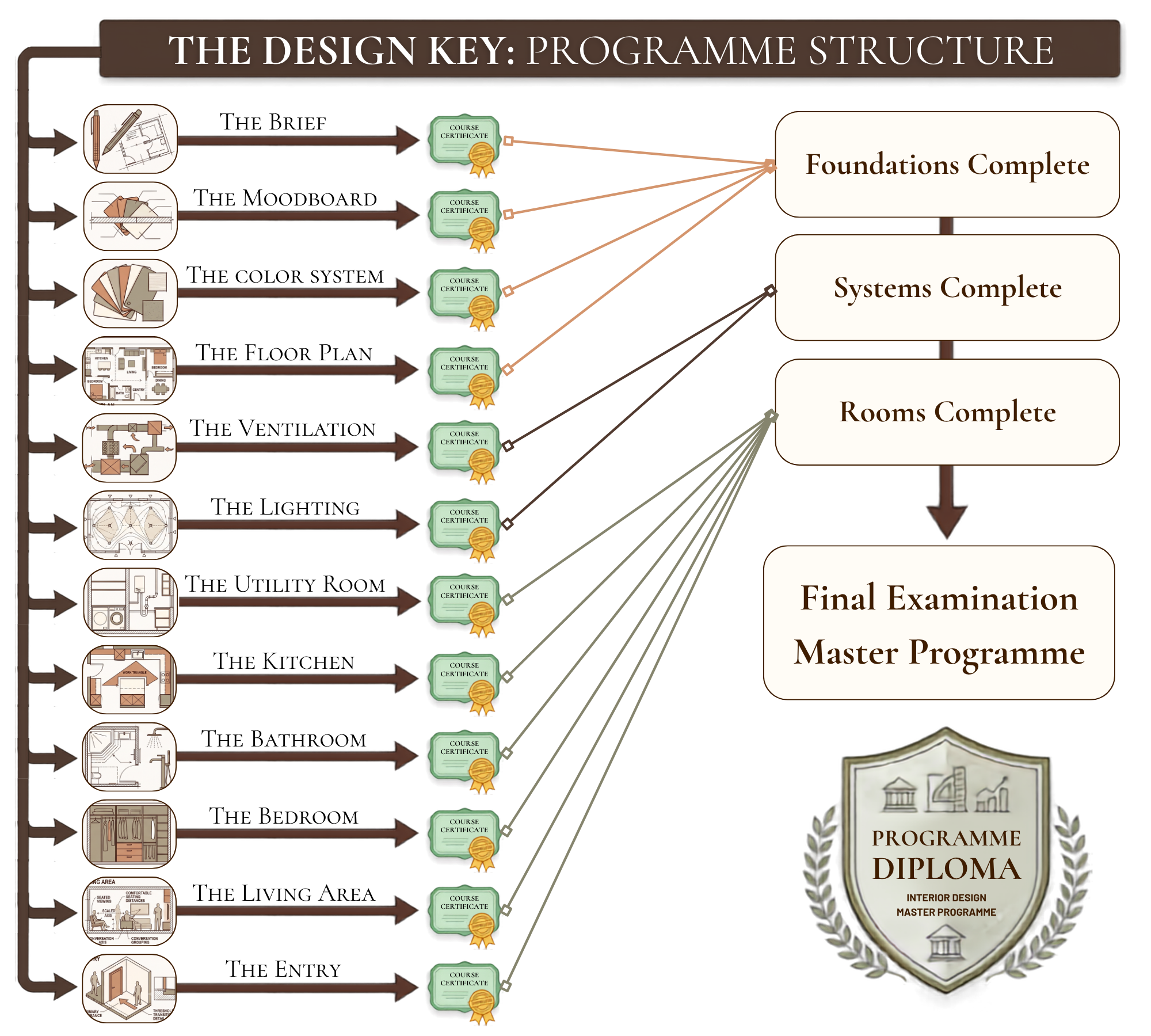
Yes. Complete any course and you earn a Certificate for that discipline. Complete all twelve and pass the final synthesis exam — which tests your ability to solve real problems across several disciplines at once — and you earn the Design Key Diploma, a credential that reflects mastery of the whole method, not just course completion.

What is "The Master Programme"?

The Master Programme is the full path: all twelve courses together, leading to the Design Key Diploma. You don't commit up front — every single course you take counts toward it. Start with one; the whole programme stays open to you.

Can I just buy one course, or do I have to take the whole series?

Start with a single course — most people do. There's no obligation to take more, but everything you complete counts toward the Master Programme and the Diploma, so a single course is also a first step if you decide to go further.

Do you offer a refund?

Yes — if a course isn't right for you, contact us and we'll make it right.

Didn’t find your answer?

Don't hestitate to contact us

THE DESIGN KEY

About the Programme

Start with one course

Learn a complete discipline — the Brief, the Mood Board, a room — and earn its Certificate. One course is a real skill on its own.

Build toward the whole

Every course you complete counts toward the Master Programme. You're never starting over — always adding to the same path.

Earn the Diploma

Complete all twelve and pass the synthesis exam to earn the Design Key Diploma — proof you can integrate the whole method, not just finish the courses.

The Design Key — Master Programme

1 of 12 courses toward the Master Programme. Every course counts.

Every single course counts towards the full Master Programme.

Description

Short description

The bedroom is the most under-designed room in residential interiors. It is the room people spend a third of their life inside — and it is most often treated as a furniture-arrangement problem instead of what it actually is: a managed environment for the body's transition between waking and sleeping states.The Design Key — Rest, Body & Room teaches the professional methodology for designing a bedroom as a complete restorative system. The three governing forces are rest, the body, and the room — and every bedroom decision is a negotiation between them. You will learn to design from physiological function, not from styling defaults, and leave with a complete bedroom layout, a full body-state specification, a constraint rule set, surfaces and textiles, lighting and atmosphere — and twenty-seven named professional tools you apply on every bedroom that follows.

Full description

The Design Key — Rest, Body & Room is a professional interior design course that teaches the methodology for designing a bedroom as a complete restorative system rather than a styled furniture arrangement. The bedroom is the most under-designed room in residential interiors — the room people spend roughly a third of their life inside, and the one most often treated as if it only mattered for the hours they spent awake in it. A bedroom is not a room with a bed in it. It is the physical environment in which the body downshifts from sympathetic to parasympathetic, the visual cortex stops processing input, the body temperature drops, the muscles release, and the mind consolidates the day into memory. A designer who understands what the bedroom is doing designs a fundamentally different room than one who treats it as a layout problem. This course teaches that methodology across six modules, thirty-two lessons, and twenty-seven named professional tools.

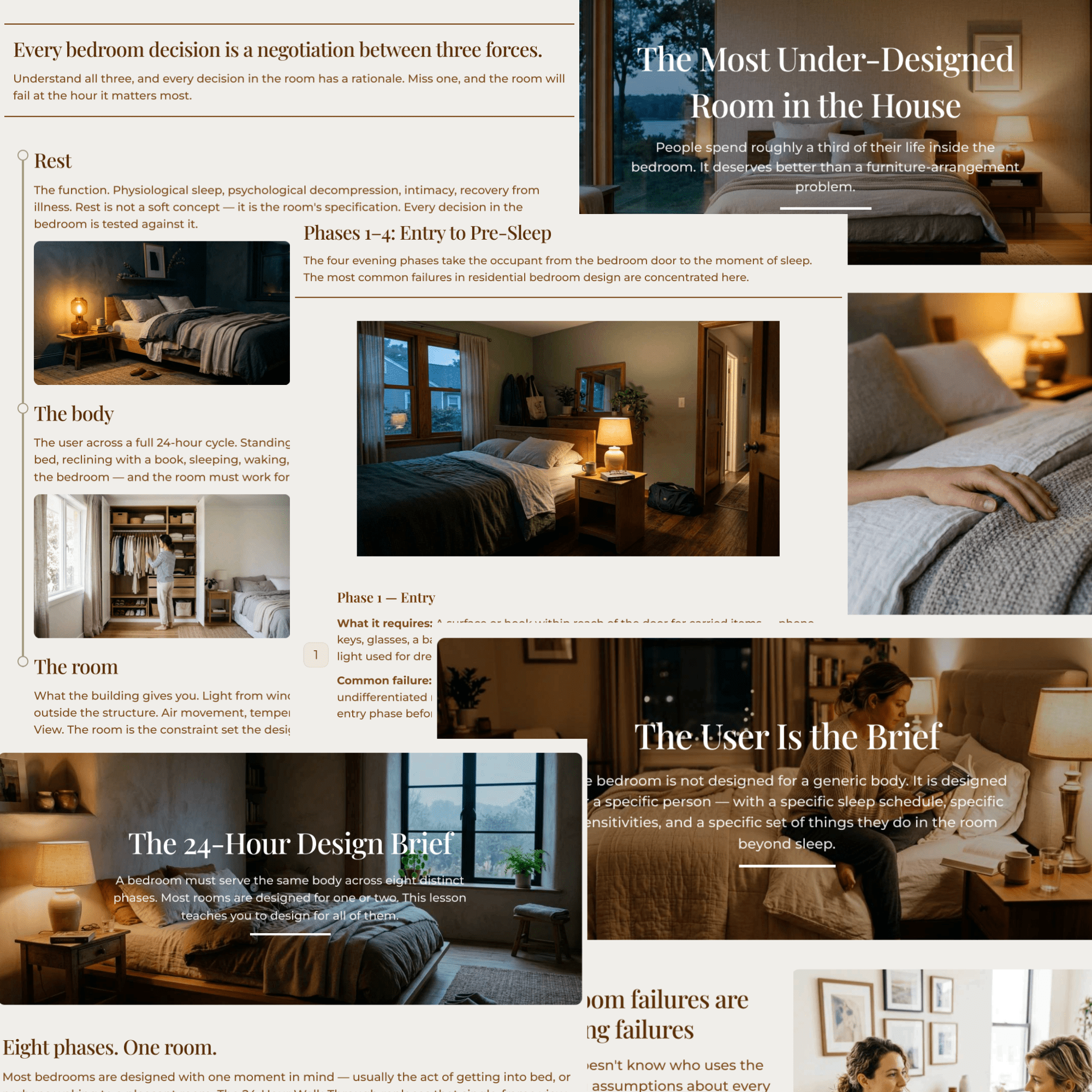
The three governing forces of the bedroom are rest, the body, and the room. Rest is the function: physiological sleep, recovery, decompression, intimacy. The body is the user across a full 24-hour cycle — standing, sitting, reclining, sleeping, waking, dressing, undressing, retreating — not the upright daytime user that most rooms are designed for. The room is what the building gives you: light at every hour, sound from inside and outside the envelope, air quality and movement, temperature, adjacency to other rooms, view, and the electrical capacity to support all of it. Every bedroom decision is a negotiation between these three forces, and the course is built to make those negotiations explicit, defensible, and repeatable.

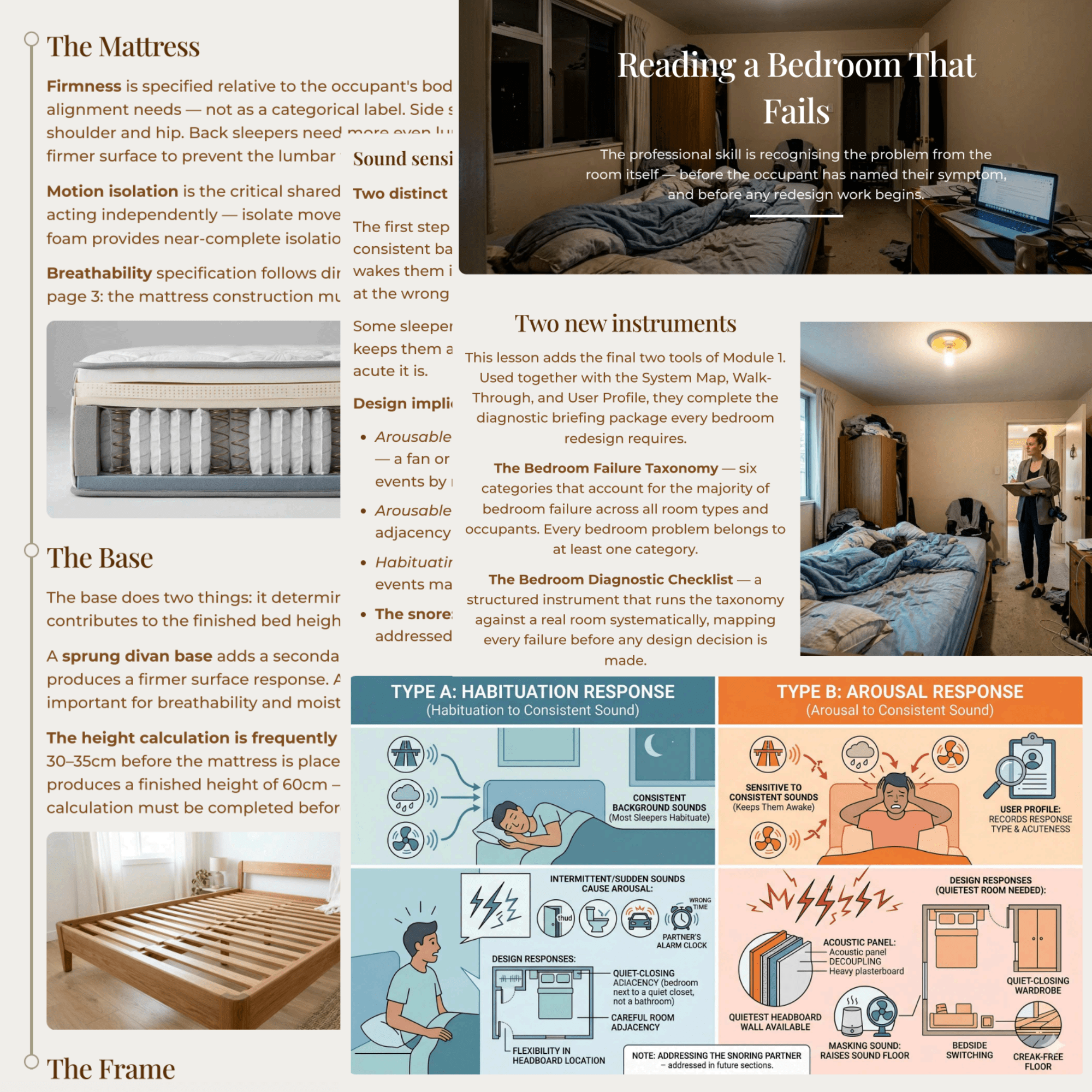
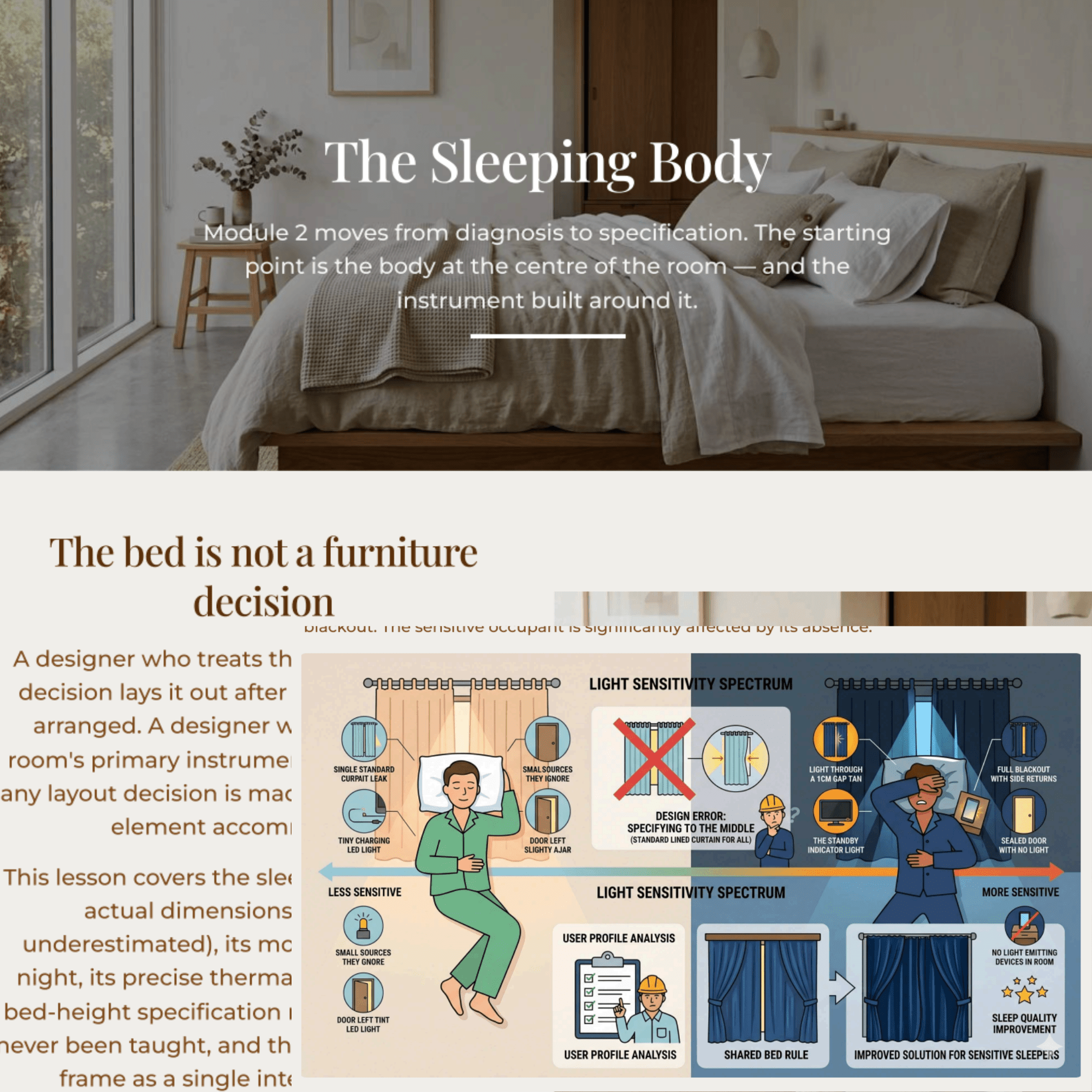
You will learn how a bedroom actually works as a multi-state environment — and how to draw the System Map and the 24-Hour Walk-Through that show the room performing every job it has to do. You will learn how to build a complete user profile across all body states in the room, not just the sleeping one. You will learn the constraint rule sets that govern bedroom layout: the light rule set, the sound rule set, the air and temperature rule set, the adjacency rule set, and the Bedroom Electrical Specification that most designers underestimate. You will learn to write the Bedroom Layout Intake Sheet that carries those constraints into the layout module.

You will learn the layout method in detail — the single largest module of the course — beginning with bed position as the first decision, and every subsequent decision flowing from it. You will resolve the bed against the door, the window, the light, the sound, and the user. You will work through three example rooms and produce three scaled variations of your own layout. You will learn surfaces and textiles as a specified system: floor, walls, ceiling, window treatment, and bed dressing as one coordinated specification rather than five separate finish decisions. You will learn the lighting and atmosphere method: layered lighting that supports the body's transition into and out of sleep, dim-circuit specification, two-way switching from bed to door, and the atmosphere decisions that turn a correctly designed bedroom into one that actually feels like a sanctuary.

The course is built to a single teaching test: at the end of each lesson, the student knows how to do something. Every lesson hands over a named tool — checklist, rule set, specification, intake sheet — and those tools compound across the modules so the final layout is built from the discipline of everything that came before. Twenty-seven named tools in total.

The Bedroom sits in the Rooms layer of The Design Key, alongside The Bathroom, The Kitchen, The Living Area, The Entry, and The Utility Room. It is a stand-alone course with its own Course Certificate, and it counts toward the Master Certificate of the full Design Key Master Programme. By the time you finish, you will have a complete bedroom layout — fully specified, defensible, decision by decision — and a reusable professional toolkit you apply to every bedroom project that follows.

EMPTY DOM REMOVE PROTECTOR