Interior design notes · Nov 26, 2026 · Read · 15 min
Managing Bespoke Items From Concept to Install
A practical guide to bespoke furniture management for interior design studios, from capturing specs to tracking lead times and install.
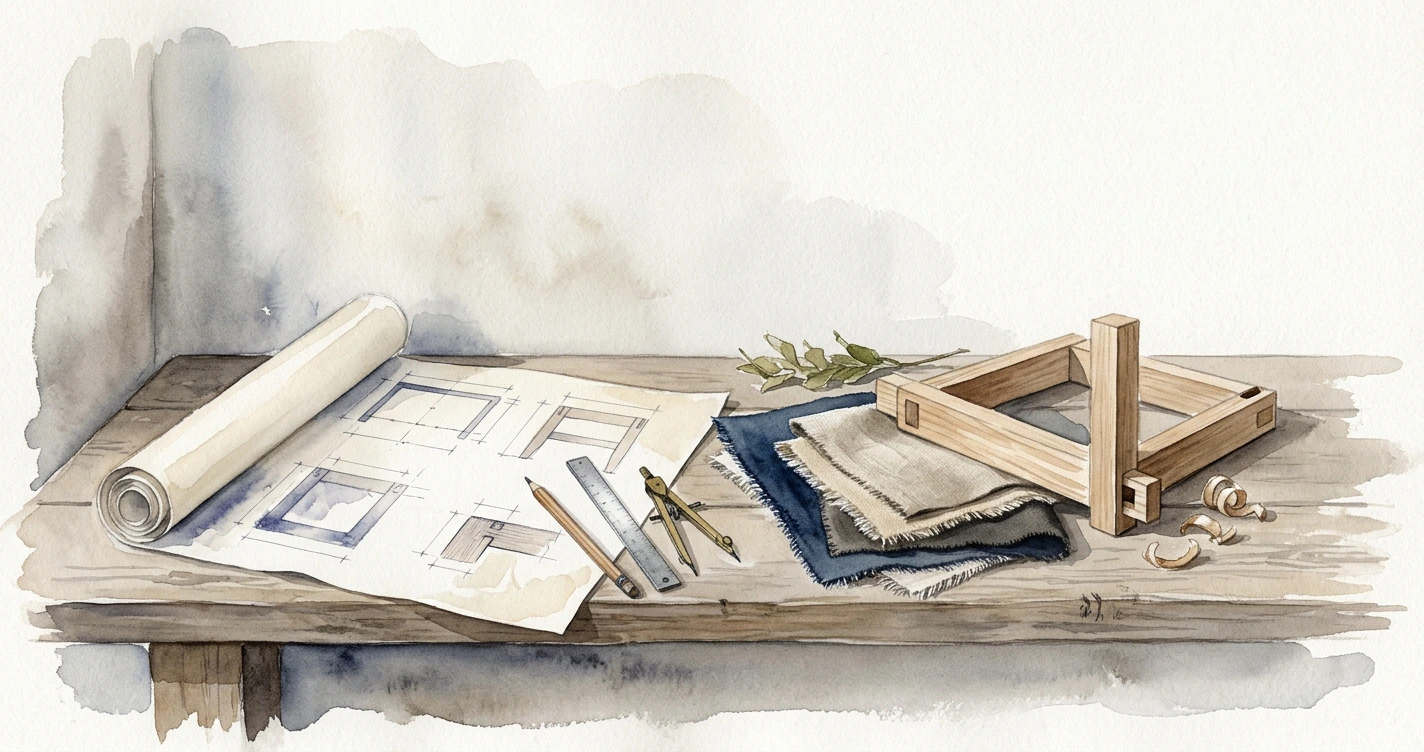
A bespoke item is the piece most likely to derail an install, and it is also the one most studios track the least carefully. Treat every custom chair, joinery run or one-off table as its own small project with its own specs, approvals and dates, and the risk drops sharply. This guide walks through practical bespoke furniture management for interior design studios: how to capture what you are making, keep the maker on track, hold the right approvals, keep the client confident, and tie all of it back to the wider project so a single slipped date never surprises you on handover day.
Custom work is a growing share of what studios specify. The global customized furniture market was valued at USD 39.55 billion in 2025, according to Straits Research. More bespoke pieces per project means more one-off items to design, approve, order and chase, and that is exactly the work that spreadsheets and email threads handle badly.
Why custom pieces need their own tracking workflow
Custom pieces fail differently from catalog pieces, which is why they need their own workflow. A standard sofa that arrives damaged can be reordered against a known SKU in days. A bespoke banquette built to the wrong radius has to be remade from scratch, and the clock starts again from the maker's queue. The cost of a mistake is measured in weeks, not in a return label.
The second difference is memory. A catalog product is fully described by its product page. A bespoke item exists only in the notes, sketches, samples and conversations your studio generates while creating it. If those are scattered across inboxes and drives, the single source of truth for the piece does not actually exist anywhere. Someone has to reconstruct it under pressure, usually the week before it is due.
The third difference is dependency. Custom pieces sit on the critical path far more often than standard ones because they take longer and cannot be swapped out late. When a project slips, the bespoke item is frequently the reason. Industry data backs this up: in the American Institute of Architects' December 2024 Architecture Billings survey, 14 percent of firms reported projects that were significantly delayed, and 40 percent of firms pointed to contractor bids and schedules running too long as a cause of delay. Long-lead custom work is squarely inside that risk.
A dedicated workflow answers three questions at a glance for every custom piece: what exactly are we making, where is it in its journey, and what is the next date that matters. Standard FF&E rarely needs that level of attention. Bespoke items always do.
What bespoke furniture management should actually cover
Not every modified product is a true bespoke item, and over-tracking wastes effort. Draw a clear line so the workflow stays focused. A piece belongs in the bespoke track when it meets any of these tests:
It is designed or dimensioned specifically for this project and cannot be reordered from a catalog.
It requires shop drawings, a sample or a prototype before production.
It needs client sign-off on a drawing or finish before the maker starts.
Its lead time is driven by a maker's production queue rather than warehouse stock.
By that definition, a joinery run, a custom rug woven to a plan, a reupholstered heirloom, a made-to-measure headboard and a commissioned light fitting all qualify. A standard dining chair in a non-stock fabric usually does not; it is a configured catalog item, and your normal procurement process handles it fine.
The reason to be strict is attention. If everything is flagged as bespoke, nothing is. Keep the list to the pieces that genuinely carry one-off design and maker risk, and the people responsible can actually watch them.
Capturing specs, drawings and maker communication
Every bespoke item needs one versioned record that holds its complete definition, because the piece that ships must match the piece that was approved. That record should carry the dimensioned drawings, the materials and finishes, the hardware schedule, the quantity, the maker, and the agreed price. When any of those change, the change lives in the same place rather than in a reply three levels deep in an email chain.
Version control is the part studios most often skip and most often regret. A maker who builds to revision B after the client approved revision C has produced an expensive mistake that is nobody's fault and everybody's problem. Name and date every revision, mark clearly which one is approved for production, and make sure the maker is working from that exact file. A good rule is that production never starts against a drawing that is not explicitly stamped as the approved version.
Keep maker communication attached to the item
Decisions made by phone or in a workshop visit are the ones that vanish. When a maker proposes a different joint detail to hit the budget, or flags that a veneer is out of stock and suggests an alternative, that exchange is part of the item's definition. Record it against the item: the question, the decision and who approved it. The goal is that anyone picking up the project cold can read the item record and understand not just what is being made, but why it is being made that way.
Standardize the spec so nothing is assumed
Makers quote and build against what the drawing says, and they are entitled to assume anything unstated is your problem, not theirs. A short internal checklist prevents the common gaps:
Overall dimensions, plus the critical internal measurements, with tolerances called out wherever a tight fit actually matters.
Materials, finishes and sheen level, named precisely. "White oak, matt lacquer" beats "light wood, natural finish".
Edge details, joint methods and hardware, with model numbers for anything bought in.
Site constraints: access widths, lift dimensions, floor levels and service locations.
Who delivers, who assembles, and whether the maker installs.
That last line about access is the one that quietly ruins installs. A beautiful nine-foot wardrobe that cannot turn the corner into the bedroom is a total loss. Capturing the route to the room in the spec, not on install day, is basic bespoke furniture management.
Managing lead times and approval milestones
Bespoke lead times are long and getting longer, so custom items should be ordered first, not last. Where a studio might leave standard furnishings until the scheme is locked, confirming a custom piece late is the single most reliable way to miss the install date. A realistic custom timeline often runs through design, drawing approval, sampling or prototyping, a production queue and then delivery, and each of those stages can absorb weeks on its own.
Break the timeline into milestones and track the item against them rather than against a single far-off delivery date. A workable set of milestones for a typical custom piece looks like this:
Concept agreed with the client and the budget confirmed.
Shop drawings issued by the maker.
Drawings approved for production, with the approved revision stamped.
Sample or prototype signed off, where the piece warrants one.
Materials secured by the maker.
Production complete and ready for delivery.
Delivered, installed and snagged.
The value of milestones is early warning. A delivery date that is twelve weeks out tells you nothing until it is too late to act. A missed "drawings approved" milestone in week two tells you immediately that the delivery date is now at risk, while you still have room to push the maker, chase the client or reorder the sequence.
Build buffer where the risk actually lives
Buffer time is not padding spread evenly across the schedule. Put it where failures cluster: sampling and client approval. Makers are often reliable once they start cutting; the unpredictable stretch is the back-and-forth before production begins, where a rejected sample or a slow client decision can add weeks. Hold a realistic approval window in the plan and treat the maker's own lead time as relatively fixed.
Track dependencies between bespoke items and the site
Custom pieces rarely stand alone. A bespoke vanity depends on the plumber's rough-in; built-in joinery depends on finished wall surfaces and accurate site dimensions; a hanging light depends on the electrician's drop being in the right place. A bespoke tracking workflow should record these site dependencies against the item, so the maker's production date is checked against the trades that have to be finished first. Ordering a built-in to arrive before the walls are ready just moves the storage problem to you.
Handling site measurements and the gap before production
The riskiest handoff in any custom piece is the move from design dimensions to final site dimensions. Early drawings are based on the architect's plans, but built walls are rarely exactly what the plans say. A built-in cabinet drawn to a nominal three-metre alcove will not fit a built alcove that came out at 2,970 millimetres. Someone must take a final site measure and reconcile it with the approved drawing before the maker commits material.
Build that reconciliation in as an explicit step, not an assumption. The item record should show both the design dimension and the verified site dimension, and flag any difference for the maker to confirm before production. For projects where the site is not ready in time, agree with the maker which dimensions are fixed and which are held open, so the queue slot is not lost while the last measurement is pending. Accurate floor plans make this far less painful, because the base drawings have to be reliable enough for a maker to cut material against.
This is also where photographing and logging existing conditions pays off. A radiator, a sloping ceiling or an out-of-square corner that nobody recorded becomes an argument about liability once the piece does not fit. A dated site photo attached to the item record settles it.
Keeping clients informed on custom progress
Clients judge a studio heavily on how informed they feel, and custom pieces are where that feeling is won or lost. The item is invisible for weeks while it sits in a workshop, so silence reads as neglect even when everything is on track. The fix is rarely more detail. What clients want is a steady, simple view of where each piece stands.
Give the client a per-item status that answers three things: what stage the piece is in, what the next milestone is, and when that milestone is expected. Most clients do not want to see the maker's cutting list or internal cost notes. They want confidence that the commissioned dining table is in production and due in a known month, and that someone is actively watching it.
Match the update to the moment
The useful moments to update a client are the milestones, not a fixed weekly email that often has nothing new to say. Sign-off requests, a sample ready for approval, production starting, and a confirmed delivery window are all natural touchpoints. Approvals in particular should be explicit and recorded: when a client approves a finish or a drawing, capture it against the item so there is no later dispute about what was agreed.
Protect the studio with a clear approval trail
A documented approval is as much protection for the studio as a courtesy to the client. If a client later dislikes a timber tone they signed off on, the record of that approval turns a potential dispute into a short conversation. The same discipline that prevents maker errors, naming and dating every approved revision, also prevents client disputes. The rule is the same one that keeps a brief from drifting into scope creep: write the decision down when it is made, not when it is contested.
When a date does slip, tell the client early and with a plan. A delay explained in week three with a recovery option is a managed project. The same delay revealed on install day is a damaged relationship.
Centralizing bespoke items alongside the full project
Bespoke items should live in the same system as the rest of the project, because a custom piece that is tracked in isolation cannot tell you what its slippage does to everything else. When a maker pushes a delivery by three weeks, that single fact should ripple automatically: the install sequence shifts, the schedule updates, the budget reflects any revised cost, and the client-facing status changes. If the bespoke item lives in a separate spreadsheet, every one of those updates is a manual task that someone has to remember to do.
This is where CB Studio earns its place. Craftnbuild keeps bespoke items on the same project record as standard procurement, the schedule and the client presentation, so the custom table, the catalog sofa and the lighting package are all visible in one place with their own statuses and dates. The difference matters most on a busy project with a dozen custom pieces at different stages, where no single person can hold the full picture in their head.
Centralizing also fixes the reporting problem. A principal who wants to know "are we going to hit the install date" should be able to see, in one view, which items are on track and which are the three holding everything up. Bespoke items that are scattered make that question unanswerable without an afternoon of chasing.
Keep bespoke items connected to procurement and the schedule
A custom piece is both a procurement line and a schedule dependency, and it needs to behave as both. Treating it only as something to be purchased ignores its install sequencing; treating it only as a task ignores its cost and payment stages. Keeping it inside the broader procurement process, the same one you apply to standard orders, means deposits, balance payments and delivery tracking are handled consistently. Studios choosing tools for this should weigh how custom items are handled, not just catalog orders, because the bespoke pieces are where generic procurement workflows tend to break down.
Tracking budget, deposits and payment stages
Bespoke items carry a payment structure that standard orders rarely do, and losing track of it costs real money. Makers almost always work on deposits, often a substantial percentage up front with the balance due before or on delivery. Across a dozen custom pieces, that is a schedule of staged payments that has to be tracked per item, reconciled against the client's budget, and released at the right moment.
Attach the financial stages to the same item record that holds the specs and milestones: the agreed price, the deposit paid and its date, the balance outstanding, and the trigger for the final payment. Two failures are common without this. A deposit gets paid twice because nobody recorded the first, or a maker holds a finished piece until a forgotten balance is settled. Both are avoidable with one accurate record.
Budget tracking for bespoke work also has to absorb the variations custom pieces invite. A client who upgrades a finish mid-build, or a site condition that forces a design change, moves the price. Capturing that variation against the item, with the client's approval of the new cost, keeps the project budget honest.
Managing delivery, install sequencing and snagging
The last mile of a bespoke item is where careful tracking either pays off or falls apart. Custom pieces often cannot simply be delivered to site and left; they may need to arrive in a specific order, be carried by hand, be assembled in the room, or be installed by the maker's own fitters. Sequencing this is part of the workflow, not an afterthought for the install crew.
Plan the delivery order against the state of the site. Built-in joinery goes in before the loose furniture that sits in front of it. A rug goes down before the table that stands on it. Large pieces go in before doors are hung or corridors are furnished. Recording the required install sequence against each item, and checking it against the construction programme, prevents the common scene of a maker arriving with a wardrobe that cannot reach the room because the hall is already full.
Snagging closes the loop. A bespoke piece should be inspected against its approved drawing on delivery, and any defect logged against the item while the maker is still engaged and the balance payment is still leverage. A snag raised at handover, after final payment, is far harder to resolve. The same item record that tracked the piece through production becomes the checklist for signing it off. Tying the finished pieces into the client presentation is easier when the project is already centralized, so the client can see how each commissioned piece sits in the finished room before it ever arrives.
Common failure points and how to avoid them
Most bespoke problems trace back to a handful of repeatable failures, and knowing them lets you design the workflow to catch each one. The recurring causes are worth naming directly:
Building to the wrong revision. Prevented by stamping one approved drawing and forbidding production against anything else.
Ordering too late. Prevented by sequencing custom items first and tracking the approval milestones, not just the delivery date.
Site dimensions that never got verified. Prevented by making a final site measure an explicit gate before production.
Approvals that were verbal and are now disputed. Prevented by recording every client sign-off against the item.
Access that was never checked. Prevented by capturing the route to the room in the spec.
Payments that slipped through. Prevented by holding deposit and balance stages on the item record.
None of these are exotic. They are ordinary oversights that a dedicated workflow turns into checklist items instead of crises. The studios that run custom work smoothly tend to be the ones who never let a bespoke item fall out of view, whatever the talent of their makers. The same rigor you apply to a standard FF&E schedule that stays accurate is what keeps bespoke items honest: one record, kept current, that everyone trusts.
Putting a bespoke workflow in place
Start with your next project and pick a single rule to adopt: every bespoke item gets one record, and production never begins against an unapproved drawing. That one change prevents the most expensive category of custom mistakes on its own. Once it is habit, layer in the milestones, the client status view and the payment stages, and connect the whole thing to the project schedule so a slipped date updates everything it touches. Managing bespoke items well is mostly a matter of refusing to let any custom piece become invisible between concept and install, and a studio that holds that discipline will hand over finished rooms on time far more often than one that trusts the pieces to look after themselves.
Questions & answers
- What is bespoke furniture management?
- It is the process of tracking custom-made pieces from the first concept sketch through specification, maker production and final install. Because each item is unique, it needs its own records, approval milestones and lead-time monitoring rather than being lumped in with standard products.
- Why do bespoke items need a separate workflow from standard FF&E?
- A catalog item can be reordered in days if something goes wrong. A bespoke item cannot. It carries one-off drawings, maker-specific lead times and client sign-offs at each stage, so an error or a missed approval can cost weeks and is far harder to recover.
- How far ahead should bespoke items be ordered?
- Order them first, before standard furnishings. Custom lead times commonly run several months once you include design approval, sampling and production, so a bespoke piece confirmed late is the item most likely to miss the install date.
- How do you keep clients updated on custom furniture progress?
- Share a simple per-item status that shows the current stage, the next milestone and the expected date. Clients rarely need shop-floor detail; they need confidence that the piece is moving and that someone is watching the dates.
Written by Craftnbuild