Interior design notes · Nov 25, 2026 · Read · 10 min
Interior Design Course for Beginners: How to Choose
How to pick a beginner interior design course: what it should teach, how to judge the level, and how the path to professional credentials works in the US.
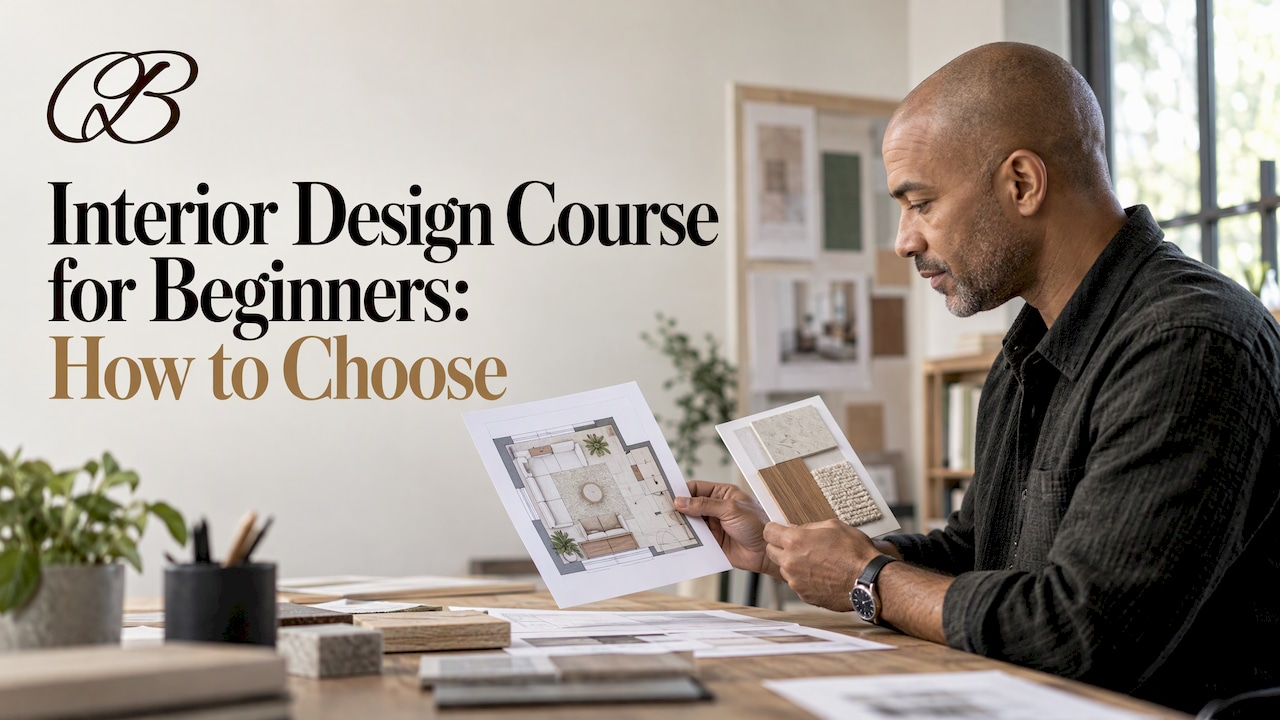
The best interior design course for a beginner teaches one design decision at a time, in the order a real project makes them, and has you apply each one to a space of your own. Start with a brief, move through the floor plan, then light, color and each room type. Our room-by-room courses at Craft & Build follow that order. Each costs $89 one-off with lifetime access, so you can start with the stage you need rather than pay for a full program.
This guide covers what a beginner course should contain, how to read a course’s level, how to practice while you learn, and when a beginner course is enough and when you need formal education.
Craft'n Build - Creator Studio ApS
craftnbuild.com
Build Your Interior Design Skills
Craft & Build offers master-level courses for aspiring spatial designers, helping bridge the gap between design theory and practical application.
Visit
TL;DR
A good beginner course needs no prior knowledge. It teaches the brief, space planning, color, lighting and room-by-room decisions, then makes you apply them.
Check the level label. Professional education guidelines define “basic” content as content that assumes no substantial prior knowledge.
Learning by project beats watching lectures. Finish every course with something you can show: a plan, a mood board, a specification.
If you want to be licensed or use a protected title in some US states, you need accredited education, work hours and the NCIDQ exam. A beginner course is the first step, not the whole route.
Our courses are priced from $52 to $89 each, one-off, with lifetime access. Browse them on the courses page.
Table of Contents
What a beginner interior design course should teach
Do you need experience or software to start?
How to judge a course before you buy
Self-paced courses or classes with a schedule?
Build a portfolio while you learn
Which of our beginner courses to start with
When a beginner course is enough, and when it isn’t
If you already work in a studio or on site
Start with the course that matches your first project
FAQ
Sources
What a beginner interior design course should teach
A beginner course should leave you able to take a room from a client’s first request to a finished layout, without guessing. That means the fundamentals come in project order, not as a list of theory topics.
1. The brief. Every project starts by working out what the people using the space need, what the budget is and what can’t change. Beginners often skip this and start picking furniture. A course that starts with the brief teaches you the habit that separates design from decorating.
2. Mood and color. Mood boards turn a vague feeling into decisions the client can approve. A color system keeps a whole home consistent, so each room has a reason for its palette instead of being picked in isolation.
3. The floor plan. This is the most important skill. Circulation, clearances, furniture sizes and how a door swings decide whether a room works. If you want to see how plans are drawn for real projects, our practical guide to floor plans for interior designers walks through it.
4. Light and air. Lighting and ventilation are the two systems most beginners ignore and clients feel every day. A decent course treats them as design topics, not afterthoughts for the electrician.
5. Room types. Kitchens, bathrooms, bedrooms, living areas, utility rooms and entries each have their own constraints. Wet rooms need different thinking from a bedroom. Learning them one at a time makes the rules stick.
6. Materials and craft. Finishes, joinery and upholstery tell you why a design costs what it does and how it gets built. Knowing this early makes your drawings more buildable.
One of the most common beginner course syllabi is the elements and principles of design: balance, rhythm, harmony, emphasis, proportion and scale. They are useful vocabulary. They only become skill when you apply them to a real plan, so judge a course by how much of it asks you to produce something.
Do you need experience or software to start?
No. A beginner course should not assume either. The American Society of Interior Designers (ASID) defines basic-level education content as information introduced without substantial prerequisite knowledge, while intermediate content expects some prior knowledge and practice, and advanced content expects substantial prior knowledge and application. If a course for beginners lists prerequisites, it is mislabeled.
Software is a later decision. Learn to think through a plan on paper or in a simple drawing tool first. CAD and 3D modeling make sense once you can explain why a layout works. When you reach that stage, our overview of 3D modeling tools for interior designers shows what to look for, and our shop carries 3D CAD files modeled to true dimensions.
How to judge a course before you buy
Use five checks. They apply to any course, ours included.
Check
What a good answer looks like
Level
Labeled beginner, no prerequisites, with a clear next level
Order
Follows a project: brief, plan, color, light, rooms
Application
Exercises that produce a plan, board or specification
Scope
One topic taught properly, not twenty skimmed
Access
Lifetime or long access so you can return when a real project arrives
ASID’s framework describes learning as moving through awareness, application, analysis and achievement. It lists exercises, tests and case studies as ways to apply what you learn, and names practicality, relevance and scaffolded curricula as what motivates adult learners (ASID Education Guidelines). Read that as a buyer’s test: does the course move you from knowing a term to using it?
If you are comparing formats, our write-up of six online interior design course options sets out the trade-offs.
Self-paced courses or classes with a schedule?
Self-paced courses suit people with jobs or other commitments. You work when you have time and repeat the parts you need. Scheduled classes add deadlines and live feedback, which helps some learners stay on track. If you are weighing formats for a degree or certificate, this overview of online, hybrid and in-person classes helps you think through the choice.
For most beginners who are testing whether design is for them, a single-topic, self-paced course costs far less than a certificate and still produces real work. Lifetime access matters here: you will come back to the lighting or kitchen lesson when a project needs it, months after you bought it.
Build a portfolio while you learn
A course certificate says you finished something. A portfolio shows you can design. Treat every lesson as a portfolio piece.
Pick one real space. Your own apartment, a friend’s kitchen, a small office. Use the same space across courses so the work builds.
Write a one-page brief first. Who uses the space, what they need, what the budget is.
Measure and draw the plan. Show the existing layout and your proposed one side by side.
Add a mood board and a color system. Keep them tied to the brief, with a reason for each choice.
Document decisions. Note why you moved the sofa or changed the lighting. The reasoning is what clients and employers want to read.
Present it as a case study. Show the problem, the process and the outcome. This guide to writing a portfolio case study covers how to frame it.
One finished project with a brief, plan, board and specification beats ten unfinished room mock-ups.
Which of our beginner courses to start with
Our room-by-room series has 14 courses at $89 each, one-off: The Brief, The Mood Board, The Colour System, The Floor Plan, The Lighting, The Ventilation, The Kitchen, The Bathroom, The Bedroom, The Living Area, The Utility Room and The Entry. Two craft courses sit alongside them: the Wood Finishing Master Course at $78 and the Upholstery Masterclass at $52.
A sensible path for a true beginner:
Start with The Brief and The Floor Plan. They set up the thinking everything else relies on.
Add The Mood Board and The Colour System once you can draw a room.
Take the room you are working on. If you are redoing a kitchen, take The Kitchen. You do not need the whole series first.
Add craft courses when you want to understand finishes and upholstery.
Each purchase is one-off with lifetime access, so you pay for the topic you need now.
When a beginner course is enough, and when it isn’t
Many beginners want to design their own home, start a side business or add skills to a related job such as architecture, construction or furniture. Beginner courses are a good fit for those goals.
If you want to practice under a protected title or be licensed, the route is formal and the rules are set by each state. The Council for Interior Design Qualification’s NCIDQ Candidate Handbook says sitting for the NCIDQ exam requires 60 semester or 90 quarter credit hours of interior design coursework, plus 3,520 to 7,040 verified work hours depending on your education. Candidates without the minimum education may apply through the Alternative Review Program with 8,800 hours of interior design work experience. The exam is offered in April and October.
Licensing is then handled by each state. In Arkansas, for example, the Department of Labor and Licensing requires a CIDA-accredited professional degree or equivalent, experience set by the degree program, and a passing NCIDQ result for registration as a registered interior designer. Check your own state board before planning.
If that is your goal, beginner courses still help. They let you confirm that you enjoy the work and build early portfolio pieces before you commit to a degree. They are not credit-bearing programs, so confirm requirements with your state board and a school’s admissions office before you enroll in anything.
If you already work in a studio or on site
Some readers searching this topic are already in the business: a junior designer, a site manager or a studio owner training new staff. For them, learning design and running projects go together. Our advanced interior design courses guide covers the next level. For studios, CB Studio connects scheduling, drawing registers, revisions, procurement, client approvals, specifications, billing and handover in one place, and it is $79 per month. CB Inspect handles mobile site inspections with photo markup, GPS stamps, voice dictation and PDF sign-off, starting at $12 per month for Pro.
Start with the course that matches your first project
The fastest way to learn interior design is to pick one real space and take the course for each decision as you reach it. Our courses are designed to follow a real project, from the brief to the final room. Each is a one-off purchase with lifetime access. See the full list and prices on the courses page.
If you also want to see how a studio runs a project from brief to handover, explore Craft & Build and the pricing page.
FAQ
What do you need to learn to become an interior designer?
You need space planning, color, lighting, materials, drawing and client communication, plus experience on real projects. If you want to be licensed, you also need accredited coursework, verified work hours and the NCIDQ exam, with rules set by your state. A beginner course covers the first group.
Can I take an interior design course with no experience?
Yes. Basic-level content is defined by ASID as content that does not require substantial prior knowledge. You do not need drawing software either. Start with the brief and the floor plan, then add topics as your projects need them.
How long does a beginner course take?
That depends on the course. Single-topic, self-paced courses fit into evenings or weekends, and lifetime access means you can return later. Certificate and degree programs run much longer and follow a set schedule.
Do I need a certificate to work in interior design?
It depends on what you do and where. Decorating and styling work generally has no licensing exam, while using certain titles or doing certain work in some states requires registration, with the NCIDQ exam as part of it. Check your state’s board for the rule that applies to you.
Sources
ASID Education Guidelines
CIDQ NCIDQ Candidate Handbook, 1225 edition
Arkansas Department of Labor and Licensing, Interior Designers
Recommended
Online Interior Design Courses: 6 Options Compared
Floor Plans for Interior Designers: A Practical Guide