listicle · Nov 26, 2026 · Read · 10 min
Professional Master-Level Interior Design Courses Compared
Last Updated: November 25, 2026
Quick Summary
Master level interior design programs come in three credential types: professional master's degrees, post-professional master's degrees, and academic master's degrees. Each suits a different goal, so sort programs by category before comparing schools. Then check accreditation, curriculum focus, format, and total time to completion.
Sort programs by credential type before comparing schools, since the name alone does not reveal the category.
Professional master's degrees suit entering or advancing in practice; academic master's degrees suit research and teaching.
Build a portfolio of three to five projects that show decisions, not just finished rooms.
Verify accreditation independently, including whether it affects licensure in your jurisdiction.
Request a written cost breakdown and compare total cost against time to completion.
Ready to Advance Your Design Practice?Craft & Build combines studio project software with master-level interior design courses for working designers.
Start Your Free Trial
Table of Contents
What Are Professional Master-Level Interior Design Courses?
Comparing Interior Design Master's Degree ProgramsThe three credential types, side by side
Format, duration and location
What to compare once you have the right category
Online Interior Design Courses With Certificates
Interior Design Course Curriculum: What You Will Study
Interior Design Software and Project Management Tools in Master-Level Study
Admissions, Portfolios and Accreditation to Check Before You ApplyBuilding a portfolio that shows process, not just results
Admissions requirements and timeline
Accreditation: what to verify and why it matters
Cost, funding and the questions to ask
Choosing Your Next Step in Professional Interior Design Study
Frequently Asked Questions
What Are Professional Master-Level Interior Design Courses?
Professional master-level interior design courses are graduate-level programs that take students beyond foundational design skills into advanced spatial planning, materials specification, project management, and professional practice.
A common question among interior design professionals is what separates a master-level course from a standard certificate. The answer usually comes down to depth of study, professional rigor, and how directly the coursework connects to real project delivery.
Master-level programs generally fall into three categories: professional master's degrees, post-professional master's degrees, and academic master's degrees. Each serves a different career goal, and choosing the wrong one can cost time and money.
Comparing Interior Design Master's Degree Programs
Interior design master's degree programs vary widely in format, duration, and focus, and the single biggest source of applicant confusion is that the word "master's" covers three different credentials. Before comparing schools, sort programs into the right category, the wrong category wastes time and money no matter how strong the curriculum looks.
The three credential types, side by side
Credential type
Built for
Typical prior background
What it optimizes for
Common outcome
Professional master's (e.g., MFA or MA in Interior Design)
Entering or advancing in professional practice
Undergraduate degree, often in design or a related field
Studio depth, design process, real-world application
Senior designer, studio lead, independent practice
Post-professional master's
Specialization or a pivot into teaching/research
An existing professional design degree
Research depth, specialization, advanced practice
Specialist role, academic track, advanced practice
Academic master's (MA/MSc)
Research, theory, scholarship
Undergraduate degree, research interest
Theory, analysis, written scholarship
Doctoral study, teaching, research roles
A common pattern is that applicants compare programs by reputation alone and only later discover the credential type does not match their goal. A post-professional degree will not necessarily satisfy entry requirements for licensure, and an academic degree may not offer the studio hours a practicing designer needs. Check the category first, then compare.
Format, duration and location
Program duration often ranges from two to three years for full-time study, with part-time and accelerated options available. Delivery matters as much as length: full-time residential programs offer studio access and faculty contact, while online and hybrid formats trade some of that for flexibility. Program location also shapes cost, internship access, and whether local licensure pathways are within reach. Before enrolling, confirm whether a program's accreditation and studio access match your needs, a hybrid program with limited studio time can be a poor fit for a portfolio-dependent career.
What to compare once you have the right category
Once the credential type is settled, compare programs on five concrete dimensions: accreditation status, curriculum focus (studio vs. research), delivery format, total time to completion, and admissions requirements. Confirm current details directly with each school, since program structures and requirements change.
Watch out: a program's name alone does not tell you its category, so read the admissions page and the curriculum map, not just the title.
Online Interior Design Courses With Certificates
Online interior design courses with certificates offer a flexible route for designers who cannot relocate or step away from work. Certificate courses are shorter than full degrees and usually focus on a specific skill set, such as materials, space planning, or project documentation.
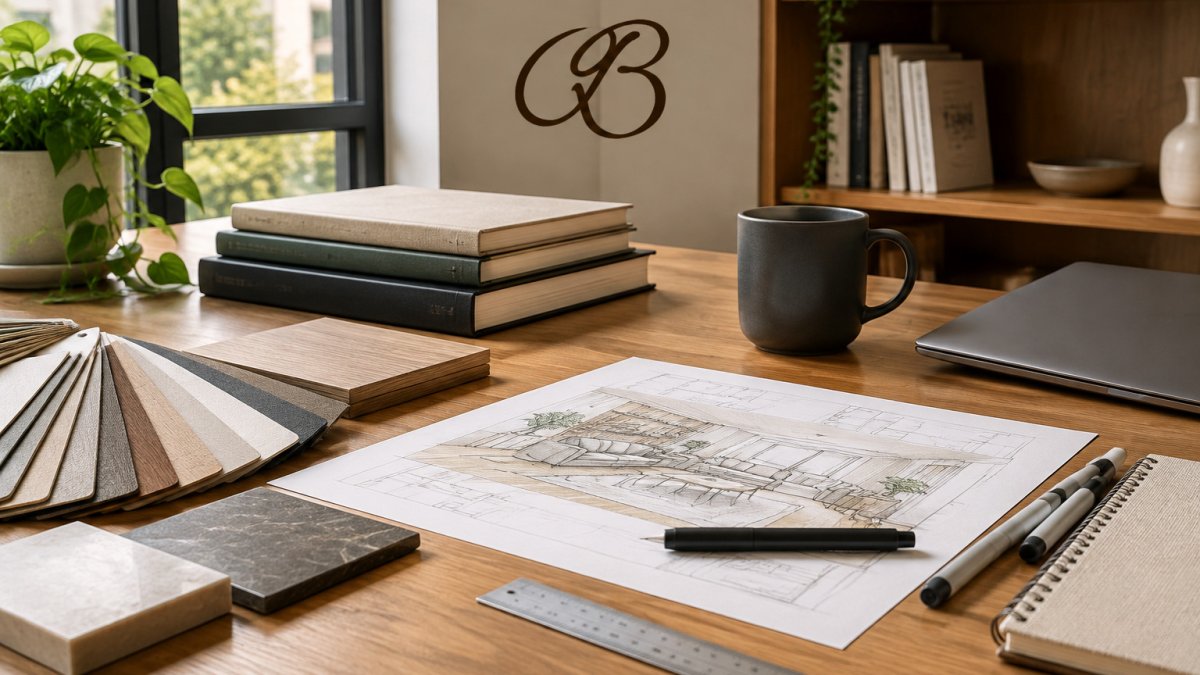
Interior designer reviewing sketches and fabric samples for a master level interior design project on a laptop
Online formats are useful for working professionals, but they demand discipline. Browse self-paced interior design courses with one-time payment and lifetime access. Self-paced courses rarely have fixed deadlines, so set a weekly study schedule and treat it like a client commitment. Confirm whether a certificate carries recognition from a professional body before you pay for it, because not all certificates hold the same weight with employers.
Explore our courses for interior design professionals.
Interior Design Course Curriculum: What You Will Study
A strong master-level curriculum covers design analysis, design programming, space planning, and human-centered design. Learn how to build a mood board that works as a decision tool for choosing a direction early. Many programs also include furniture design, materials and finishes, color, textiles, and residential design. Students in master level interior design programs who also study interior architecture gain a broader understanding of how interiors connect to the structure of a building.
Expect coursework in design principles and elements, then progress to advanced studio projects. See how the floor plan process takes you from measuring a room to a fully annotated plan. Most programs close with a thesis or capstone that brings together research, design development, and presentation skills.
Interior Design Software and Project Management Tools in Master-Level Study
Software skills are now part of professional interior design study, not an optional extra. Students are expected to manage projects, document specifications, and communicate designs to clients and contractors using digital tools.
Craft & Build pairs CB Studio, our project software for interior design studios, with master-level interior design courses and precision 3D CAD assets. When evaluating any platform, ask whether it fits your existing workflow, how it handles client approvals, and whether it can export the documents your contractors need.
Admissions, Portfolios and Accreditation to Check Before You Apply
Most master-level programs ask for a completed undergraduate degree, a portfolio of previous work, a statement of purpose, and references. The difference between a competitive and a weak application usually comes down to how the portfolio is structured and whether the applicant has verified accreditation before committing.
Building a portfolio that shows process, not just results
A portfolio that only shows finished rooms reads as decoration; a portfolio that shows decisions reads as design. A common pattern among admitted applicants is a portfolio built around three to five projects, each with a short arc: the brief, the constraints, two or three development sketches, the plan, and a written rationale for the key choices. Include sketches, plans, and written rationale where possible. If your background is outside design, a single strong process-driven project beats six polished but unexplained images.
Admissions requirements and timeline
Expect to supply transcripts, a statement of purpose, references, and in many cases a portfolio and interview. Application windows vary by school, so work backward from the deadline: portfolio review and revision typically take the longest, followed by reference requests. Request portfolio feedback from a faculty member or a practicing designer before you submit, not after.
Accreditation: what to verify and why it matters
Accreditation is the most important credential to verify, and it operates at two levels. Institutional accreditation covers the school as a whole; program-level accreditation covers the specific interior design program. Confirm which body accredits the program, and check whether that accreditation affects licensure or professional recognition in your jurisdiction. Licensure rules are jurisdiction-specific, so a program that supports practice in one region may not satisfy requirements in another. Ask the program directly which licensure pathways its graduates pursue, and confirm the answer in writing.
Cost, funding and the questions to ask
Tuition, fees, and scholarship availability differ by school, so request a written cost breakdown before you commit. Ask specifically about scholarship deadlines, assistantship availability, and whether fees cover studio access and software. Compare total cost against time to completion, not annual cost alone.
Watch out: accreditation claims can be vague. Ask for the accrediting body's name and verify it independently rather than relying on a program's marketing page.
Choosing Your Next Step in Professional Interior Design Study
Start by deciding what you want the qualification to do for you. A professional master's suits designers aiming for senior practice roles, a post-professional degree suits those seeking specialization, and an academic master's suits those heading toward research or teaching. A short online certificate can fill a specific skill gap without the time commitment of a full degree.
Once you have a direction, compare programs on accreditation, curriculum focus, format, and total cost. Then request portfolio feedback from a faculty member or a practicing designer before you apply.
Ready to build your skills alongside project tools? Explore what Craft & Build offers for interior design professionals and start with the free trial.
Frequently Asked Questions
What credentials do you need for interior design?
Requirements vary by country and by the type of work you plan to do. Many professional roles expect a recognised degree or certificate in interior design, and some regions require a licence or registration for certain services. A master's degree is not always required to practise, but it can strengthen your credentials for senior, specialised or teaching roles. Check the rules for your location before enrolling, and confirm that any course you choose is recognised by the bodies that matter in your market.
Is there a master's degree in interior design?
Yes. Master's degrees in interior design are offered in several formats, including Master of Fine Arts (MFA), Master of Interior Design and professional master's programmes. Some are full-time residential programmes, while others are delivered online or in part-time formats. Programme length, admissions criteria and focus areas differ between schools, so compare curricula and entry requirements directly rather than relying on the degree title alone.
What are some online interior design courses that offer certificates?
Online interior design courses with certificates are available from universities, specialist design schools and professional platforms. Certificate courses are usually shorter than degrees and focus on a defined skill set, such as space planning or residential design. When comparing options, check whether the certificate is issued by an accredited institution, whether assessment includes practical projects, and whether the course content matches the software and project tools used in current practice.
What is the difference between a master's degree and a professional certificate in interior design?
A master's degree is a broader, longer qualification that typically includes design theory, research, a major studio project and a thesis or capstone. A professional certificate is shorter and concentrates on specific skills, such as CAD, lighting or project documentation. A master's suits those aiming for leadership, teaching or specialist practice, while a certificate can update skills for working designers. Many professionals combine both over time.
How do you choose a professional interior design course?
Start by defining your career goal, then check accreditation or recognition, curriculum depth, delivery format and entry requirements. Review the portfolio standard expected for admission and the tools taught in the course, including design software and project management systems. Compare total study costs and time commitment against the career outcomes you need. Speaking to alumni or current students can clarify how well a programme prepares graduates for real studio work.
Add craftnbuild.com as a preferred source on Google →
Written by Morten Skipper