


Vol2 (2).png__PID:56a9fe49-d75d-427e-bf6f-2b716e593d32

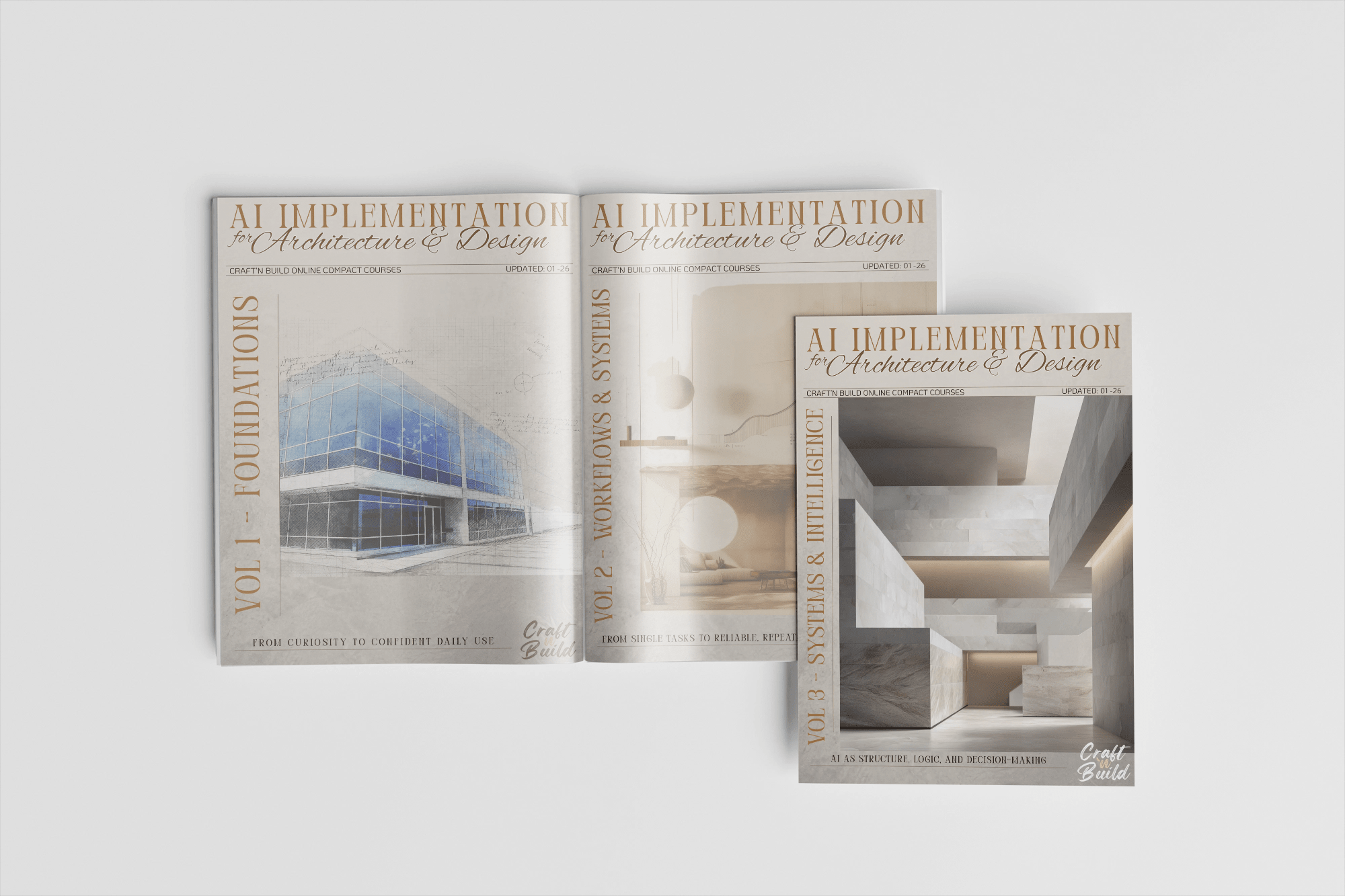
A practical trilogy for designers who want clarity, structure, and control

craftnbuild_make_an_illustration_of_a_mid_sized_restaurant_de_f2a00648-9d9d-4587-84cc-3b0f5b85ed39_1.png__PID:fdd48421-736c-46d8-8303-e476041d4f1e

Artificial intelligence is quickly becoming part of design practice — but many designers are left navigating it through isolated prompts, fragmented tools, and unclear advice.

This trilogy takes a different approach. Instead of teaching tricks or trends, it shows how to integrate AI into architectural and design workflows with intention, structure, and professional judgment — from first interaction to real project application.

Choose a single volume — or save on the complete AI Implementation Trilogy

AI Vol. 1 Foundations

This course is designed for architects, designers, and advanced students who want to understand how AI actually behaves, where it adds value, and how to integrate it into daily practice with confidence.

Copy of  Architecture and Design AI Course Vol 2 - Cover Page.png__PID:28833484-a089-471c-8dfc-2f781e53a908

AI Vol. 2 Workflows

Where Vol. 1 focuses on understanding AI as a tool and learning how to interact with it effectively, Vol. 2 shifts the focus to process.You’ll learn how to structure AI use so it mirrors architectural thinking

Vol 3 Featured Image - Cover Page.png__PID:833484a0-89d7-4c0d-bc2f-781e53a908be

AI Vol. 3 Systems

This volume shows how to treat AI not as a creative shortcut, but as a designed system — one that supports professional judgment, preserves intent, and remains stable across time, phases, and decisions.

Complete AI Implementation Trilogy Vol. 1 + 2 + 3

Complete AI Implementation Series (1).png__PID:884df721-c316-41fb-a878-d42ba17d12e9

The Complete AI Implementation Trilogy is a structured, practical guide to using AI as a real design tool — not a shortcut.Across three volumes, you’ll move from foundational understanding to refined workflows and finally to robust systems you can reuse across projects, studios, and teams.Built specifically for architects, designers, and creative professionals who want clarity, control, and long-term value — not prompt tricks.

249,00 kr
369,00 kr
459,00 kr
784,00 kr

Full Descriptions

AI Implementation for Architecture & Design — Vol. 1: Foundations

Open magazine mockup (1) - Edited.png__PID:60c46dc1-6453-4f89-898a-4fca0d2ffd3b
Hardcover Book Mockup Close Up Poster.png__PID:64532f89-498a-4fca-8d2f-fd3bcaceceee

Artificial intelligence is already part of architectural practice — quietly embedded in writing, research, communication, and early-stage thinking.Yet most professionals are left to figure out how to use it responsibly, consistently, and without compromising quality.

AI Integration for Architecture & Design – Vol. 1: Foundations is a calm, professional introduction to working with AI as a reliable design collaborator — not a shortcut, and not a replacement for judgement.

This course is designed for architects, designers, and advanced students who want to understand how AI actually behaves, where it adds value, and how to integrate it into daily practice with confidence.

Rather than focusing on tools or trends, this volume establishes the core thinking required to work well with AI:

  • How to instruct AI clearly and professionally
  • How to control tone, structure, and intent
  • How to avoid common risks such as overconfidence, generic output, and unchecked claims
  • How to use AI as a thinking and communication partner — not an author or decision-maker

The course is structured as a visually rich, magazine-style learning experience, combining short lessons, clear workflows, diagrams, and practical examples that mirror real architectural situations — from concept development and client communication to policy orientation and planning preparation.

A key focus is professional responsibility. You’ll learn when AI is appropriate, when it is not, and how to remain fully accountable for the work you produce.

Designed for Long-Term Relevance

AI tools evolve quickly — but the principles for using them well change far more slowly.

That’s why this course focuses on foundations, not features.

As AI capabilities evolve, this course will be updated regularly to reflect meaningful changes in how AI can be used in architectural and design practice.All updates are included as part of your lifetime access, ensuring the course remains relevant long after purchase.

You’re not buying a snapshot in time — you’re investing in a learning resource that grows with the field.

What You’ll Learn:

  • How AI fits (and does not fit) into architectural practice
  • How to move from casual prompting to clear professional instruction
  • How to maintain consistent tone and quality across outputs
  • How to use AI for concept articulation, writing, and workflow support
  • How to avoid professional and ethical pitfalls
  • How to build simple, reusable ways of working with AI

Who This Course Is For.

  • Architects and designers in professional practice
  • Studio owners and small practices
  • Advanced architecture and design students
  • Professionals who want practical, responsible AI use — without hype

Who It’s Not For

  • Those looking for automation shortcuts or “AI hacks”
  • Anyone expecting AI to replace design thinking or judgement

Included

  • Full access to Vol. 1: Foundations
  • Magazine-style lessons and visuals
  • Practical examples and workflows
  • Ongoing updates as AI evolves
  • Lifetime access - self-paced online course

This first volume lays the groundwork for the full course collection, preparing you for deeper workflows and systems explored in later volumes — while already delivering immediate value in daily practice.

AI Implementation for Architecture & Design — Vol. 2: Workflows

Copy of  Architecture and Design AI Course Vol 2 - Cover Page.png__PID:28833484-a089-471c-8dfc-2f781e53a908
Hardcover Book Mockup Close Up Poster (1).png__PID:532f8949-8a4f-4a0d-affd-3bcaceceeeac
Open magazine mockup - Edited.png__PID:2760c46d-c164-432f-8949-8a4fca0d2ffd

From isolated prompts to reliable professional processes.

Most AI tools promise speed.In practice, speed without structure quickly leads to confusion: inconsistent outputs, drifting narratives, duplicated effort, and decisions that are hard to trace or defend. What looks efficient in isolation often breaks down when applied across real projects, teams, and timeframes.

Vol. 2 addresses that gap.

This volume is designed for architects and designers who already use AI — and now want to use it properly. It moves beyond isolated prompts and shortcuts, and shows how to integrate AI into reliable, repeatable professional workflows that hold up under real-world pressure.

From interaction to workflow

Where Vol. 1 focuses on understanding AI as a tool and learning how to interact with it effectively,

Vol. 2 shifts the focus to process.

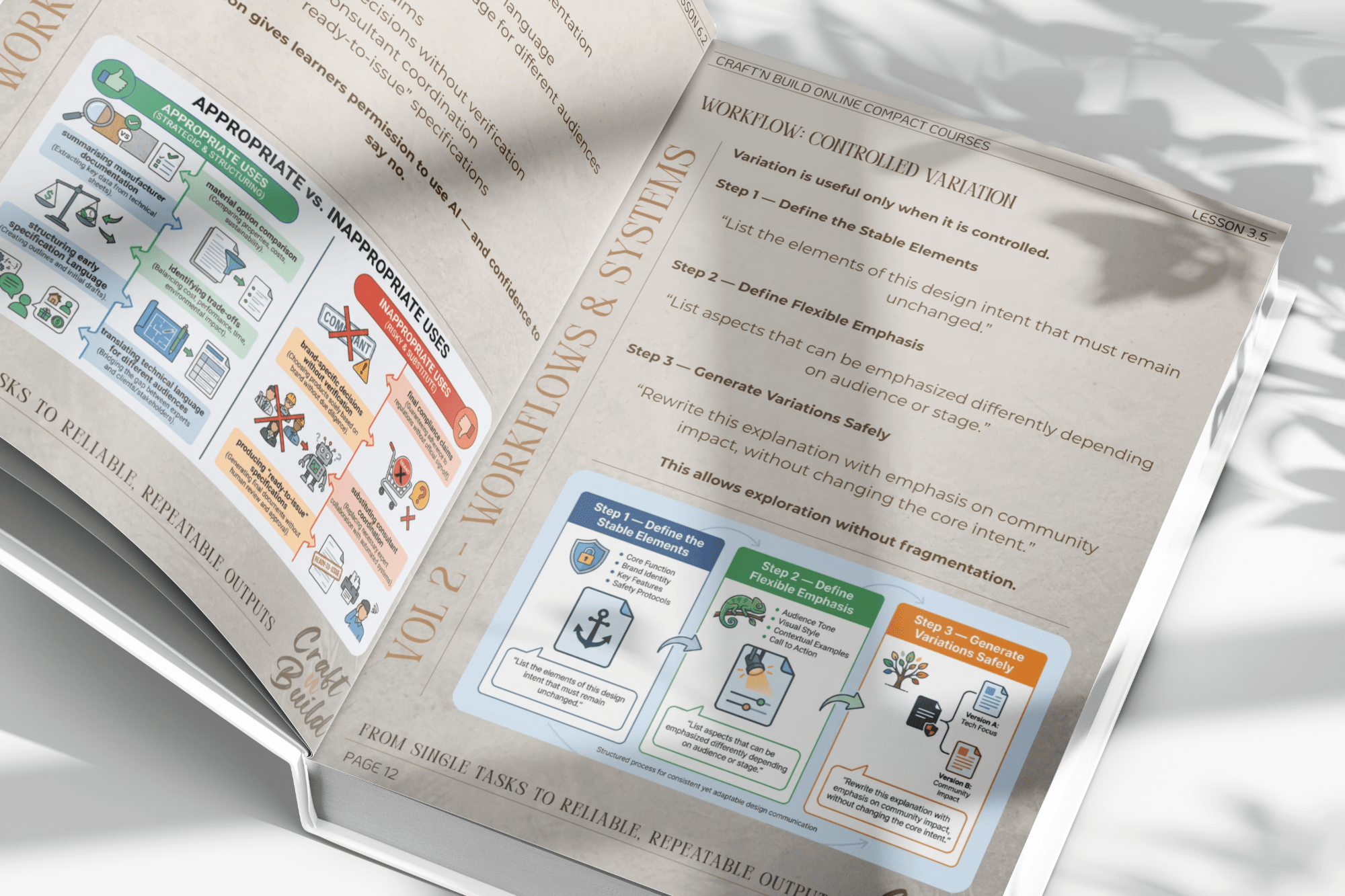
You’ll learn how to structure AI use so it mirrors architectural thinking:

  • staged rather than reactive
  • cumulative rather than disposable
  • contextual rather than generic

Instead of treating each AI interaction as a fresh start, Vol. 2 shows how to maintain continuity — allowing intent, constraints, and decisions to carry forward across project stages.

Maintaining intent across time and complexity

One of the biggest challenges in design practice is not generating ideas, but keeping them aligned.

As projects evolve, information multiplies: planning requirements, stakeholder input, technical constraints, and narrative explanations all need to remain coherent. Vol. 2 demonstrates how AI can support this process by acting as a stabilizing layer — helping maintain consistency between documents, conversations, and decisions without taking authorship away from the designer.

You’ll learn workflows that help:

  • reduce narrative drift
  • manage parallel design threads
  • translate ideas between audiences
  • keep decisions legible over time

Systems, not shortcuts

Vol. 2 deliberately avoids “prompt hacks” and novelty use cases.Instead, it focuses on systems:

  • repeatable structures
  • controlled variation
  • clear inputs and outputs
  • verification and responsibility

AI is positioned as a quiet partner — one that supports judgment, enforces consistency, and reduces cognitive load — rather than a creative driver or decision-maker.

This approach allows AI to integrate seamlessly into professional practice without crossing ethical, technical, or authorship boundaries.

Practical workflows you’ll explore

Throughout the volume, you’ll work with advanced but grounded workflows for:

  • design narratives and concept articulation
  • planning and regulatory strategy
  • internal and external communication systems
  • managing technical and descriptive information
  • maintaining clarity under uncertainty and time pressure

Each workflow is designed to be adaptable across project types and scales, and to remain useful regardless of specific AI tools or platforms.

Who Vol. 2 is for

This volume is ideal if you want AI to:

  • support professional workflows — not replace them
  • reduce friction and rework across projects
  • maintain clarity under uncertainty and time pressure
  • integrate naturally into architectural and design practice

It assumes:

  • design experience
  • professional responsibility
  • and a desire for structure over novelty

How Vol. 2 fits into the trilogy

  • Vol. 1 introduces AI as a tool and interaction
  • Vol. 2 turns AI into infrastructure
  • Vol. 3 applies that infrastructure to a real project system

Vol. 2 is the bridge — the volume where AI stops being something you use occasionally and becomes something you work with deliberately.

AI Implementation for Architecture & Design — Vol. 3: Systems

Vol 3 Featured Image - Cover Page.png__PID:833484a0-89d7-4c0d-bc2f-781e53a908be
Hardcover Book Mockup Close Up Poster (2).png__PID:c164532f-8949-4a4f-8a0d-2ffd3bcacece
Open magazine mockup - Edited.png__PID:2760c46d-c164-432f-8949-8a4fca0d2ffd

AI as structure, logic, and decision-making

Most designers reach a point where prompts are no longer enough.They can generate text, ideas, and images — but the work starts to feel fragmented. Decisions drift. Outputs lose coherence.

AI becomes impressive in moments, yet unreliable across an entire project.

Vol. 3 is about moving beyond that ceiling.

This volume shows how to treat AI not as a creative shortcut, but as a designed system — one that supports professional judgment, preserves intent, and remains stable across time, phases, and decisions.

Instead of teaching more prompts, this course teaches structure.

From tools to systems

Vol. 3 begins by closing the door on prompt-centric thinking.

You’ll learn why prompts — no matter how refined — fail to scale in real design practice, and why professional AI use depends on systems that carry intent, logic, and constraints forward instead of resetting them with every interaction.

You’ll gain a clear, architectural definition of what a Design AI System actually is, and how it differs from tools, models, or automation.

From there, the course introduces a layered system framework built around:

  • Intent
  • Context
  • Logic
  • Output

Preserving authorship and professional judgment

A central concern for many designers is authorship.

Vol. 3 addresses this directly, showing how loss of authorship is not a technological problem, but a structural one. When intent is implicit and decisions are undocumented, AI feels unpredictable. When structure is explicit, authorship becomes visible and defensible.

You’ll learn how systems reduce cognitive load without removing control — allowing you to focus less on phrasing and correction, and more on evaluation, direction, and decision-making.

Systems across time and project phases

Design is not linear — and neither is intelligence.

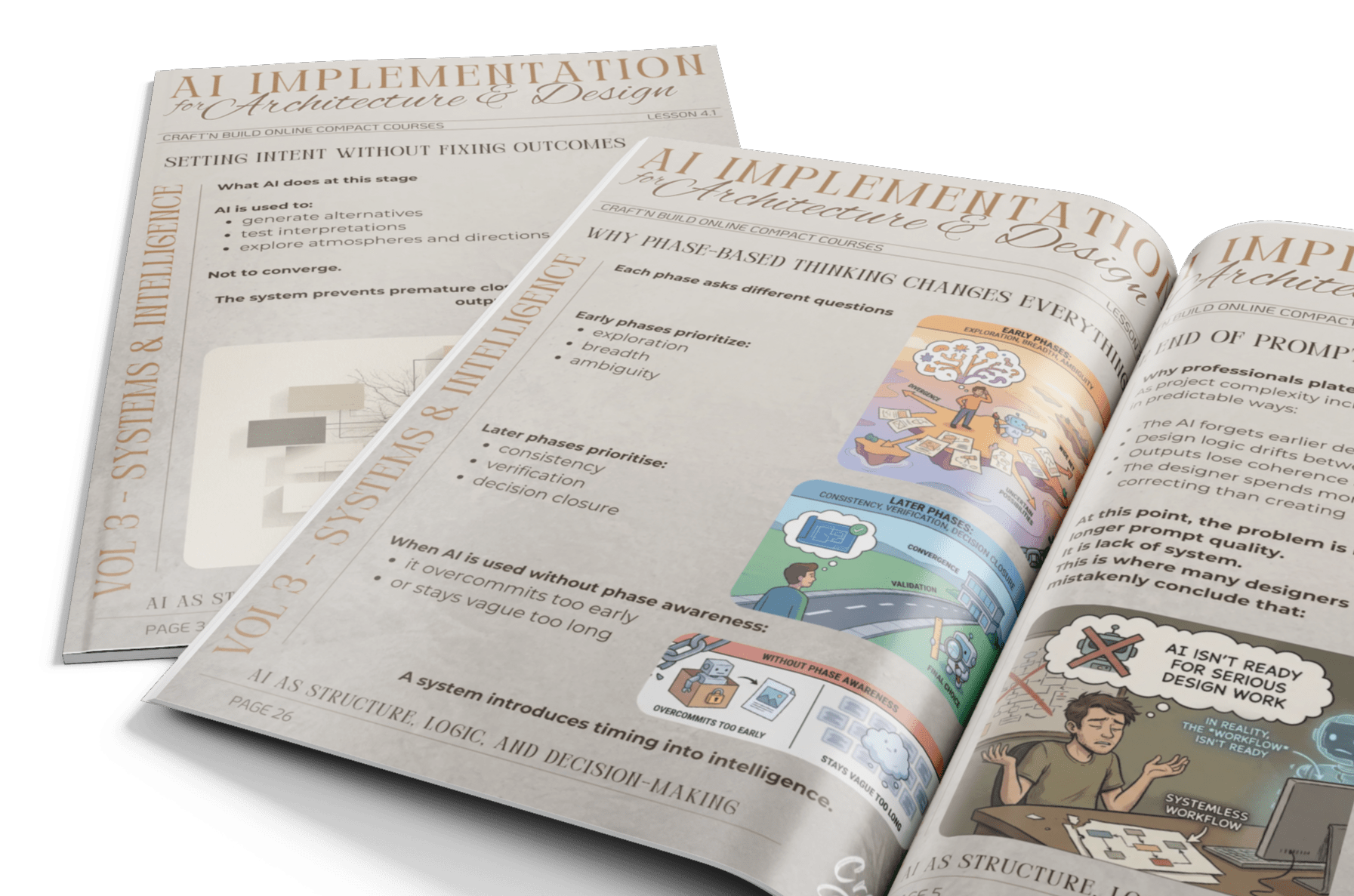
Vol. 3 introduces phase-based thinking, showing how the same AI should behave differently depending on where a project sits in its lifecycle. Early exploration, concept development, and final decision-making all require different types of intelligence.

By structuring AI use around phases instead of tasks, friction is reduced, confidence increases, and the most common failure is avoided: using the right intelligence at the wrong time.

A full case study — the framework in motion

The second half of Vol. 3 moves away from theory entirely.

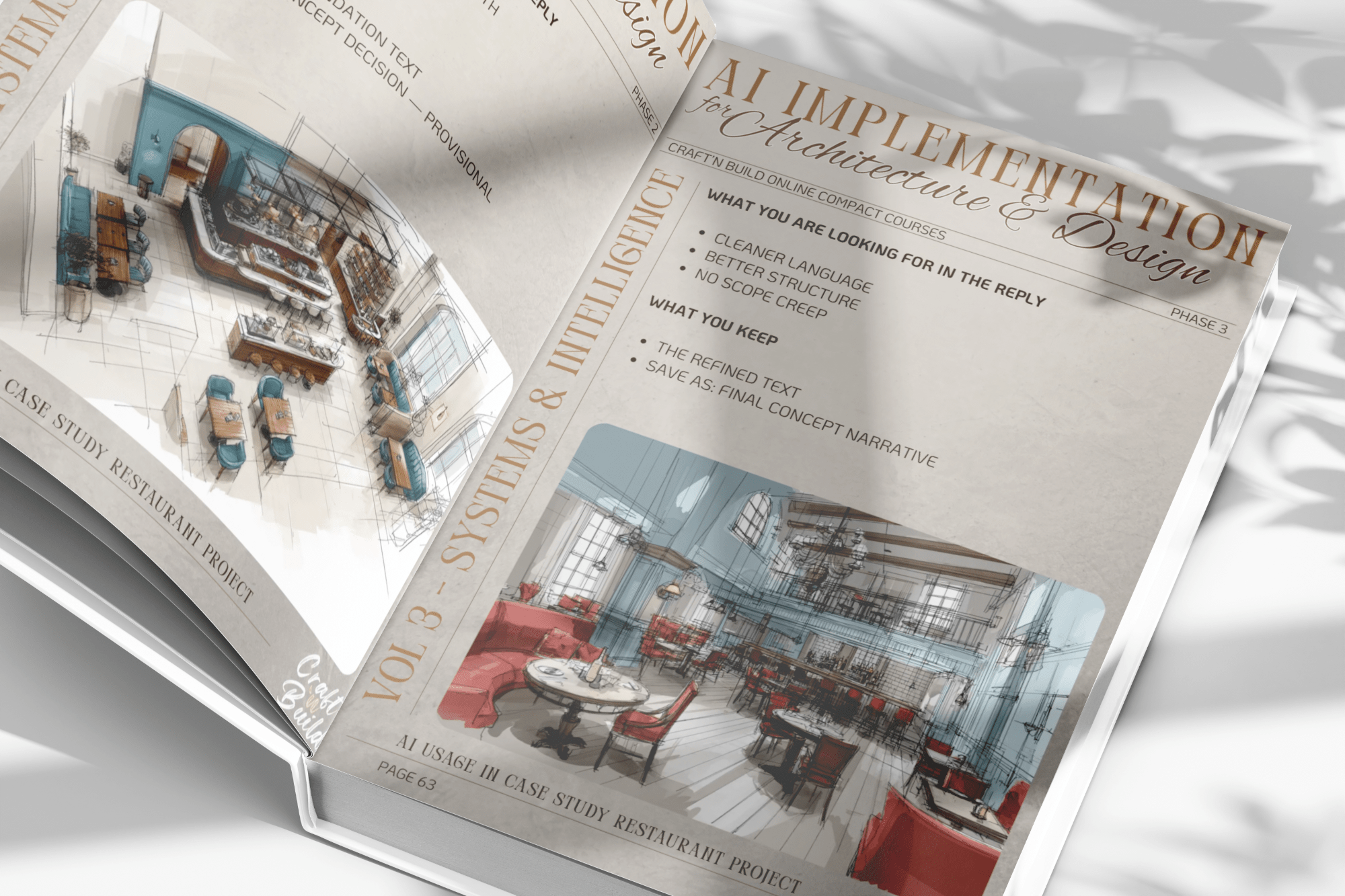
You will follow a single, realistic restaurant project from early brief definition through concept development and final decision support.

This is not an example added on top of the framework — it is the framework, applied.

Across three clearly defined phases, you’ll see exactly how AI can support real design work:

  • Phase 1 — Brief & Concept Framing

    Use AI to structure client input, extract constraints, define intent, and stress-test assumptions — before design begins.
  • Phase 2 — Concept Development & Variation

    Generate multiple concept directions, expand them into review-ready narratives, test spatial logic without drawing, and compare options objectively — without locking decisions too early.
  • Phase 3 — Refinement, Decision & Handoff

    Stress-test the selected concept, tighten narratives without redesigning, lock decisions explicitly, and prepare a clean handoff or presentation package.
  • Each phase includes:

     - Clear objectives

     - Practical prompts

     - What to keep vs. what to ignore

     - Concrete outputs that carry forward

No restarting. No re-briefing. No AI “magic.” Just controlled, professional use.

Who this volume is for

Vol. 3 is designed for architects, interior designers, and experienced practitioners who:

  • Already understand basic AI tools
  • Want consistency across projects, not isolated outputs
  • Care about authorship, clarity, and decision quality
  • Need AI to support professional judgment — not replace it

It is not about speed for its own sake.It is about thinking clearly under complexity.

How Vol. 3 fits into the trilogy

  • Vol. 1 introduces AI tools and interaction
  • Vol. 2 builds workflows and design communication
  • Vol. 3 completes the system — showing how AI operates across time, structure, and real projects

Included

  • Full access to Vol. 3: Systems
  • Magazine-style lessons and visuals
  • Practical examples and workflows
  • Ongoing updates as AI evolves
  • Lifetime access - self-paced online course

Together, the trilogy forms a complete, professional framework for integrating AI into architectural and design practice with clarity, structure, and control.