


-
Lifetime access
-
Professional methodology
-
Learn at your pace
-
No experience needed
-
Immediate course access
-
Real-world application
-
Taught by practitioner
-
Constantly updated content


AI Implementation for Architecture & Design — Vol. 3

ALL
Secure checkout — all major payment methods accepted
Pairs well with

AI Implementation for Architecture & Design — Vol. 3
What our students say.
What You'll Learn
If you have any questions, you are always welcome to contact us. We'll get back to you as soon as possible, within 24 hours on weekdays.
-
Shipping Information
Use this text to answer questions in as much detail as possible for your customers.
-
Customer Support
Use this text to answer questions in as much detail as possible for your customers.
-
FAQ’s
Use this text to answer questions in as much detail as possible for your customers.
-
Contact Us
Use this text to answer questions in as much detail as possible for your customers.
Description
Full description
AI Implementation for Architecture & Design — Vol. 3
Systems & Intelligence
AI as structure, logic, and decision-making
Most designers reach a point where prompts are no longer enough.
They can generate text, ideas, and images — but the work starts to feel fragmented. Decisions drift. Outputs lose coherence. AI becomes impressive in moments, yet unreliable across an entire project.
Vol. 3 is about moving beyond that ceiling.
This volume shows how to treat AI not as a creative shortcut, but as a designed system — one that supports professional judgment, preserves intent, and remains stable across time, phases, and decisions.
Instead of teaching more prompts, this course teaches structure.
From tools to systems
Vol. 3 begins by closing the door on prompt-centric thinking.
You’ll learn why prompts — no matter how refined — fail to scale in real design practice, and why professional AI use depends on systems that carry intent, logic, and constraints forward instead of resetting them with every interaction.
You’ll gain a clear, architectural definition of what a Design AI System actually is, and how it differs from tools, models, or automation.
From there, the course introduces a layered system framework built around:
-
Intent
-
Context
-
Logic
-
Output
This structure allows AI to remain consistent without becoming rigid — and powerful without taking control.
Preserving authorship and professional judgment
A central concern for many designers is authorship.
Vol. 3 addresses this directly, showing how loss of authorship is not a technological problem, but a structural one. When intent is implicit and decisions are undocumented, AI feels unpredictable. When structure is explicit, authorship becomes visible and defensible.
You’ll learn how systems reduce cognitive load without removing control — allowing you to focus less on phrasing and correction, and more on evaluation, direction, and decision-making.
Systems across time and project phases
Design is not linear — and neither is intelligence.
Vol. 3 introduces phase-based thinking, showing how the same AI should behave differently depending on where a project sits in its lifecycle. Early exploration, concept development, and final decision-making all require different types of intelligence.
By structuring AI use around phases instead of tasks, friction is reduced, confidence increases, and the most common failure is avoided: using the right intelligence at the wrong time.
A full case study — the framework in motion
The second half of Vol. 3 moves away from theory entirely.
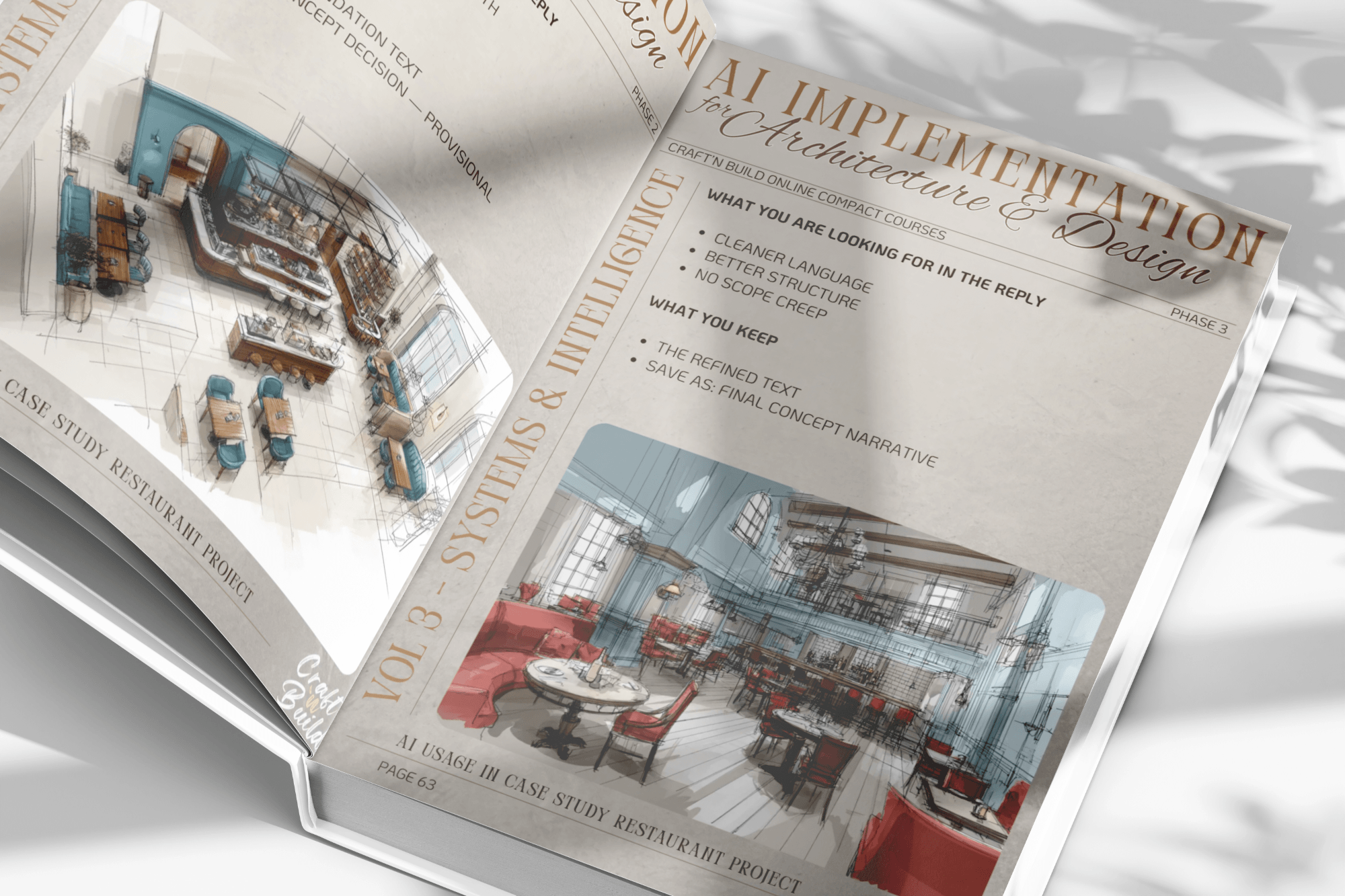
You will follow a single, realistic restaurant project from early brief definition through concept development and final decision support. This is not an example added on top of the framework — it is the framework, applied.
Across three clearly defined phases, you’ll see exactly how AI can support real design work:
Phase 1 — Brief & Concept Framing
Use AI to structure client input, extract constraints, define intent, and stress-test assumptions — before design begins.
Phase 2 — Concept Development & Variation
Generate multiple concept directions, expand them into review-ready narratives, test spatial logic without drawing, and compare options objectively — without locking decisions too early.
Phase 3 — Refinement, Decision & Handoff
Stress-test the selected concept, tighten narratives without redesigning, lock decisions explicitly, and prepare a clean handoff or presentation package.
Each phase includes:
-
Clear objectives
-
Practical prompts
-
What to keep vs. what to ignore
-
Concrete outputs that carry forward
No restarting. No re-briefing. No AI “magic.” Just controlled, professional use.
Who this volume is for
Vol. 3 is designed for architects, interior designers, and experienced practitioners who:
-
Already understand basic AI tools
-
Want consistency across projects, not isolated outputs
-
Care about authorship, clarity, and decision quality
-
Need AI to support professional judgment — not replace it
It is not about speed for its own sake.
It is about thinking clearly under complexity.
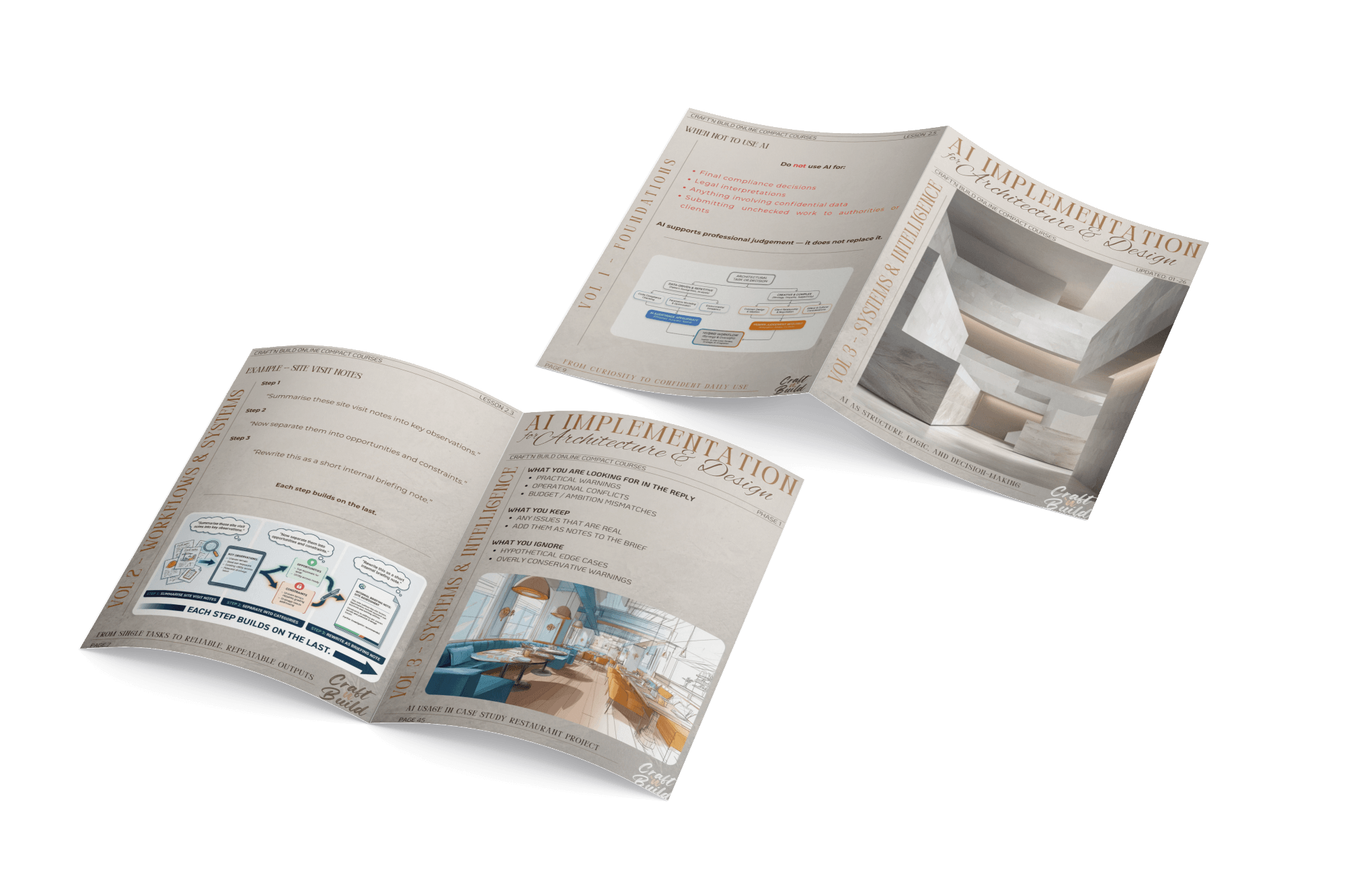
How Vol. 3 fits into the trilogy
-
Vol. 1 introduces AI tools and interaction
-
Vol. 2 builds workflows and design communication
-
Vol. 3 completes the system — showing how AI operates across time, structure, and real projects
Together, the trilogy forms a complete, professional framework for integrating AI into architectural and design practice with clarity, structure, and control.
Who is this for
The AI Implementation Trilogy is built for architects, interior designers, and design professionals who are already using AI — but feel like their use is fragmented, inconsistent, or hard to defend in a professional context.
If you find yourself re-prompting the same tasks, struggling to maintain a coherent design narrative across a project, or unsure how to present AI-assisted work to clients with confidence, this trilogy gives you the structure you've been missing.
It is not an introduction to AI tools. It is a professional framework for making AI work the way your practice demands — repeatable, traceable, and genuinely yours.
About the Trilogy
The AI Implementation Trilogy is a professional development series from Craft'n Build. Each volume covers a distinct layer of AI practice in architecture and interior design — from first interaction to fully structured workflow — taught through a framework built for real project conditions, not controlled demonstrations.
This is not a series about tools or trends. It is a series about professional structure. How working designers integrate AI into their practice with consistency, accountability, and confidence — and how that level of mastery is available to anyone willing to build it properly.