




-
Lifetime access.
-
Professional methodology
-
Learn at your pace
-
No experience needed
-
Immediate course access
-
Real-world application
-
Taught by practitioner
-
Constantly updated content
The Bedroom- The Design Key Series.

ALL.
Secure checkout — all major payment methods accepted
Pairs well with
The Bedroom- The Design Key Series.
What our students say.


Color-Material-Finish

Color-Material-Finish

Color-Material-Finish

Color-Material-Finish

Color-Material-Finish

Color-Material-Finish
What You'll Learn
-
The bedroom as system
-
Body specification
-
Constraint rule sets
-
The layout method
-
Surfaces & textiles
-
Light & atmosphere
If you have any questions, you are always welcome to contact us. We'll get back to you as soon as possible, within 24 hours on weekdays.
-
Shipping Information
Use this text to answer questions in as much detail as possible for your customers.
-
Customer Support
Use this text to answer questions in as much detail as possible for your customers.
-
FAQ’s
Use this text to answer questions in as much detail as possible for your customers.
-
Contact Us
Use this text to answer questions in as much detail as possible for your customers.
Description
Short description
Full description
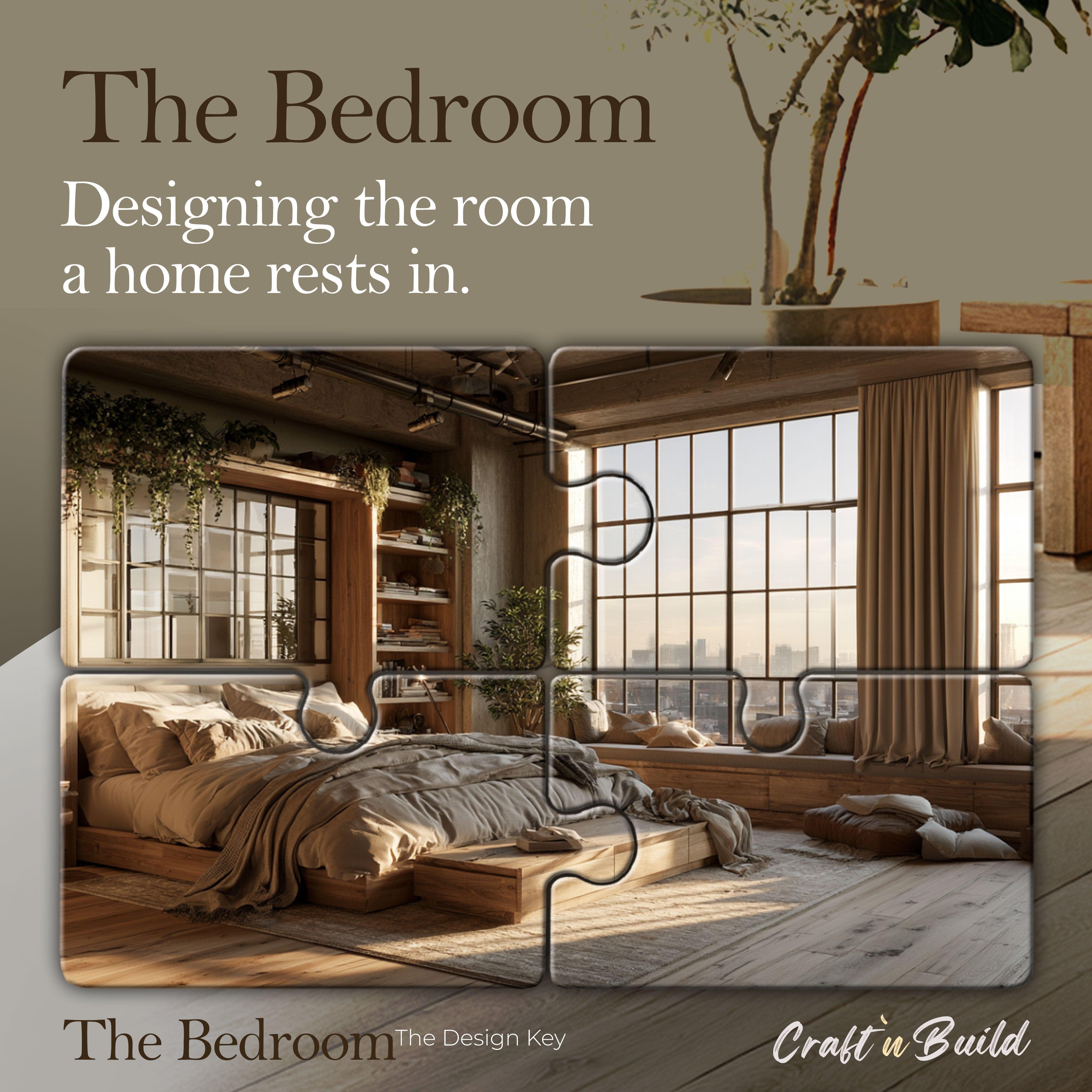
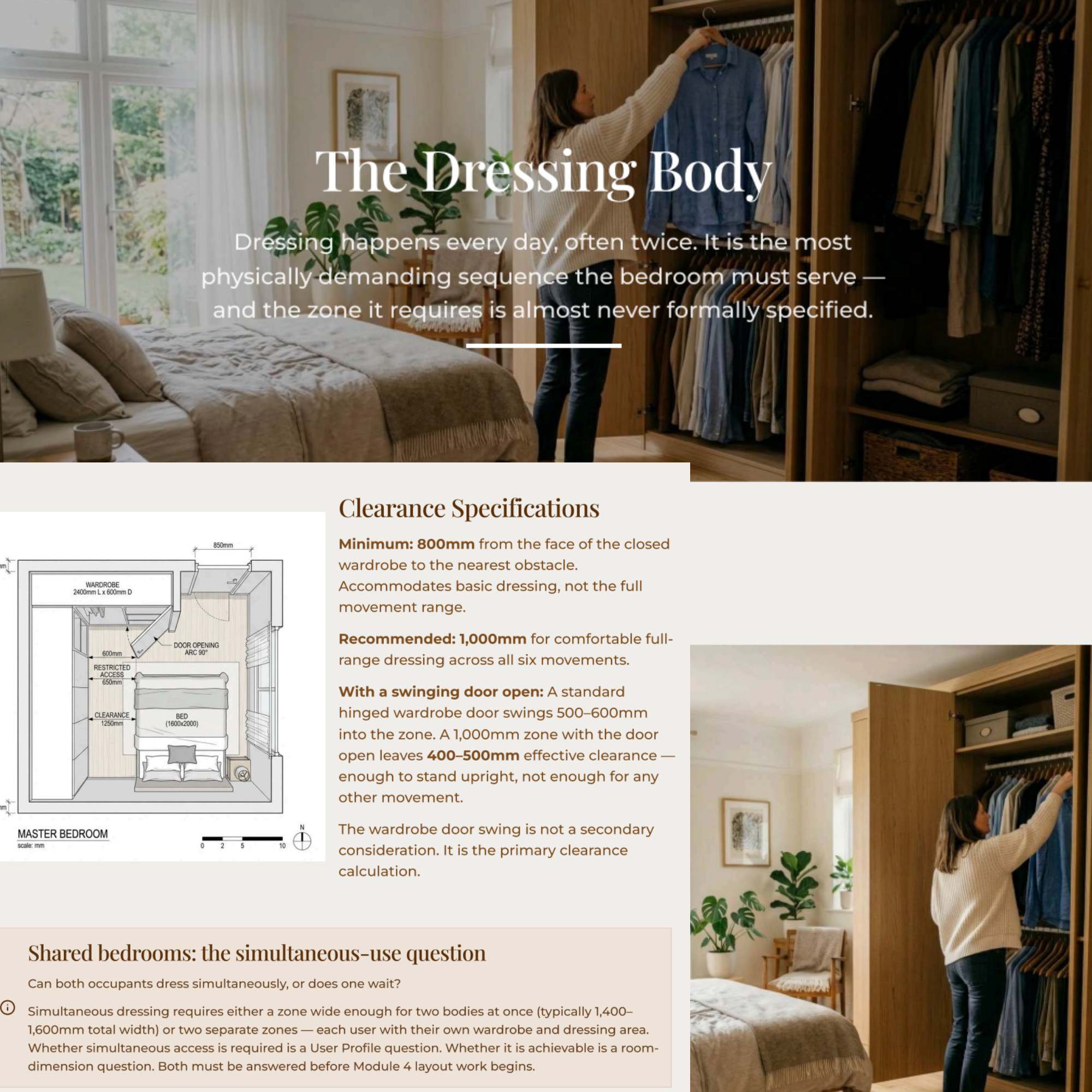
The Design Key — Rest, Body & Room is a professional interior design course that teaches the methodology for designing a bedroom as a complete restorative system rather than a styled furniture arrangement. The bedroom is the most under-designed room in residential interiors — the room people spend roughly a third of their life inside, and the one most often treated as if it only mattered for the hours they spent awake in it. A bedroom is not a room with a bed in it. It is the physical environment in which the body downshifts from sympathetic to parasympathetic, the visual cortex stops processing input, the body temperature drops, the muscles release, and the mind consolidates the day into memory. A designer who understands what the bedroom is doing designs a fundamentally different room than one who treats it as a layout problem. This course teaches that methodology across six modules, thirty-two lessons, and twenty-seven named professional tools.
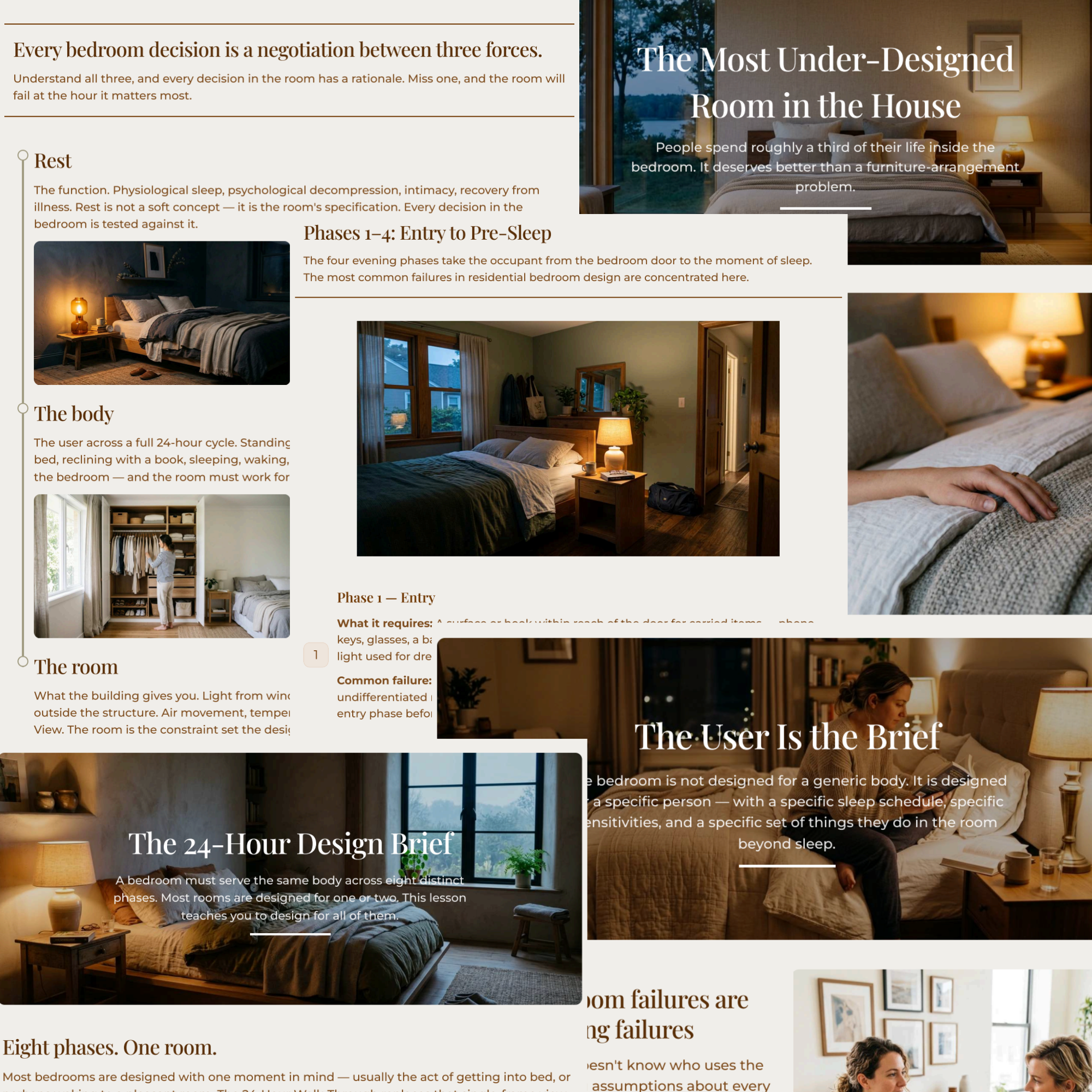
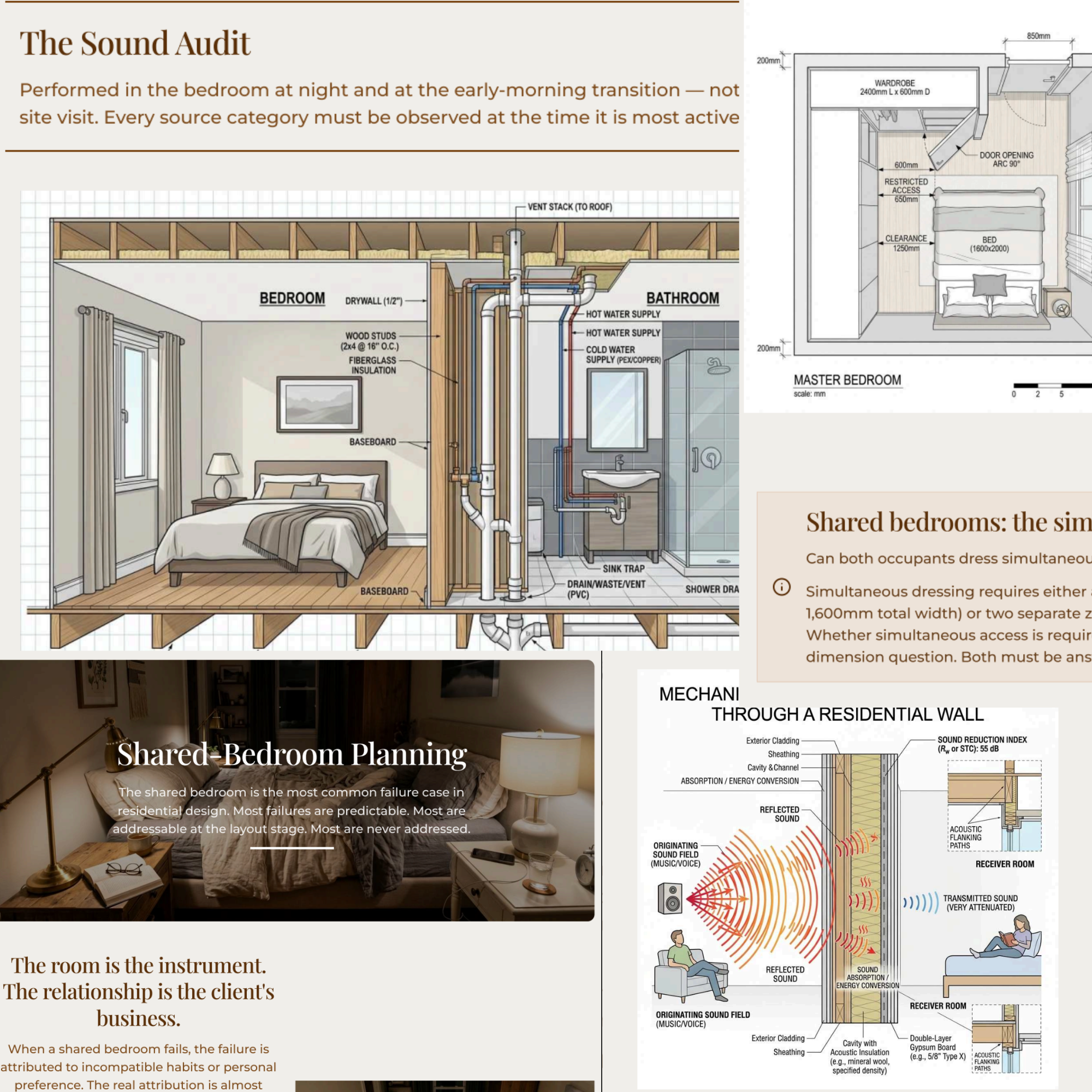
The three governing forces of the bedroom are rest, the body, and the room. Rest is the function: physiological sleep, recovery, decompression, intimacy. The body is the user across a full 24-hour cycle — standing, sitting, reclining, sleeping, waking, dressing, undressing, retreating — not the upright daytime user that most rooms are designed for. The room is what the building gives you: light at every hour, sound from inside and outside the envelope, air quality and movement, temperature, adjacency to other rooms, view, and the electrical capacity to support all of it. Every bedroom decision is a negotiation between these three forces, and the course is built to make those negotiations explicit, defensible, and repeatable.
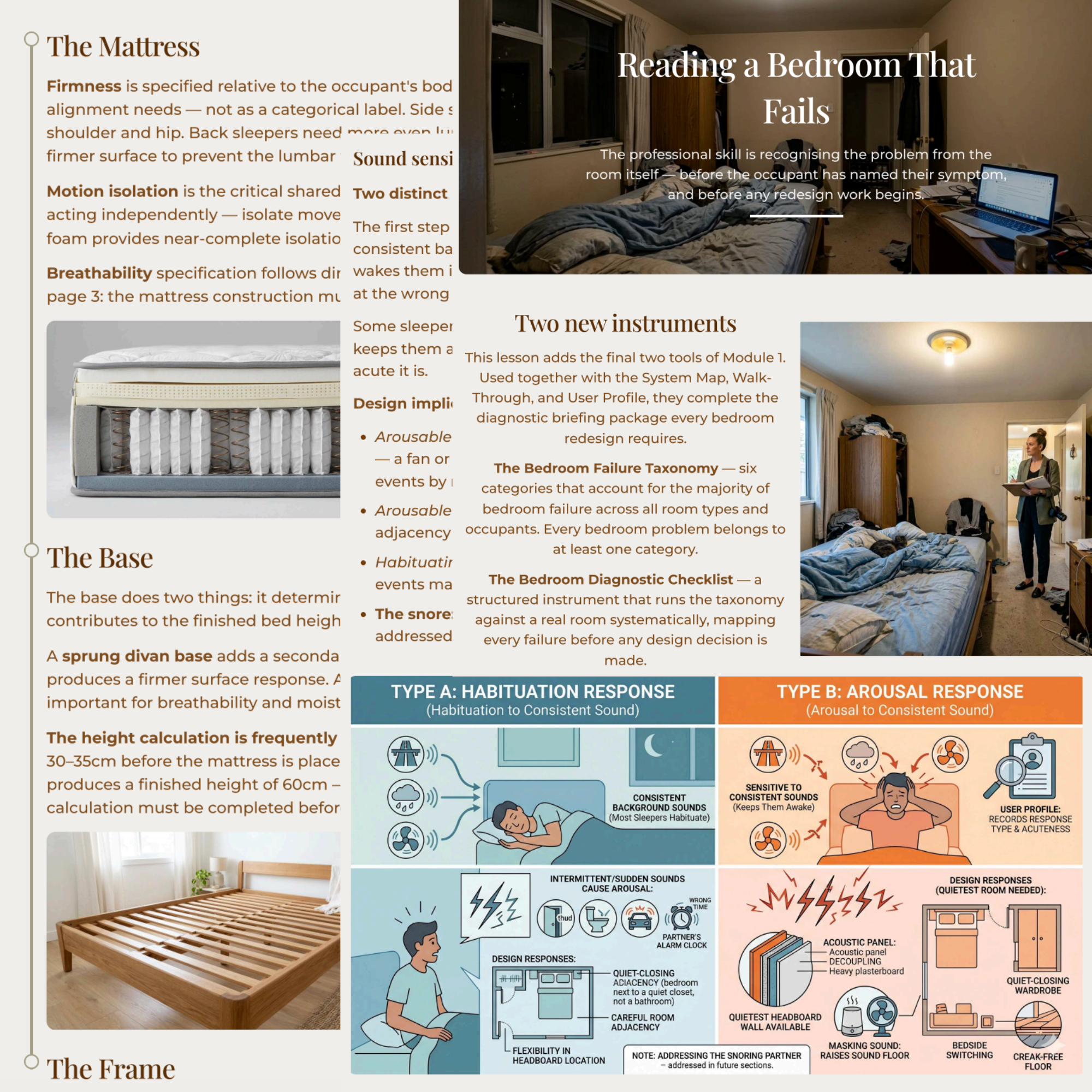
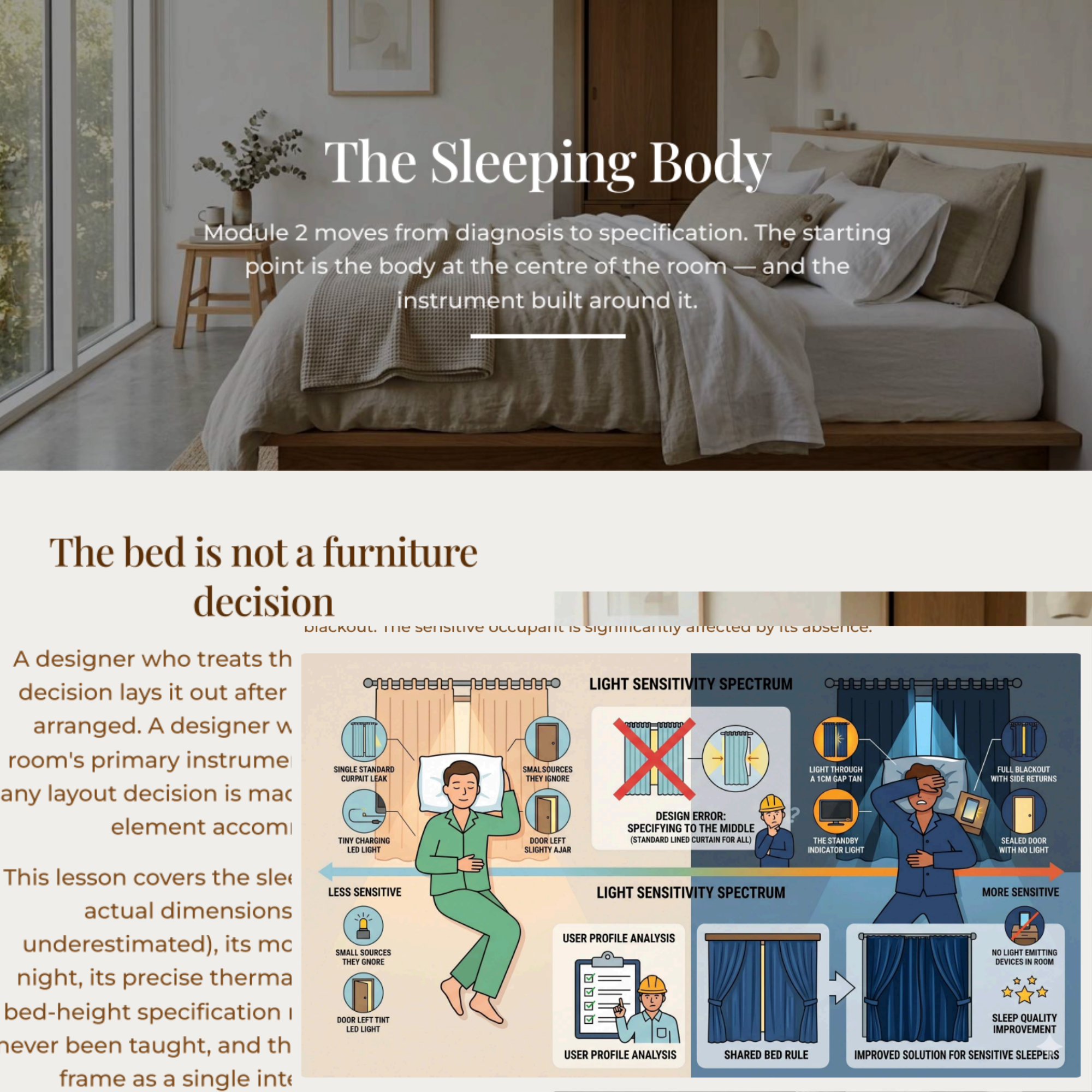
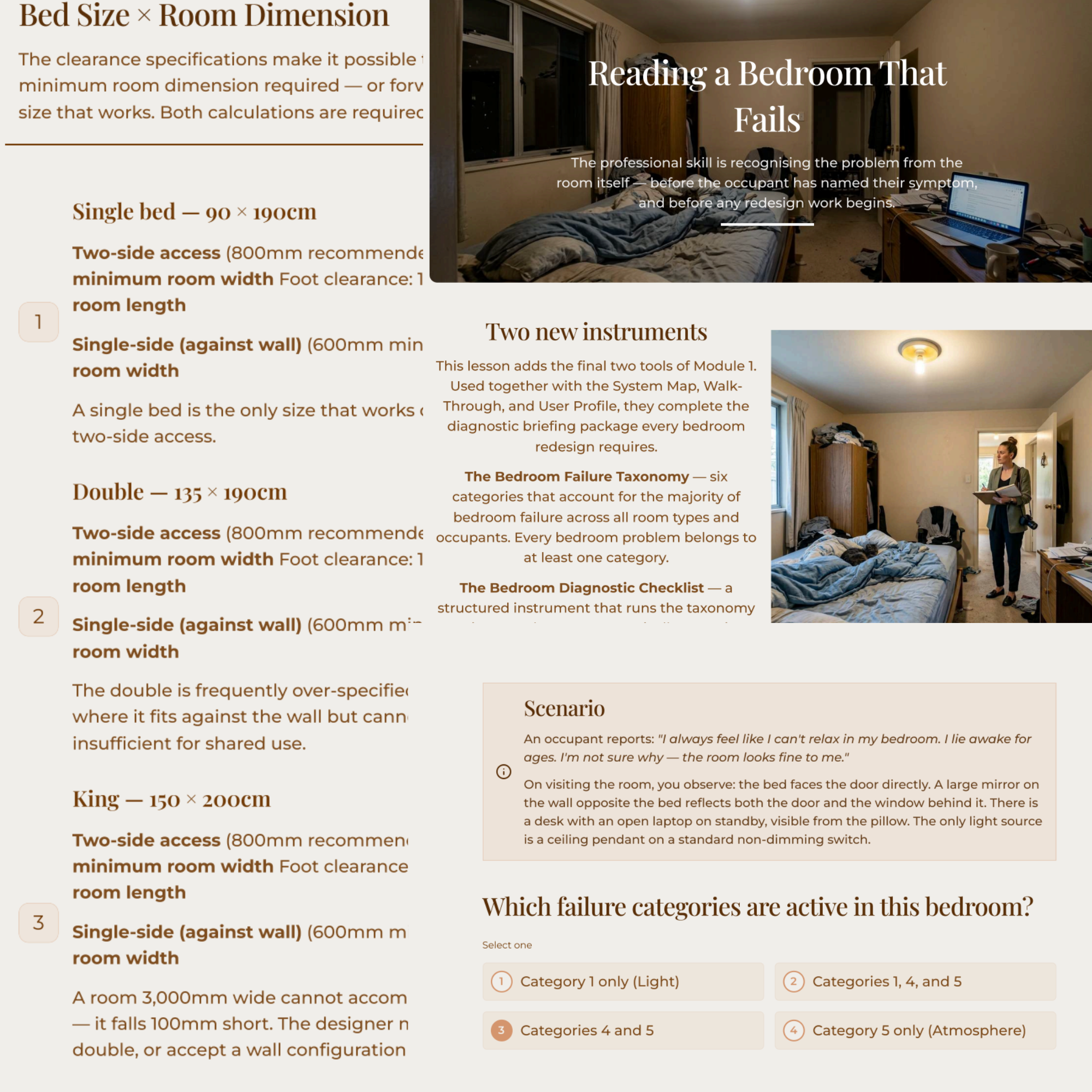
You will learn how a bedroom actually works as a multi-state environment — and how to draw the System Map and the 24-Hour Walk-Through that show the room performing every job it has to do. You will learn how to build a complete user profile across all body states in the room, not just the sleeping one. You will learn the constraint rule sets that govern bedroom layout: the light rule set, the sound rule set, the air and temperature rule set, the adjacency rule set, and the Bedroom Electrical Specification that most designers underestimate. You will learn to write the Bedroom Layout Intake Sheet that carries those constraints into the layout module.
You will learn the layout method in detail — the single largest module of the course — beginning with bed position as the first decision, and every subsequent decision flowing from it. You will resolve the bed against the door, the window, the light, the sound, and the user. You will work through three example rooms and produce three scaled variations of your own layout. You will learn surfaces and textiles as a specified system: floor, walls, ceiling, window treatment, and bed dressing as one coordinated specification rather than five separate finish decisions. You will learn the lighting and atmosphere method: layered lighting that supports the body's transition into and out of sleep, dim-circuit specification, two-way switching from bed to door, and the atmosphere decisions that turn a correctly designed bedroom into one that actually feels like a sanctuary.
The course is built to a single teaching test: at the end of each lesson, the student knows how to do something. Every lesson hands over a named tool — checklist, rule set, specification, intake sheet — and those tools compound across the modules so the final layout is built from the discipline of everything that came before. Twenty-seven named tools in total.
The Bedroom sits in the Rooms layer of The Design Key, alongside The Bathroom, The Kitchen, The Living Area, The Entry, and The Utility Room. It is a stand-alone course with its own Course Certificate, and it counts toward the Master Certificate of the full Design Key Master Programme. By the time you finish, you will have a complete bedroom layout — fully specified, defensible, decision by decision — and a reusable professional toolkit you apply to every bedroom project that follows.
Who is this for
Whether you're a working designer looking to sharpen your process, a design student building professional skills, or a homeowner who wants to approach their own space the way a professional would — the methodology is the same.
No credentials required. No prior experience assumed. Just a commitment to learning how design actually works.
About the Series
The Design Key is a professional methodology series from Craft'n Build. Each course covers a core discipline of interior design practice — taught through the same rigorous, real-world framework used by working designers.
This is not a series about aesthetics. It is a series about method. How professionals think, plan, and execute — and how those skills are available to anyone willing to learn them.
Color, Material & Finish is the first course in the series. Floor Plan, Bathroom, Kitchen and more follows.